Sixteenth Finance Commission Retains 41 Percent Devolution
Source:The Hindu ↗
Why It Matters
The Finance Commission's recommendations are a core component of India's fiscal federalism and are explicitly mentioned in the GS2 syllabus. The tension over cesses, surcharges, and criteria like demographic performance versus GDP contribution reflects ongoing debates over equity and efficiency between the Centre and States, highly relevant for Mains and Prelims.
Summary
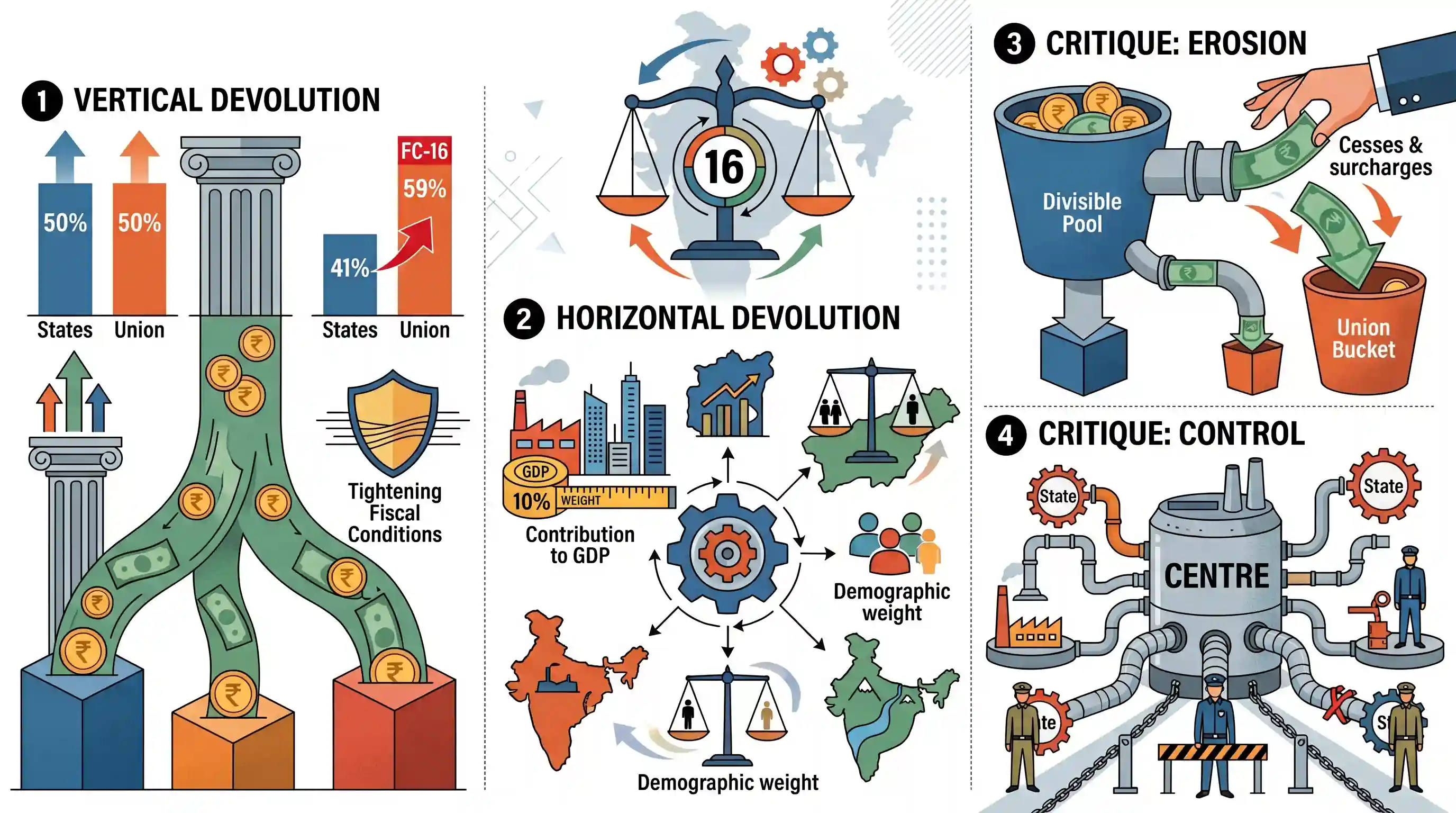
The editorial reviews the cautious approach of the Sixteenth Finance Commission (FC-16), which retained the states' vertical share of central taxes at 41%, dismissing their calls for a 50% share amid tightening fiscal conditions under GST. FC-16 made notable tweaks to horizontal devolution by introducing a 'contribution to GDP' criterion (10% weight) to reward industrialized states, alongside adjustments to demographic and population weightings. However, the editorial critiques the Commission for missing an opportunity to structurally reform fiscal federalism. It highlights that the divisible pool continues to be eroded by the Union’s expanding use of cesses and surcharges, while heavy reliance on Centrally Sponsored Schemes undermines states' flexibility, reducing them to mere implementers of the Centre's mandates.
Key Points
- The Sixteenth Finance Commission (FC-16) retained the vertical devolution of central taxes to states at 41% for the 2026-31 period, despite state demands for 50%.
- In horizontal devolution, FC-16 replaced the 'tax effort' criterion with 'contribution to GDP' (10% weight), rewarding industrialized states like Maharashtra, Tamil Nadu, and Gujarat.
- The weightage for demographic performance was reduced from 12.5% to 10%, while the weight for the 2011 population was raised from 15% to 17.5%, providing a slight bump to populous states.
- FC-16 failed to address the structural issue of a shrinking divisible pool caused by the Centre's increasing reliance on non-shareable cesses and surcharges.
- Centrally Sponsored Schemes (CSS) comprise ~42% of the total recommended transfers, perpetuating a top-down model where states are tied to implementing New Delhi's priorities.
Important Terms
Sixteenth Finance Commission (FC-16)

A constitutional body appointed every five years under Article 280 to recommend the distribution of tax revenues between the Union and States and among individual States.
UPSC context
GS Paper-II/Polity; essential for understanding constitutional bodies, fiscal federalism, and Centre-State financial relations.
Vertical Devolution
The percentage share of the 'divisible pool' of central taxes that is distributed by the Union government to all States collectively.
UPSC context
GS Paper-III/Economy; tests knowledge of fiscal transfers and the 'balancing wheel' of Indian federalism.
Horizontal Devolution
The formula-based distribution of the States' collective share of central taxes among individual States based on criteria like population, area, and performance.
UPSC context
GS Paper-II/Polity; critical for discussing regional equity, demographic performance, and inter-state fiscal disparities.
Divisible Pool
The portion of gross central tax revenue (e.g., Corporation Tax, GST) that is shareable with States, excluding cesses, surcharges, and collection costs.
UPSC context
GS Paper-III/Economy; central to debates on the shrinking effective revenue share of States.
Cesses and Surcharges
Specific-purpose levies collected by the Union that remain outside the divisible pool, meaning they are not shared with State governments.
UPSC context
GS Paper-II/Governance; key for analyzing 'fiscal centralization' and its impact on State autonomy.
Centrally Sponsored Schemes (CSS)
Schemes funded jointly by the Centre and States but implemented by States, often focused on national priorities like health or education.
UPSC context
GS Paper-II/Governance; tests understanding of executive federalism and the financial flexibility of sub-national governments.
Fiscal Federalism
The financial relationship and distribution of powers/responsibilities between different levels of government, aimed at maintaining economic stability and equity.
UPSC context
GS Paper-II/Polity; overarching theme for questions on Indian federal structure and resource allocation.
Prelims Trap
"Cesses and surcharges are included in the divisible pool of taxes if recommended by the Finance Commission."
Article 271 allows the Union to levy surcharges, and Article 270 explicitly excludes both cesses and surcharges from the divisible pool shared with states.
Static Concepts Connected
What is the constitutional basis of Grants-in-Aid to states?
- Statutory Grants: Article 275 mandates grants to states in need, charged on the Consolidated Fund of India, based strictly on Finance Commission recommendations.
- Discretionary Grants: Article 282 allows the Centre to make grants for any public purpose. This is the primary vehicle for Centrally Sponsored Schemes (CSS) funding.
What constitutes the 'Divisible Pool' of central taxes?
- Included Taxes: Includes all Union taxes and duties under Article 270, such as corporation tax, personal income tax, Central GST, and customs duties.
- Excluded Components: Cesses and surcharges (Article 271) and the administrative cost of tax collection are constitutionally kept out of the divisible pool.
Cross-Topic Patterns
Demography vs Delimitation debates
The FC's juggling of 2011 population weight (17.5%) vs demographic performance (10%) mirrors the political tension between Southern and Northern states over the upcoming post-2026 Lok Sabha delimitation exercise.
CSS and Fiscal Autonomy
CSS accounts for ~42% of fiscal transfers, tying state funds to Union mandates under Article 282. This constantly connects to NITI Aayog's ongoing push to rationalize schemes and improve state autonomy.

Expect a 2026 Prelims MCQ comparing 15th vs 16th FC horizontal criteria, specifically targeting the new 'Contribution to GDP' weightage.
Linked PYQs · 5
Linked PYQs · 5
- 2025MainsGS2
Examine the evolving pattern of Centre-State financial relations in the context of planned development in India. How far have the recent reforms impacted the fiscal federalism in India?
- 2021MainsGS2
How have the recommendations of the 14th Finance Commission of India enabled the States to improve their fiscal position?
- 2018MainsGS2
How is the Finance Commission of India constituted? What do you know about the terms of reference of the recently constituted Finance Commission? Discuss.
- 2020MainsGS3
Explain the rationale behind the Goods and Services Tax (Compensation to States) Act of 2017. How has COVID-19 impacted the GST compensation fund and created new federal tensions?
- 2023PrelimsGS1
Consider the following: 1. Demographic performance 2. Forest and ecology 3. Governance reforms 4. Stable government 5. Tax and fiscal efforts For the horizontal tax devolution, the Fifteenth Finance Commission used how many of the above as criteria other than population area and income distance?
