Pre Colonial Caste Enumeration in Marwar Kingdom
Source:Indian Express ↗
Why It Matters
Provides crucial historical evidence that caste-based demographic enumeration was an administrative reality in pre-colonial Indian states, challenging the prevailing notion that such exercises were strictly a colonial invention. This enriches answers in GS1 (History and Indian Society) regarding the evolution of the caste system and the census mechanism.
Summary
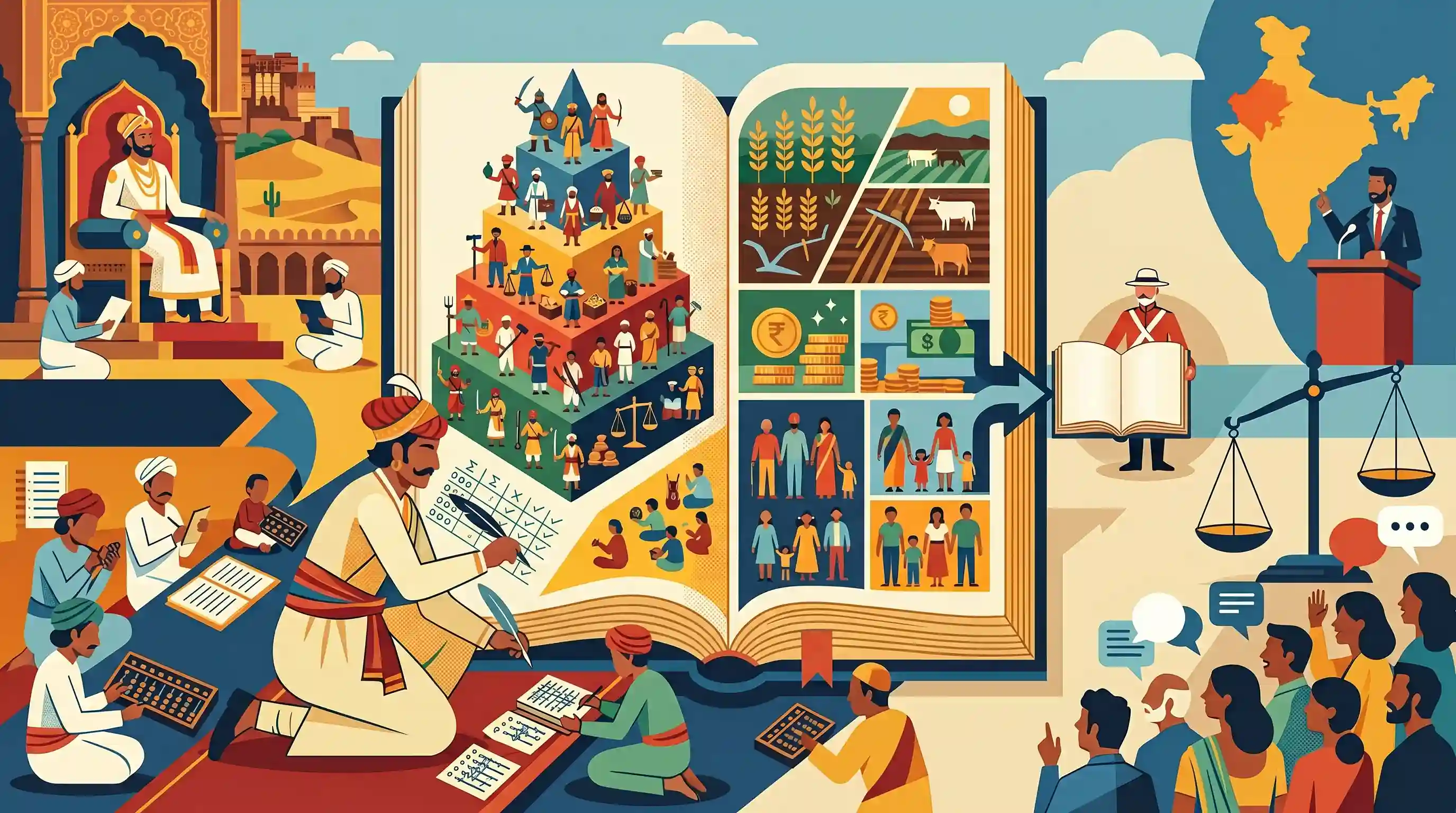
A detailed demographic and caste enumeration was carried out in the kingdom of Marwar (present-day Rajasthan) during the 17th century, serving as a historical precursor to the British census in India. Conducted by Munhot Nainsi, the diwan to Maharaja Jaswant Singh, the exercise was recorded in his monumental work, 'Marwar Ra Pargana Ri Vigat'. This text meticulously documented the demographics, agriculture, economy, and caste composition of Marwar roughly two centuries before the British colonial administration conducted its first systematic census. This historical revelation counters the popular belief that modern demographic and caste mapping in India is purely a colonial legacy, offering profound historical depth to contemporary political debates surrounding the demand for a nationwide caste census.
Key Points
- In the 17th century, Munhot Nainsi, the diwan (minister) to Maharaja Jaswant Singh of Marwar, compiled a detailed gazetteer titled 'Marwar Ra Pargana Ri Vigat'.
- This historical work functioned as a comprehensive village-level census, meticulously documenting households, castes, professions, and agricultural revenue.
- Nainsi's state-led enumeration occurred roughly 200 years before the British initiated the first nationwide census in India (1871-1881).
- The 'Vigat' reveals that administrative mapping of populations based on social stratification and caste was actively practiced in pre-colonial Indian kingdoms.
- This historical precedent provides crucial context to the contemporary socio-political demands for a national caste census, illustrating that demographic profiling by caste is not solely a colonial construct.
Prelims Trap
The first demographic and caste enumeration in Indian history was conducted by the British in 1872.
While the British introduced the modern, nationwide decennial census, rigorous regional demographic and caste mapping existed in pre-colonial India (e.g., Marwar in the 17th century).
Static Concepts Connected
What are the key milestones of the Census in British India?
- 1872 (Lord Mayo): The first non-synchronous nationwide census was conducted under Viceroy Lord Mayo.
- 1881 (Lord Ripon): The first synchronous census establishing the ongoing decennial pattern was conducted under W.C. Plowden during Ripon's tenure.
- 1931 Census: The last British-era census to systematically and comprehensively tabulate caste data (until the SECC 2011).
Who was Munhot Nainsi and what is his literary significance?
- Administrative Role: Often called the 'Abul Fazl of Rajputana', he was the Diwan to Maharaja Jaswant Singh of Marwar in the 17th century.
- The Vigat: His monumental work 'Marwar Ra Pargana Ri Vigat' functions as a gazetteer containing detailed village-level data on households, castes, and revenue.
- Nainsi Ri Khyat: He also authored 'Nainsi Ri Khyat', a major historical chronicle crucial for reconstructing Rajputana history.
Cross-Topic Patterns
Historical precedent for Caste Census
Nainsi's 17th-century enumeration is directly relevant to contemporary polity debates on the Socio-Economic Caste Census (SECC), countering claims that caste-mapping is purely a colonial artifact.
Ain-i-Akbari vs. Nainsi's Vigat
UPSC often links Mughal administrative texts (Ain-i-Akbari) with regional equivalents. Nainsi's 'Vigat' serves as the Rajputana mirror to Abul Fazl's statistical survey of the Mughal Empire.

Expect a pairs-matching question linking medieval authors (Nainsi, Abul Fazl) to their administrative texts and modern census milestones.
Linked PYQs · 4
Linked PYQs · 4
- 2018MainsGS1
Caste system is assuming new identities and associational forms. Hence, caste system cannot be eradicated in India." Comment.
- 2020MainsGS1
Has caste lost its relevance in understanding the multi-cultural Indian Society? Elaborate your answer with illustrations.
- 2023PrelimsGS1
With reference to ancient Indian History, consider the following pairs: Literary work Author 1. Devichandragupta : Bilhana 2. Hammira-Mahakavya : Nayachandra Suri 3. Milinda-panha : Nagarjuna 4. Nitivakyamrita : Somadeva Suri How many of the above pairs are correctly matched?
- 2022MainsGS2
Discuss the role of the National Commission for Backward Classes in the wake of its transformation from a statutory body to a constitutional body.
