Global Carbon Coalition and India Strategic Climate Policy
Source:The Hindu ↗
কেন এটি গুরুত্বপূর্ণ
Crucial for understanding India's stance on global climate negotiations, international carbon markets, and navigating trade barriers like CBAM while pursuing net-zero goals.
সারসংক্ষেপ
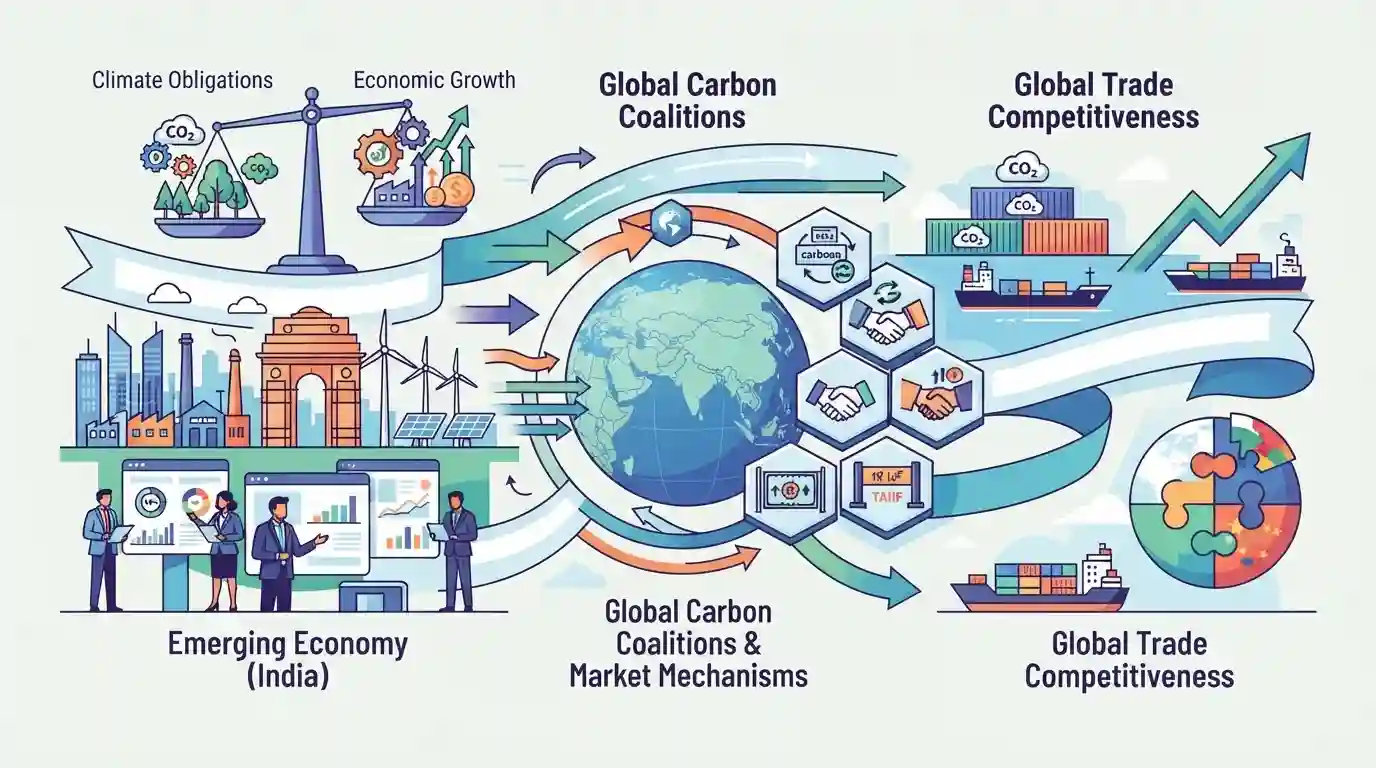
The article evaluates the strategic imperative for emerging economies like India to engage with global carbon coalitions and international market mechanisms, balancing climate obligations with trade competitiveness and economic growth.
মূল বিষয়
- The article explores the strategic advantages and policy arguments for India to join global carbon coalitions or collaborative international carbon pricing initiatives.
- It discusses how international carbon markets and cooperative mechanisms under Article 6 can facilitate cost-effective emission reductions.
- It addresses the challenges posed by unilateral trade measures like the Carbon Border Adjustment Mechanism (CBAM) and how cooperative global carbon frameworks can offer alternatives.
- The piece highlights the balancing act between protecting domestic industrial competitiveness and meeting ambitious climate commitments.
গুরুত্বপূর্ণ শব্দ
Paris Agreement

A legally binding international treaty on climate change adopted in 2015, aiming to hold global temperature increase to well below 2°C above pre-industrial levels through nationally determined contributions (NDCs).
UPSC context
GS Paper III (Environment, Ecology & Climate Change); tests conceptual understanding of global climate governance and commitments.
Article 6 of the Paris Agreement
The section of the Paris Agreement outlining international carbon market mechanisms, enabling countries to trade emission reductions (ITMOs) cooperatively to achieve climate targets.
UPSC context
GS Paper III (Environment and Climate Policy); tests knowledge of market-based mechanisms and international trade-related climate instruments.
সংযুক্ত স্থির ধারণা
What are the core components and mechanisms under Article 6 of the Paris Agreement?
- ITMOs & Bilateral Deals: Cooperative Approaches (Article 6.2) enables bilateral or multilateral transfer of Internationally Transferred Mitigation Outcomes (ITMOs) between countries.
- Centralized SDM Market: Sustainable Development Mechanism (Article 6.4) establishes a centralized UN-run carbon market for trading certified emission reductions from specific projects.
- Non-market Strategies: Non-market Approaches (Article 6.8) promotes mitigation through cooperative plans, financial resource mobilization, and technology transfer without market trading.
আন্তঃবিষয় প্যাটার্ন
CBAM vs WTO Non-Discrimination Principle
The EU's Carbon Border Adjustment Mechanism tests compatibility with WTO non-discrimination principles while acting as a de facto carbon tariff on developing nation exports.
Article 6 Carbon Markets and Trade Competitiveness
Article 6 mechanisms bridge international climate finance and domestic carbon market architectures, linking UNFCCC obligations to global market-based trading.

Expect assertion-reasoning questions on whether Article 6 cooperative approaches exempt developing economies from unilateral CBAM tariffs.
সংযুক্ত PYQ · 3
সংযুক্ত PYQ · 3
- 2023PrelimsGS1
Consider the following statements: Statement-I: Carbon markets are likely to be one of the most widespread tools in the fight against climate change. Statement-II: Carbon markets transfer resources from the private sector to the State. Which one of the following is correct in respect of the above statements?
- 2025PrelimsGS1
Consider the following statements : Statement I: Article 6 of the Paris Agreement on climate change is frequently discussed in global discussions on sustainable development and climate change. Statement II: Article 6 of the Paris Agreement on climate change sets out the principles of carbon markets. Statement III : Article 6 of the Paris Agreement on climate change intends to promote inter-country non-market strategies to reach their climate targets. Which one of the following is correct in respect of the above statements?
- 2022MainsGS3
Discuss global warming and mention its effects on the global climate. Explain the control measures to bring down the level of greenhouse gases which cause global warming, in the light of the Kyoto Protocol, 1997.
