Infrastructure Financing Transition and Banking Sector Credit Gaps
Source:The Hindu ↗
Why It Matters
Understanding the transition from bank-led credit to capital market financing is crucial for GS-3. It connects the dots between fiscal policy (budget deficits), monetary dynamics (credit-deposit gaps), and infrastructure development (asset-liability mismatches).
Summary
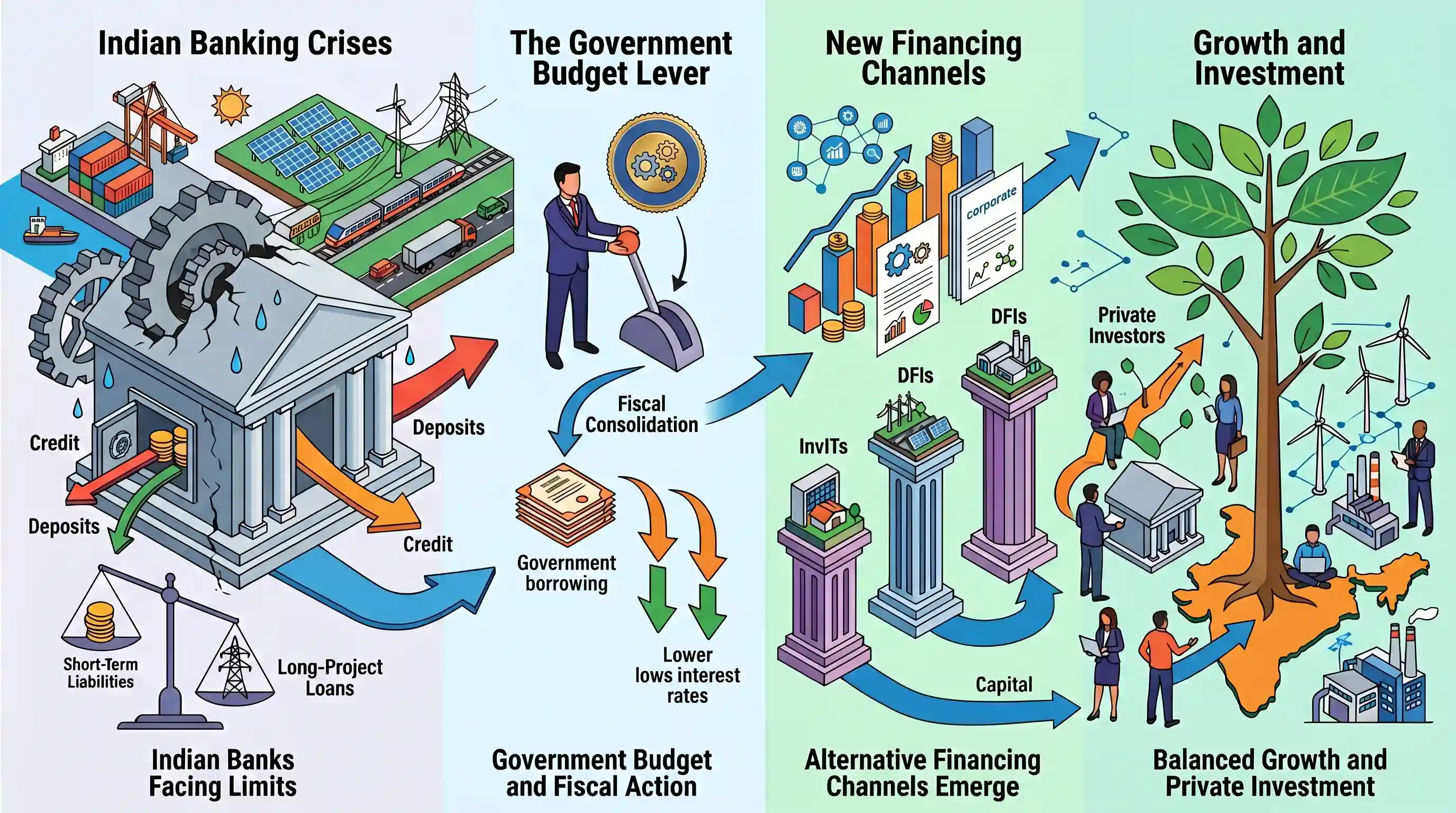
The article highlights the structural limitations of Indian banks in single-handedly financing the country's massive economic and infrastructure growth. Facing challenges like asset-liability mismatches and a lagging deposit growth rate compared to credit expansion, banks cannot bear the entire burden of long-term financing. The Union Budget provides a crucial signal by emphasizing fiscal consolidation, which lowers government borrowing and bond yields. This macroeconomic environment incentivizes the corporate bond market and alternative institutions (such as Development Financial Institutions and InvITs) to step in and assume a greater share of capital formation, ensuring that private investment is crowded in without overwhelming the banking sector.
Key Points
- Indian banks are facing a growing asset-liability mismatch, making it structurally risky to fund long-gestation infrastructure projects using short-term retail deposits.
- There is an expanding gap between credit growth and deposit mobilization, which stretches banks' Credit-Deposit (CD) ratios and limits their capacity to be the sole engines of economic expansion.
- The Union Budget signals a shift by emphasizing fiscal consolidation, which reduces the government's gross market borrowing.
- Reduced government borrowing eases pressure on bond yields, effectively crowding in private investment and encouraging corporations to turn to the corporate bond market.
- Sustainable capital formation requires diversifying credit sources beyond commercial banks to include robust capital markets, DFIs, and alternative instruments like InvITs.
Important Terms
Fiscal Responsibility and Budget Management (FRBM) Act

Enacted in 2003, this legislation provides a legal framework to institutionalize financial discipline, reduce fiscal deficits, and ensure long-term macroeconomic stability through rule-based targets.
UPSC context
GS Paper III (Indian Economy); tests knowledge of fiscal policy, deficit management, and government accountability.
Development Financial Institutions (DFIs)
Specialized financial entities that provide long-term capital for high-risk, large-scale infrastructure and industrial projects which commercial banks often struggle to finance due to maturity constraints.
UPSC context
GS Paper III (Infrastructure/Investment Models); key for understanding resource mobilization beyond the traditional banking sector.
Asset-Liability Mismatch (ALM)
A financial risk occurring when the tenure of a bank's assets (long-term loans) does not align with its liabilities (short-term deposits), often leading to liquidity crises.
UPSC context
GS Paper III (Banking); critical for analyzing systemic risks in infrastructure financing and bank stability.
Infrastructure Investment Trusts (InvITs)
Investment vehicles that pool money from multiple investors to invest directly in revenue-generating infrastructure projects, allowing developers to monetize assets and free up capital.
UPSC context
GS Paper III (Investment Models); tests understanding of alternative instruments for infrastructure funding and resource mobilization.
Crowding In
An economic phenomenon where proactive government spending—particularly in infrastructure—improves business conditions and encourages the private sector to increase its own investment.
UPSC context
GS Paper III (Growth/Planning); helps evaluate the impact of fiscal consolidation and public expenditure on private capital.
Union Budget
The Annual Financial Statement (Article 112) presenting the government's estimated receipts and expenditures, serving as the primary document for fiscal planning and policy signaling.
UPSC context
GS Paper III (Government Budgeting); fundamental for understanding constitutional requirements and sectoral resource allocation.
Prelims Trap
"Increased government borrowing lowers bond yields, leading to a crowding in of private investment."
Higher government borrowing increases bond supply, depressing prices and pushing yields UP. This makes private borrowing costlier, causing "crowding out," not crowding in.
Static Concepts Connected
What causes Asset-Liability Mismatch (ALM) in banks funding infrastructure?
- Short-term Liabilities: Banks rely heavily on retail deposits (like CASA and term deposits), which typically have short-to-medium maturity profiles and can be withdrawn quickly.
- Long-term Assets: Infrastructure projects (highways, power plants) demand long-gestation capital (10-20 years) before they become profitable, locking in bank funds.
- Liquidity Risk: This maturity gap creates a structural risk where banks may lack adequate liquid cash to meet immediate depositor demands if too much capital is locked up.
How do Infrastructure Investment Trusts (InvITs) ease banking stress?
- Asset Monetization: InvITs pool investor money (similar to mutual funds) to acquire operational, revenue-generating infrastructure assets like completed toll highways.
- Capital Decongestion: Infrastructure developers use the proceeds from selling assets to InvITs to repay their existing bank loans, cleaning up and freeing the banking sector's balance sheet.
- Greenfield Rotation: Once the commercial bank's capital is freed from older operational projects, it can be recycled to fund new, riskier greenfield infrastructure developments.
Cross-Topic Patterns
Fiscal math aiding Monetary Policy
Lower government borrowing limits bond yield spikes. This fiscal prudence gives the RBI greater flexibility to manage banking liquidity and policy rates without fighting sovereign-induced interest rate hikes.
Twin Balance Sheet to DFI shift
The 2010s NPA crisis stemmed from banks over-leveraging on infra loans. The current push towards NaBFID, InvITs, and corporate bonds is a structural fix to prevent another Twin Balance Sheet problem.

Expect a multi-statement prelims question interlinking government borrowing, bond yields (crowding out/in), and the rationale for InvITs.
Linked PYQs · 5
Linked PYQs · 5
- 2021MainsGS3
“Investment in infrastructure is essential for more rapid and inclusive economic growth.” Discuss in the light of India's experience.
- 2020MainsGS3
Explain the meaning of investment in an economy in terms of capital formation. Discuss the factors to be considered while designing a concession agreement between a public entity and a private entity.
- 2014MainsGS3
Explain how Private Public Partnership arrangements, in long gestation infrastructure projects, can transfer unsustainable liabilities to the future. What arrangements need to be put in place to ensure that successive generations' capacities are not compromised?
- 2023PrelimsGS1
Consider the following markets: 1. Government Bond Market 2. Call Money Market 3. Treasury Bill Market 4. Stock Market How many of the above are included in capital markets?
- 2025PrelimsGS1
Suppose the revenue expenditure is ₹ 80,000 crores and the revenue receipts of the Government are ₹60,000 crores. The Government budget also shows borrowings of ₹ 10,000 crores and interest payments of ₹ 6,000 crores. Which of the following statements are correct? I. Revenue deficit is ₹ 20,000 crores. II. Fiscal deficit is ₹ 10,000 crores. III. Primary deficit is ₹ 4,000 crores. Select the correct answer using the code given below.
