Bilateral Investment Treaties and Foreign Direct Investment Policy
Source:The Hindu ↗
हे का महत्त्वाचे आहे
Understanding Bilateral Investment Treaties (BITs) and foreign investment frameworks is essential for aspirants analyzing India's trade policy, economic diplomacy, and efforts to attract FDI while retaining regulatory autonomy.
सारांश
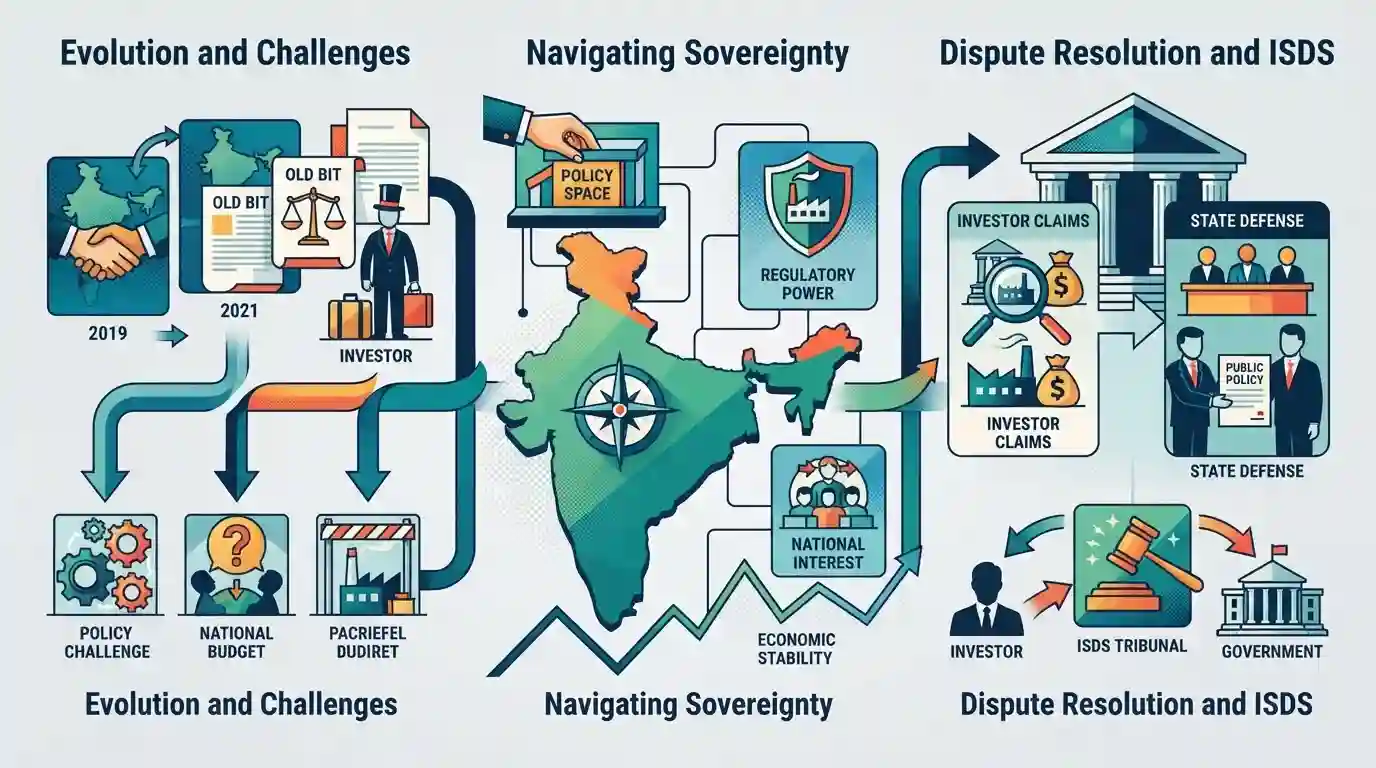
The article discusses the nuances, policy challenges, and evolution of Bilateral Investment Treaties (BITs), highlighting how nations like India navigate investor protection, state sovereignty, and dispute resolution frameworks like ISDS.
मुख्य मुद्दे
- Bilateral Investment Treaties (BITs) play a crucial role in shaping foreign direct investment (FDI) inflows by balancing investor protection with state regulatory sovereignty.
- India's model BIT framework emphasizes domestic legal remedies (exhaustion of local remedies) before international arbitration, aiming to protect sovereign policy space.
- Debates continue on how to strike the right balance between attracting foreign investment through robust dispute resolution mechanisms and safeguarding national interests against excessive litigation.
महत्त्वाच्या संज्ञा
Bilateral Investment Treaties

International agreements between two countries establishing terms and conditions for private investments made by nationals of one state in the other, aiming to promote and protect foreign direct investment.
UPSC context
UPSC GS Paper III (Indian Economy & International Trade); tests understanding of foreign investment policies, state sovereignty, and international economic law.
Investor-State Dispute Settlement
An international arbitration mechanism allowing foreign investors to sue host governments directly for alleged treaty breaches, bypassing domestic courts.
UPSC context
UPSC GS Paper III (Economy/Global Trade) and GS Paper II (International Relations); evaluates mechanisms for resolving international trade disputes and investor grievances.
World Trade Organization
An international organization dealing with the global rules of trade between nations, ensuring that trade flows as smoothly, predictably, and freely as possible.
UPSC context
UPSC GS Paper III (Indian Economy & Global Economic Bodies); critical for understanding multilateral trade agreements, tariffs, and dispute settlement structures.
पूर्वपरीक्षा सापळा
Foreign investors can directly initiate international investor-state dispute settlement (ISDS) without approaching domestic courts under India's current Model BIT framework.
Aspirants often assume India's Model BIT allows immediate international arbitration like older treaties, ignoring the mandatory exhaustion of local remedies clause.
संबंधित स्थिर संकल्पना
What are the key features and strategic shifts in India's 2015 Model Bilateral Investment Treaty (BIT)?
- Exhaustion of Remedies: Mandates exhaustion of local judicial remedies for at least 5 years before initiating international arbitration.
- Exclusion of MFN: Completely excluded the Most-Favoured-Nation (MFN) provision to prevent treaty shopping and multi-forum litigation.
- Narrowed FET: Narrowed Fair and Equitable Treatment (FET) to an exhaustive list of state actions constituting a breach.
- Asset Definition: Restricted enterprise-based definition of investment and excluded 'portfolio investments' to limit speculative capital claims.
आंतर-विषय नमुने
Model BITs & WTO/FTA Sovereign Space
India's cautious Model BIT directly parallels its defensive stance in plurilateral FTA negotiations and data localization mandates, prioritizing sovereign policy space over investor comfort.

Expect a statement-based prelims question on Model BIT 2015 features: MFN exclusion, FET narrowing, and exhaustion of local remedies.
संबंधित PYQ · 1
संबंधित PYQ · 1
- 2025MainsGS3
What are the challenges before the Indian economy when the world is moving away from free trade and multilateralism to protectionism and bilateralism? How can these challenges be met?
