Sample registration system report and pandemic mortality undercount
Source:The Hindu ↗
Why It Matters
Vital statistics and demographic data are crucial for public health planning, assessing the true impact of pandemics, and ensuring accountability in governance. The delay and undercounting highlighted in this article underscore significant systemic gaps in India's health infrastructure and data governance, which are critical themes for GS Paper 2 (Governance and Health).
Summary
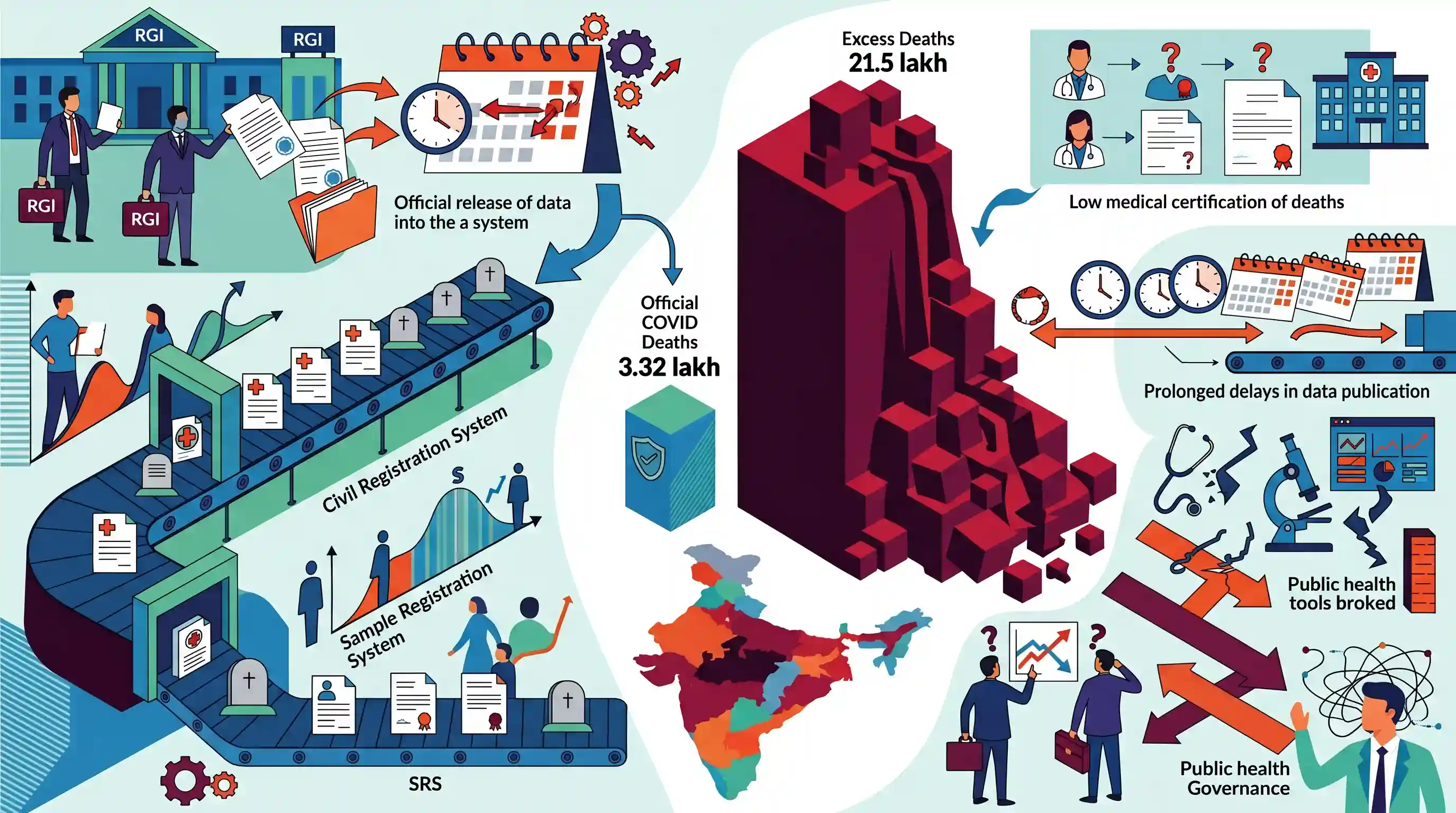
The article analyzes the Registrar General of India's belated release of the Sample Registration System (SRS) report for 2021, revealing a significant undercount of COVID-19 deaths. While official figures stood at 3.32 lakh, excess deaths were recorded at 21.5 lakh, particularly in states like Gujarat, Madhya Pradesh, and Uttar Pradesh. Despite improvements in the Civil Registration System, the low rate of medical certification of deaths and prolonged delays in data publication weaken India's public health tools, hindering accurate disease tracking and effective health policymaking.
Key Points
- The Registrar General of India delayed the release of the Sample Registration System Report 2021 by nearly four years, hindering timely public health analysis.
- Data indicates approximately 21.5 lakh excess deaths in 2021, revealing a severe undercount compared to the official COVID-19 toll of 3.32 lakh for that period.
- States including Gujarat, Madhya Pradesh, Uttar Pradesh, and Telangana exhibited significant discrepancies between registered excess deaths and reported COVID-19 fatalities.
- While the overall registration of births and deaths has improved to near 100%, the medical certification of the cause of death remains low (around one-fifth of registered deaths).
- The lack of timely, medically certified mortality data undermines disease tracking, life expectancy predictions, and robust health policymaking.
Important Terms
Civil Registration System (CRS)

A statutory mechanism under the Registration of Births and Deaths Act, 1969, for mandatory, continuous, and permanent recording of vital events like births and deaths across India.
UPSC context
GS Paper 2: Governance/Social Sector. Important for evaluating administrative data efficiency and universal health coverage.
Sample Registration System (SRS)
A large-scale demographic survey providing annual estimates of fertility and mortality indicators (like IMR and MMR) through a dual-record system of continuous enumeration and retrospective surveys.
UPSC context
GS Paper 1: Population. Essential for comparing sample-based estimates against actual registered deaths to identify undercounting.
Registrar General of India (RGI)
A statutory office under the Ministry of Home Affairs responsible for conducting the decennial Census, managing the Civil Registration System, and supervising the Sample Registration System.
UPSC context
GS Paper 2: Governance. Key nodal agency for national demographic data and institutional health governance.
Medical Certification of Cause of Death (MCCD)
A system under the RBD Act where a medical practitioner certifies the cause of death; it is vital for tracking disease-specific mortality trends.
UPSC context
GS Paper 2: Health Governance. Crucial for evidence-based health policymaking and pandemic response.
Prelims Trap
The Sample Registration System (SRS) and Civil Registration System (CRS) are administered by the Ministry of Health.
This is a classic ministry trap. Both the SRS and CRS are administered by the Registrar General of India (RGI), which functions under the Ministry of Home Affairs, not Health.
Static Concepts Connected
What is the difference between CRS and SRS in India?
- CRS Scope: Mandatory and universal recording of births and deaths governed by the Registration of Births and Deaths (RBD) Act, 1969.
- SRS Scope: A large-scale, continuous demographic sample survey providing reliable national and state-level estimates for IMR, MMR, birth rates, and death rates.
- SRS Methodology: SRS employs a dual-record system (continuous enumeration by resident part-time enumerators + retrospective half-yearly surveys by supervisors) to cross-verify vital statistics.
What is the Medical Certification of Cause of Death (MCCD)?
- Core Objective: A scheme under the RBD Act, 1969, meant to provide a medically certified underlying cause of death to aid epidemiological research and WHO mortality coding.
- Implementation Gap: Despite near 100% death registration under CRS, MCCD coverage remains critically low (around 20-22%), creating a massive blind spot for evidence-based public health policymaking.
Cross-Topic Patterns
Data Governance + Welfare Targeting
Accurate mortality data (IMR, MMR) via SRS dictates fund allocation under the National Health Mission and shapes India's HDI ranking. Institutional delays in publication cripple targeted welfare delivery.
Federalism + Health Emergency Responses
While Health is a State subject, the Registration of Births and Deaths Act is central. Massive discrepancies between state reporting and central data highlight weak cooperative federalism in epidemiological surveillance.

Expect a 2026 Prelims question pairing demographic databases (SRS, CRS, NFHS, Census) with their nodal ministries and statutory backing.
Linked PYQs · 3
Linked PYQs · 3
- 2021MainsGS2
“Besides being a moral imperative of a Welfare State, primary health structure is a necessary precondition for sustainable development.” Analyze.
- 2020MainsGS2
Critically examine the role of WHO in providing global health security during the Covid-19 pandemic.
- 2023MainsGS2
e-governance, as a critical tool of governance, has ushered in effectiveness, transparency and accountability in governments. What inadequacies hamper the enhancement of these features ?
