India first national income survey and household earnings data
Source:Indian Express ↗
Why It Matters
Accurate estimation of poverty, inequality, and national income is a fundamental theme in the GS3 syllabus. The shift from proxy consumption-based estimation to direct household income surveys represents a major structural reform in India's statistical architecture, essential for evidence-based policymaking.
Summary
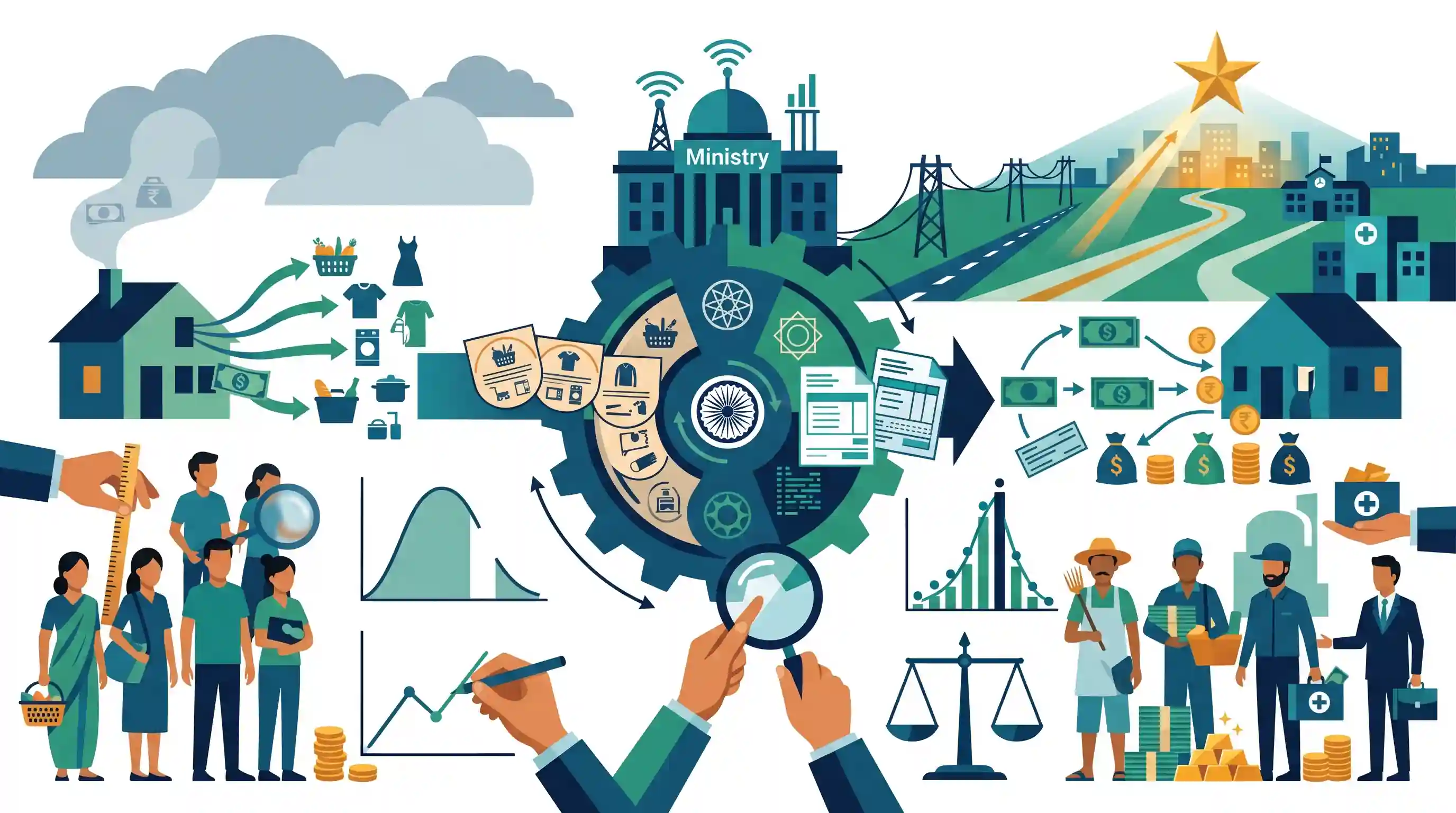
The Ministry of Statistics and Programme Implementation is preparing to conduct India's first-ever National Income Survey to directly assess household earnings across the country. In the Pune region, 9,800 households will be surveyed as a component of this large-scale exercise. Historically, India has relied on Household Consumption Expenditure Surveys to estimate poverty and act as a proxy for income, an approach often criticized for underestimating income inequality and failing to capture top-tier wealth accumulation. By shifting to direct income measurement, the government aims to generate more robust data on citizens' economic status. This statistical reform will be instrumental in analyzing true economic disparities, delivering targeted welfare, and accurately tracking India's progress toward inclusive development.
Key Points
- India is initiating its first comprehensive National Income Survey to directly record household earnings, moving beyond the historical reliance on consumption expenditure data.
- As part of the massive nationwide sampling effort, 9,800 households will be surveyed in the Pune region to capture diverse economic profiles.
- Directly capturing income data will address existing statistical blind spots, providing a more precise measurement of income inequality, wealth distribution, and true economic well-being.
- This methodological shift aligns India's data collection with global standards, crucial for formulating targeted social security measures and evaluating the inclusiveness of economic growth.
Important Terms
National Household Income Survey (NHIS)

India's first dedicated nationwide survey (launched 2026) to directly assess household earnings from various sources like salaries, business, and agriculture, rather than relying on consumption proxies.
UPSC context
GS Paper III: Indian Economy; tests understanding of inclusive growth and shifts in statistical methodology for inequality measurement.
Household Consumption Expenditure Survey (HCES)
A periodic survey measuring household spending on goods and services; historically India's primary tool for estimating poverty lines and assessing living standards.
UPSC context
GS Paper III: Poverty and Inequality; tests knowledge of historical data sources for poverty estimation.
National Statistical Office (NSO)
The executive statistical body formed in 2019 by merging the CSO and NSSO to streamline data collection, national accounting (GDP), and large-scale sample surveys.
UPSC context
GS Paper II: Governance/Institutions; tests knowledge of the institutional framework for Indian official statistics.
Ministry of Statistics and Programme Implementation (MoSPI)
The nodal ministry for the Indian statistical system, responsible for the NSO and monitoring the implementation of major government projects and schemes.
UPSC context
GS Paper II: Statutory and Regulatory Bodies; tests awareness of administrative oversight for economic data.
Monthly Per Capita Consumption Expenditure (MPCE)
An indicator derived from HCES representing average monthly spending per person, serving as the primary metric for calculating poverty ratios in India.
UPSC context
GS Paper III: Issues related to Planning; tests ability to interpret household-level economic health and welfare.
Gini Coefficient
A statistical measure of distribution ranging from 0 (perfect equality) to 1 (perfect inequality), frequently used by MoSPI to report on consumption and income disparities.
UPSC context
GS Paper III: Inclusive Growth; tests quantitative understanding of economic inequality and development outcomes.
Prelims Trap
"Official poverty lines in India have historically been calculated using direct household income data."
Post-independence committees historically used consumption expenditure (not income) as a proxy to define poverty lines, because India's vast informal sector made direct income too volatile to measure accurately.
Static Concepts Connected
How did major committees approach poverty estimation in India?
- Tendulkar Committee (2009): Shifted from calorie-intake norms to a broader consumption basket (health, education) using a uniform reference period.
- Rangarajan Committee (2014): Reverted partially to separate rural/urban baskets and used a modified mixed reference period.
- Common Baseline: All major historical poverty lines relied exclusively on Household Consumption Expenditure Survey (HCES) data, never direct income.
What is the organizational structure behind India's socio-economic surveys?
- NSO Merger: Formed in 2019 by merging the Central Statistics Office (CSO) and the National Sample Survey Office (NSSO).
- Nodal Ministry: The National Statistical Office operates under the Ministry of Statistics and Programme Implementation (MoSPI).
- Mandate: NSO acts as the nodal agency for all large-scale socio-economic surveys, including HCES, the Periodic Labour Force Survey (PLFS), and the new National Income Survey.
Cross-Topic Patterns
Measuring Inequality: Gini & IHDI
Consumption surveys often mask top-tier wealth accumulation. Direct income surveys will likely reveal starker inequalities, directly impacting how India's Gini coefficient and Inequality-adjusted HDI are calculated.
CPI Weights vs. Inequality Metrics
While the new Income Survey tracks wealth gaps, traditional consumption surveys (HCES) remain the vital data source for updating Consumer Price Index (CPI) weights and revising GDP base years.

A 2026 multi-statement question will likely contrast HCES (CPI weights) with the new National Income Survey's utility for Gini calculations.
Linked PYQs · 4
Linked PYQs · 4
- 2019PrelimsGS1
In a given year in India, official poverty lines are higher in some States than in others because
- 2018PrelimsGS1
Increase in absolute and per capita real GNP do not connote a higher level of economic development, if
- 2025MainsGS3
Distinguish between the Human Development Index (HDI) and the Inequality-adjusted Human Development Index (IHDI) with special reference to India. Why is the IHDI considered a better indicator of inclusive growth?
- 2017MainsGS3
What are the salient features of 'inclusive growth'? Has India been experiencing such a growth process? Analyse and suggest measures for inclusive growth.
