Land Earmarked in NTR District for Polavaram Oustees
Source:thehindu ↗
ఇది ఎందుకు ముఖ్యం
The Polavaram Irrigation Project is a critical National Project for Andhra Pradesh, and its related Resettlement and Rehabilitation (R&R) efforts frequently appear in APPSC exams. The socio-economic impacts of displacement, especially the distinction between tribal and non-tribal R&R, highlight vital governance and geographical issues.
సారాంశం
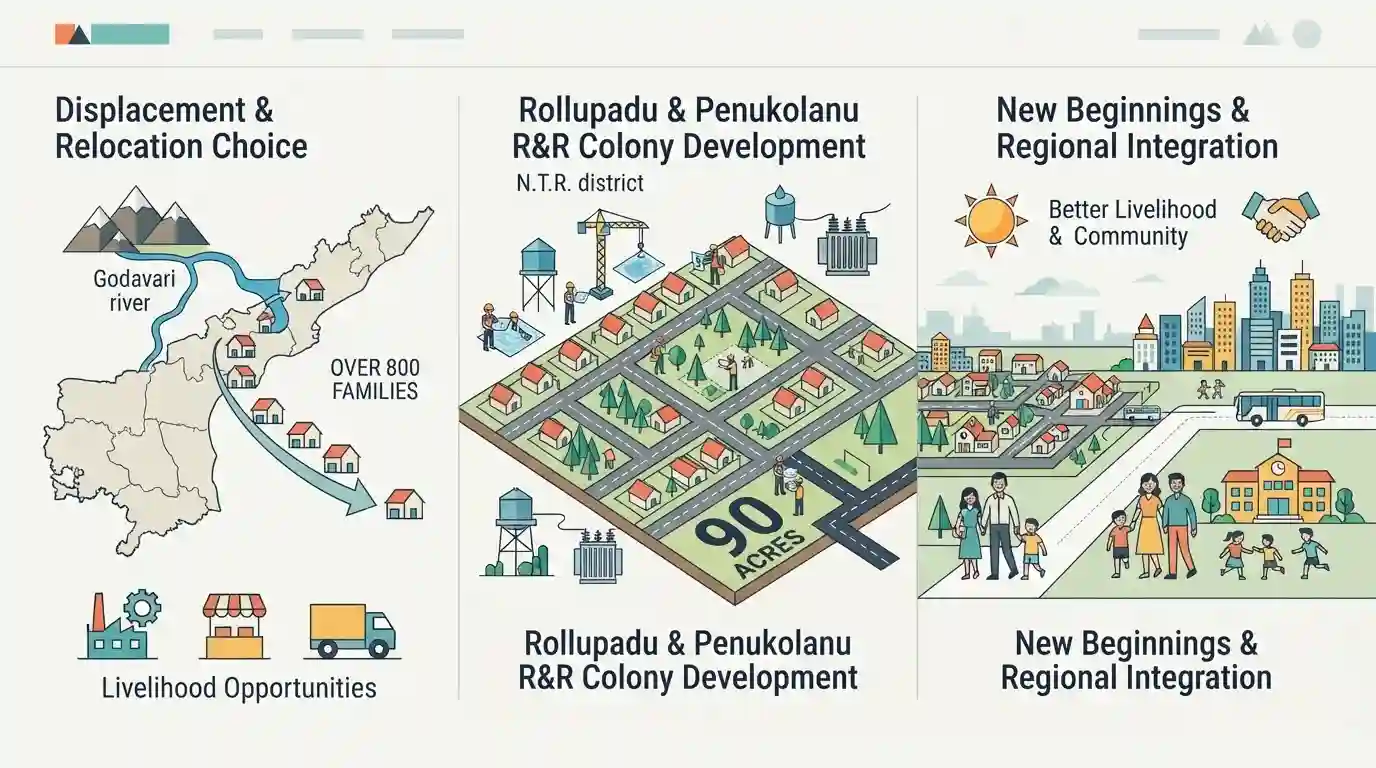
The Andhra Pradesh government has earmarked 90 acres in the N.T.R. district, specifically in Rollupadu and Penukolanu, to develop Resettlement and Rehabilitation (R&R) colonies. These colonies will accommodate over 800 non-tribal families from V.R. Puram mandal who were displaced by the Polavaram irrigation project. The relocation to the Vijayawada region was chosen by the families to secure better livelihood opportunities. Authorities are currently finalizing the layouts to begin establishing basic infrastructure.
ముఖ్య అంశాలు
- The Andhra Pradesh state government has identified and cleared 90 acres of land in N.T.R. district to build Resettlement and Rehabilitation (R&R) colonies.
- These colonies will house 864 non-tribal families displaced by the Polavaram irrigation project in V.R. Puram mandal of Polavaram district.
- The displaced families opted for relocation near Vijayawada (Rollupadu and Penukolanu) in search of better livelihood prospects.
- The district administration is drafting layouts and will soon initiate the construction of basic amenities like drinking water and roads.
ముఖ్యమైన పదాలు
Polavaram irrigation project

A multi-purpose irrigation project on the Godavari River in Andhra Pradesh. Designated as a National Project, it provides irrigation, hydropower, drinking water, and inter-basin water transfer, though its massive scale has displaced thousands of families.
UPSC context
Crucial for GS-I (Water Resources) and GS-III (Infrastructure). Tests knowledge of river interlinking, water management, and related displacement issues.
Resettlement and Rehabilitation (R&R) policy
A policy framework ensuring families displaced by large-scale development or land acquisition receive adequate compensation, physical relocation (resettlement), and support to rebuild their economic livelihoods and social links (rehabilitation).
UPSC context
Core to GS-II (Social Justice) and GS-III (Inclusive Growth). It addresses the legal and ethical rights of project-affected, vulnerable populations.
Development-induced Displacement
The involuntary migration or forced relocation of communities to make way for massive economic initiatives like dams, mining, and urban infrastructure projects.
UPSC context
Vital for GS-I (Society) and GS-III (Economic Development), highlighting the friction between national economic growth and local human rights.
National Projects Scheme (Irrigation)
A Central Government classification for major water resource projects—like Polavaram—that receive substantial (usually 90%) central funding due to their immense scale, inter-state complexity, or strategic national importance.
UPSC context
Important for GS-II (Governance) and GS-III (Infrastructure). Evaluates understanding of federal financing, center-state relations, and major irrigation capacity building.
ప్రిలిమ్స్ ఉచ్చు
The Polavaram project exclusively displaces Scheduled Tribes and PVTGs in the Godavari basin.
UPSC frames extreme statements. While Polavaram's submergence zone predominantly affects Scheduled Tribes and PVTGs (like Konda Reddis), it displaces a significant number of non-tribal families who also receive statutory R&R.
అనుసంధానమైన స్థిర భావనలు
What is the geographical and statutory significance of the Polavaram Project?
- River System: Built on the Godavari river, it acts as a major inter-basin node to transfer surplus water to the deficit Krishna River basin.
- National Status: Declared a National Project under Section 90 of the AP Reorganisation Act, 2014, making the Union government responsible for funding its irrigation component.
- Tribunal Award: It is executed in accordance with the 1980 final award of the Godavari Water Disputes Tribunal.
What are the key mandates for resettlement under the LARR Act, 2013?
- Mandatory SIA: Makes a Social Impact Assessment (SIA) mandatory before acquiring land for mega-projects to evaluate displacement costs and alternatives.
- Comprehensive Rehab: Mandates not just monetary compensation, but the establishment of R&R colonies with basic infrastructure, housing, and livelihood support.
- Consent Clause: Requires the consent of 70% of affected families for PPP projects and 80% for private entities before land acquisition.
అంతర-అంశ నమూనాలు
River Boards & AP Reorganisation Act
The Apex Council and Godavari/Krishna River Management Boards created by the AP Reorganisation Act 2014 link directly to Polity themes on Article 262 and inter-state water disputes.
Mega-projects & PVTG displacement
Polavaram's submergence zones impact the Konda Reddis, connecting infrastructure development directly to the demographic and cultural threats faced by Particularly Vulnerable Tribal Groups (PVTGs).

Polavaram's National Project status, its Godavari-Krishna link, and LARR 2013 R&R mandates make it ripe for a multi-statement Geography Q.
అనుసంధాన PYQలు · 3
అనుసంధాన PYQలు · 3
- 2023APPSC_PRELIMSGS1
Polavaram Project is a
- 2023APPSC_PRELIMSGS1
Apex Council of Godavari and Krishna river water resources and their management consists of
- 2023APPSC_PRELIMSGS1
Match the following Irrigation Projects and their States (location): | Irrigation Projects | States | |---|---| | a. Parwan Multipurpose Project | I. Madhya Pradesh | | b. Renukaji Dam Project | II. Uttarakhand | | c. Lakhwar | III. Himachal Pradesh | | d. Ken-Betwa Link Project | IV. Rajasthan | Choose the correct answer using the codes given below: Code: a b c d
