Uniform Civil Code Public Feedback and Governor Briefing in MP
Source:socialnews.xyz ↗
Why It Matters
This article illustrates how state governments act on Directive Principles (Article 44 - UCC) and highlights the real-time functioning of Article 167, which defines the constitutional communication channel between the Chief Minister and the Governor. Such institutional operations and local executive profiles are vital areas of focus for the MPPSC Prelims.
Summary
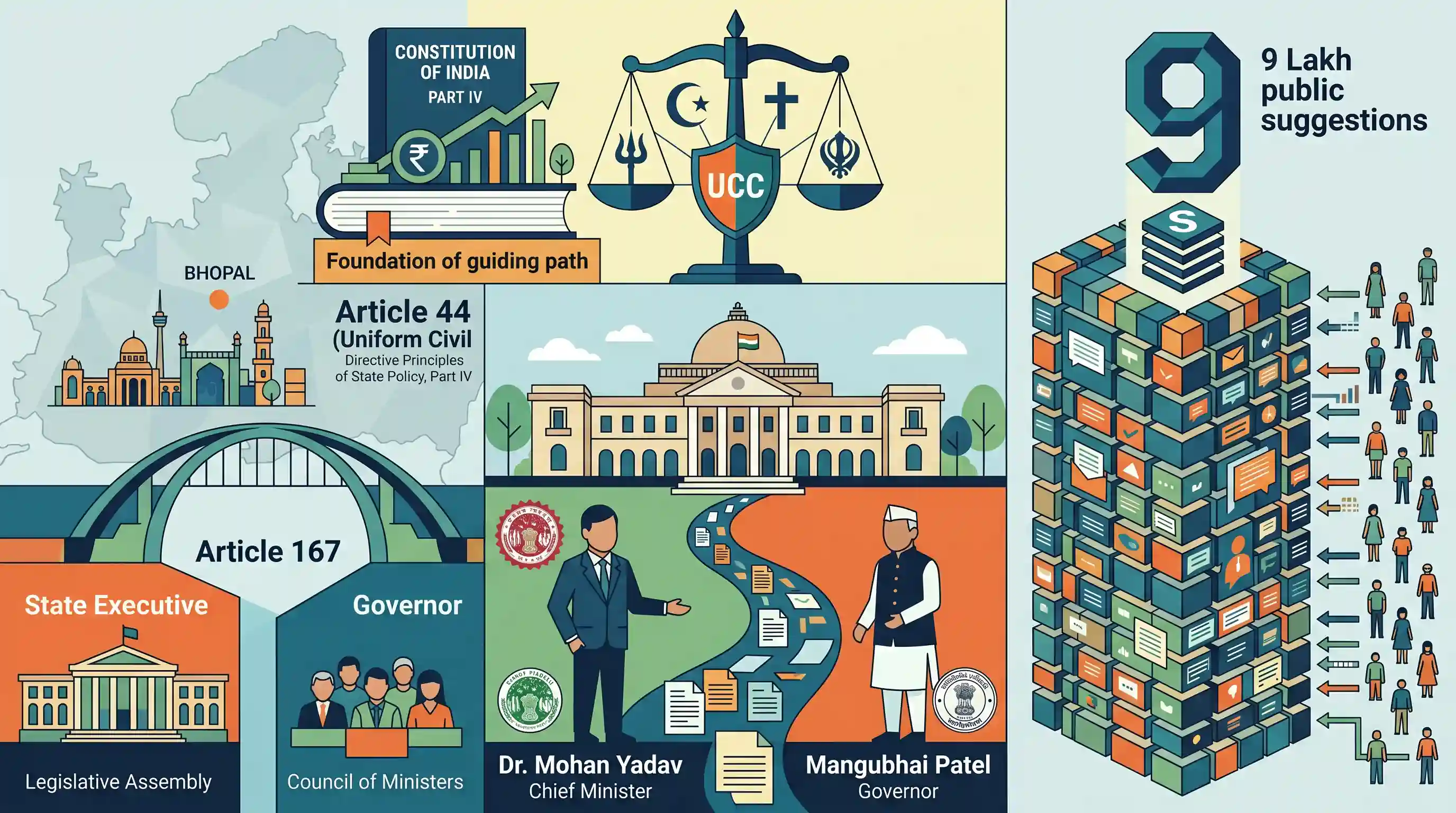
Madhya Pradesh Chief Minister Dr. Mohan Yadav met Governor Mangubhai Patel at Raj Bhavan to brief him on key administrative affairs and the progress of the state's proposed Uniform Civil Code (UCC). The Chief Minister highlighted that the initiative has received an unprecedented response, with over nine lakh public suggestions being registered. This routine administrative briefing aligns with Article 167 of the Constitution, which regulates information sharing between the Chief Minister and the Governor.
Key Points
- Madhya Pradesh Chief Minister Dr. Mohan Yadav met Governor Mangubhai Patel at Raj Bhavan in Bhopal to brief him on crucial state initiatives.
- The primary focus of the meeting was updating the Governor on the formulation process and public feedback concerning the Uniform Civil Code (UCC) in Madhya Pradesh.
- Over nine lakh (9,000,000) suggestions have been received from the public regarding the proposed Uniform Civil Code, demonstrating high levels of civic participation.
- The meeting represents the functional implementation of Article 167 of the Constitution, which details the duties of the Chief Minister in furnishing information to the Governor.
- The UCC is envisioned under Article 44 of the Directive Principles of State Policy (DPSP) in Part IV of the Indian Constitution, a concept originally borrowed from the Constitution of Ireland.
Important Terms
Uniform Civil Code

A proposed common set of personal laws governing civil matters such as marriage, divorce, inheritance, and adoption for all citizens of India, regardless of their religion, as envisioned under Article 44.
UPSC context
GS Paper II (Polity & Governance). Tests understanding of Article 44, gender justice, personal laws, and federal-state dynamics.
Directive Principles of State Policy
Non-justiciable guidelines enshrined in Part IV (Articles 36-51) of the Indian Constitution, directing the State to frame policies that promote a welfare state and secure socio-economic justice.
UPSC context
GS Paper II (Polity). Tests the constitutional vision of a welfare state and the DPSP relationship with Fundamental Rights.
Article 167 of the Constitution
A constitutional provision outlining the Chief Minister's duty to communicate cabinet decisions, administrative affairs, and legislative proposals of the state to the Governor, facilitating executive information sharing.
UPSC context
GS Paper II (Polity). Tests the constitutional balance, executive communication protocols, and the Governor-Chief Minister relationship.
State Executive
The administrative wing of a state government in India, comprising the Governor as nominal head, the Chief Minister as real head, the Council of Ministers, and the Advocate General.
UPSC context
GS Paper II (Polity). Tests the constitutional design, federal structure, and powers of provincial administrative heads.
Prelims Trap
Goa was the first state in post-independence India to draft and pass its own custom Uniform Civil Code.
Goa did not draft or pass a UCC post-independence; it simply retained the 1867 Portuguese Civil Code. Uttarakhand is the first state to draft and pass its own post-independence UCC.
Static Concepts Connected
What are the three specific constitutional duties of the Chief Minister under Article 167?
- Communicate cabinet decisions: To communicate to the Governor all decisions of the Council of Ministers relating to state administration and legislative proposals.
- Furnish administrative details: To furnish such information relating to the state's administration and legislative proposals as the Governor may call for.
- Submit individual decisions: To submit for the Council's consideration any matter decided by a Minister but not yet reviewed by the Council, if the Governor directs.
How does federalism affect a state's power to enact a Uniform Civil Code?
- Concurrent List entry: Personal laws like marriage, divorce, and succession fall under Entry 5 of the Concurrent List, enabling state-level initiatives.
- Article 254(2) assent: State UCC bills repugnant to existing Central personal laws must obtain Presidential assent under Article 254(2) to be valid.
Cross-Topic Patterns
Federalism and personal law diversity
State-specific UCC laws create regional variations in civil codes, testing Entry 5 of the Concurrent List and the principle of a uniform national legal framework.
Article 167 and executive harmony
The constitutional duty to inform the Governor under Article 167 acts as a safeguard against unilateral cabinet actions, balancing state executive powers.

UPSC may test the concurrent legislative power over personal laws and the presidential assent mechanism (Art 254) using UCC precedents.
Linked PYQs · 4
Linked PYQs · 4
- 2023MPPSC_PRELIMSGS1
The Directive Principles of State Policy are explained in Part IV of the Indian Constitution. This system has been taken from the Constitution of which country ?
- 2022MPPSC_PRELIMSGS1
Who among the following shall preside the meeting of Council of Ministers in Madhya Pradesh in the absence of the Chief Minister?
- 2020MPPSC_PRELIMSGS1
Who among the following Governors of Madhya Pradesh has been the Chief Minister of Haryana?
- 2025MPPSC_PRELIMSGS1
_____ was the Governor of Madhya Pradesh when President's rule was imposed in Madhya Pradesh between 30.04.1977 to 23.06.1977.
