Illness Outbreak and Child Mortality in Balaghat Tribal Villages
Source:indiatribune ↗
Why It Matters
This tragic event is highly relevant for state-level examinations as it touches upon the socio-economic vulnerabilities of PVTGs (specifically the Baiga tribe) in Madhya Pradesh, regional health disparities, and the effectiveness of tribal nutrition and welfare schemes like the Ahar Anudan Yojana.
Summary
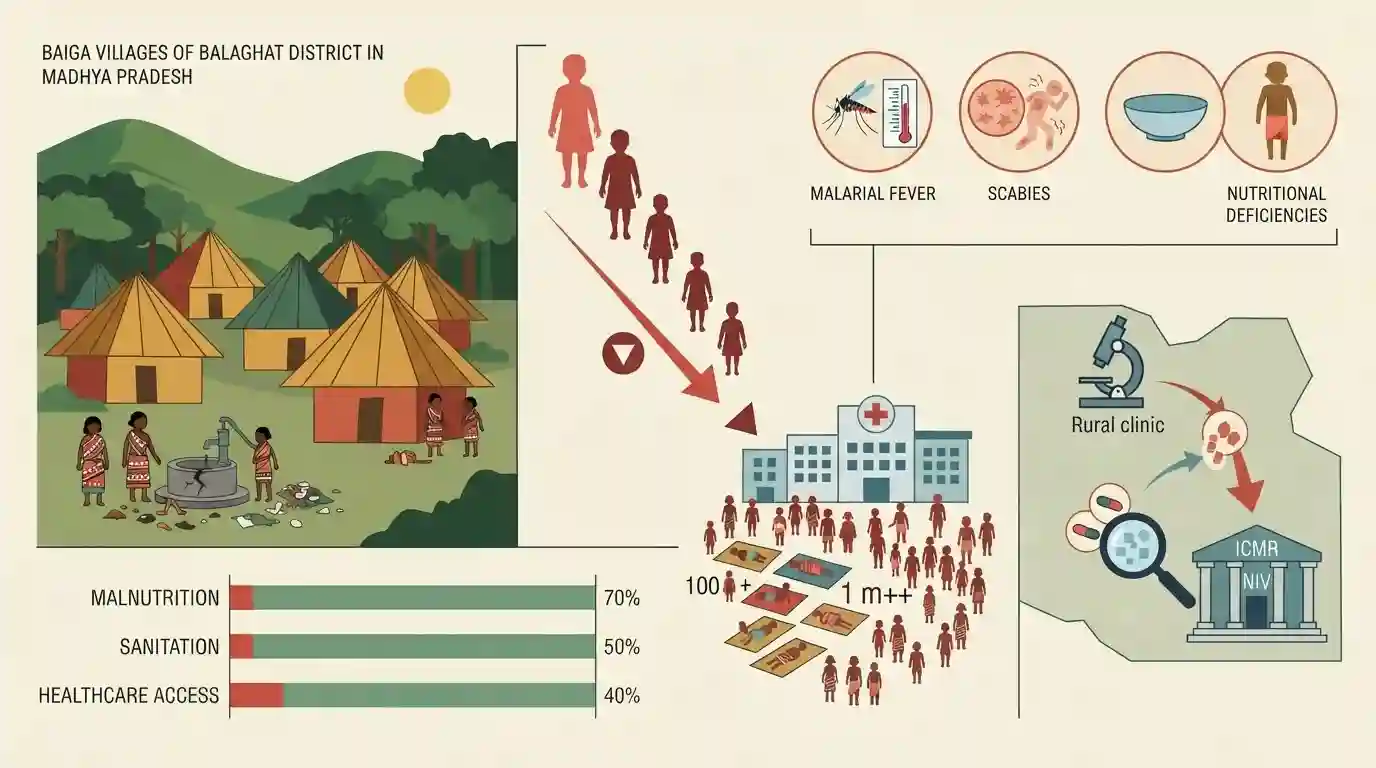
An outbreak of suspected illness in the Baiga-dominated tribal villages of Madhya Pradesh's Balaghat district has reportedly claimed the lives of nine children and led to the hospitalization of over 100 more. The children have shown symptoms of malarial fever, scabies, and nutritional deficiencies, prompting authorities to send samples to ICMR Kolkata and NIV Pune for investigation. The Baiga tribe is one of Madhya Pradesh's Particularly Vulnerable Tribal Groups (PVTGs), and this health crisis draws critical attention to the ongoing challenges of malnutrition, inadequate sanitation, and poor healthcare access in the state's remote tribal regions.
Key Points
- Nine children have died and over 100 hospitalized in Baiga-dominated tribal villages of Balaghat district, Madhya Pradesh due to an undiagnosed illness outbreak.
- The affected children exhibited symptoms including malarial fever, scabies skin infection, and severe nutritional deficiencies.
- The Baiga community is recognized as one of the three Particularly Vulnerable Tribal Groups (PVTGs) in Madhya Pradesh, highlighting their marginalized socio-economic and health status.
- Medical samples have been dispatched to ICMR Kolkata and NIV Pune to identify the exact cause of the illness.
- The tragic incident underscores urgent policy and governance gaps regarding malnutrition, sanitation, and last-mile healthcare access in remote tribal belts of Madhya Pradesh.
Important Terms
Ahar Anudan Yojana

A Madhya Pradesh state scheme providing monthly financial assistance to women from Particularly Vulnerable Tribal Groups (PVTGs)—such as the Baiga, Sahariya, and Bharia—aiming to combat malnutrition and improve health outcomes.
UPSC context
Highly relevant for MPPSC GS Paper 2 (Tribal Welfare & State Schemes). Tests knowledge of targeted interventions for vulnerable demographic groups.
Indian Council of Medical Research (ICMR)
Established in 1911, it is the apex national body in India responsible for formulating, coordinating, and promoting biomedical research to address public health challenges and investigate disease outbreaks.
UPSC context
Important for MPPSC GS Paper 2 (Public Health) and GS Paper 3. Tests awareness of India's primary health research institutions.
National Institute of Virology (NIV)
A premier research institute under the ICMR located in Pune. It specializes in the diagnosis, surveillance, and study of viral diseases, playing a vital role during national health emergencies.
UPSC context
Crucial for MPPSC GS Paper 3 (Science & Technology) and GS Paper 2 (Health). Focuses on specialized agencies managing viral epidemics.
Prelims Trap
"Aahar Anudan Yojana provides a monthly stipend of ₹1500 to all BPL tribal families in Madhya Pradesh."
The scheme is exclusively for women of the three Particularly Vulnerable Tribal Groups (PVTGs)—Baiga, Bharia, and Sahariya—not all ST or BPL families.
Static Concepts Connected
Who are the Particularly Vulnerable Tribal Groups (PVTGs) of Madhya Pradesh?
- Origin: Originally designated as Primitive Tribal Groups by the Dhebar Commission (1973), renamed to PVTGs in 2006.
- MP's PVTGs: Madhya Pradesh has three: Baiga (Mandla/Balaghat region), Bharia (Patalkot in Chhindwara), and Sahariya (Gwalior-Chambal region).
- Identification Criteria: Pre-agricultural system of existence, zero or negative population growth, extremely low literacy, and subsistence economy.
What are the key demographic and geographical facts about Balaghat district?
- Highest Sex Ratio: Holds the highest sex ratio in Madhya Pradesh as per Census 2011, with 1021 females per 1000 males.
- Mineral Wealth: Home to the famous Bharveli mine (Manganese) and Malanjkhand mine (Copper), making it a major mineral hub.
- Tribal Belt: Forms a major part of the 'Baiga-Chak' tribal belt along with Mandla and Dindori.
Cross-Topic Patterns
PVTG Health + Aahar Anudan Yojana
The malnutrition crisis directly tests the efficacy of the Aahar Anudan Yojana, making it a prime target for scheme-based questions in Prelims and Mains (GS Paper 2).
Mineral Wealth vs. Tribal Underdevelopment
The paradox of Balaghat—rich in manganese and forest resources yet struggling with extreme tribal poverty—is a classic Mains case study on inequitable development and resource curse.

Expect a multi-statement question on MP's PVTGs combining tribal geography (Baiga Chak), Aahar Anudan Yojana, and Dhebar Commission.
Linked PYQs · 4
Linked PYQs · 4
- 2025MPPSC_PRELIMSGS1
Which one of the following is not one of the Particularly Vulnerable Tribal Group (PVTG) of Madhya Pradesh?
- 2025MPPSC_PRELIMSGS1
Since the date 23.12.2017, 'Ahar Anudan Yojana' is a yojana to get rid of malnutrition of which tribal community?
- 2022MPPSC_PRELIMSGS1
Which of the following districts has large manganese reserves?
- 2021MPPSC_PRELIMSGS1
District which has minimum sex ratio in Madhya Pradesh?
