Bihar Legislative Council Polls: Nine candidates file nominations
Source:The Hindu ↗
Why It Matters
Understanding the structure, composition, and historical background of the Bihar Legislative Council is a high-yield topic for BPSC Prelims, which frequently asks questions about the first session of the Council (1913), the transition to bicameralism under the GOI Act 1919, the first Chairman under the GOI Act 1935, and relevant constitutional articles.
Summary
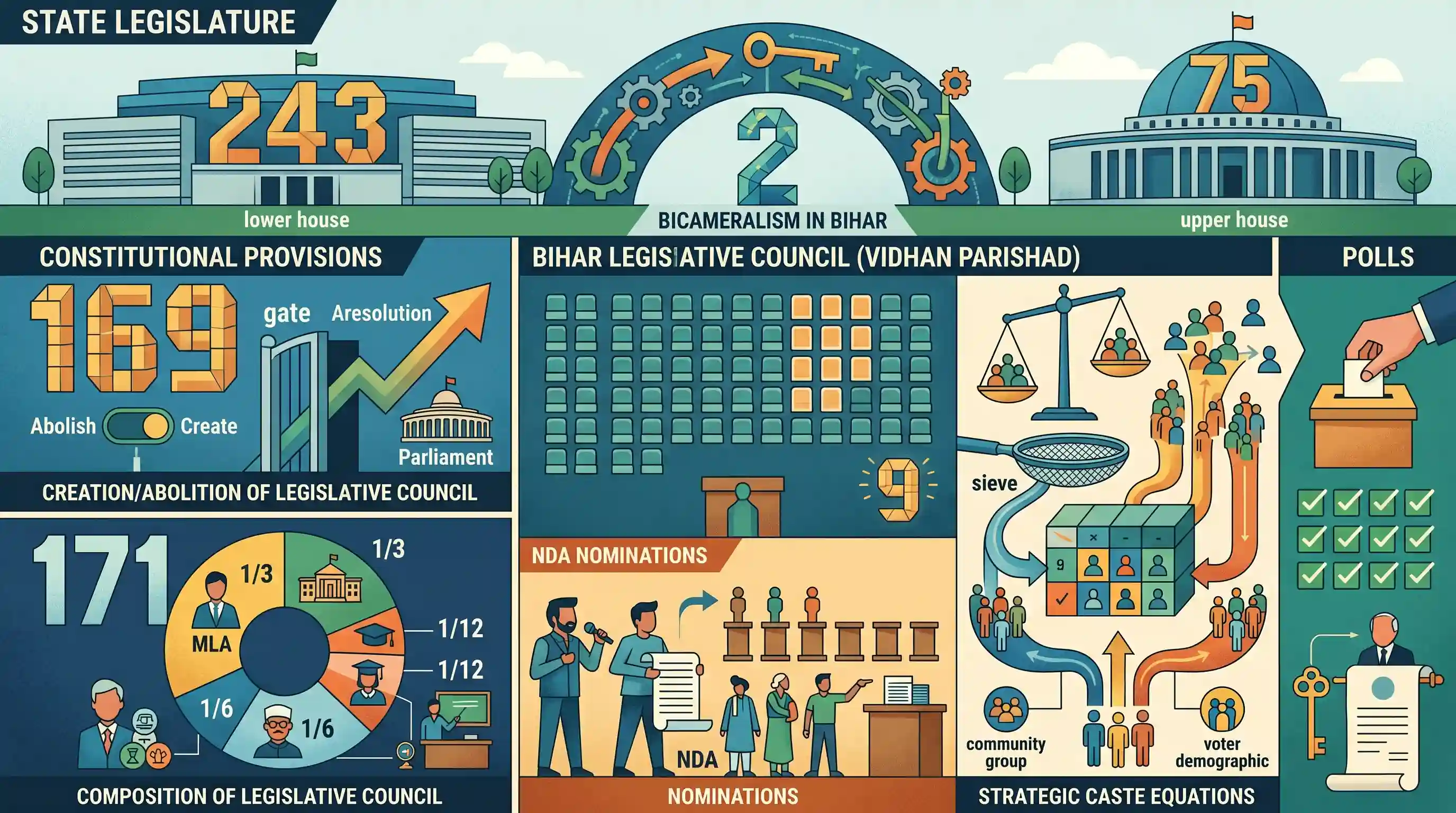
Nine candidates of the ruling National Democratic Alliance (NDA) in Bihar, including Pawan Singh and Nishant Kumar, filed nomination papers for the upcoming biennial polls to fill nine seats in the 75-member Bihar Legislative Council (Vidhan Parishad). The article highlights the strategic candidate selections targeting various caste equations (including EBCs and OBCs) ahead of the polls, set against the backdrop of Bihar’s bicameral legislative history and constitutional framework.
Key Points
- Biennial polls are scheduled for nine seats of the 75-member Bihar Legislative Council (Vidhan Parishad), with candidate nominations representing a diverse spectrum of political and caste configurations (including EBCs and OBCs).
- Bhojpuri singer Pawan Singh (backed by BJP) and State Minister Nishant Kumar (son of JD(U) president Nitish Kumar) are among the prominent candidates who filed their nominations.
- The Bihar Legislative Council has historical significance: its first sitting was convened on January 20, 1913, and it was converted into a bicameral legislature from unicameral under the Government of India Act 1919.
- Rai Bahadur Satish Chandra served as the first elected Chairman of the Bihar Legislative Council under the Government of India Act 1935.
- Constitutional provisions for the Legislative Council are governed by Article 169 (creation/abolition, which can be done by Parliament via simple majority and doesn't require Article 368 ratification) and Article 171 (composition, limit of 1/3rd of Vidhan Sabha strength and minimum of 40 members).
Important Terms
Bihar Legislative Council (Vidhan Parishad)

The upper house of Bihar’s bicameral state legislature, functioning as a permanent body with 75 members who are indirectly elected or nominated for six-year terms, with one-third retiring every two years.
UPSC context
GS Paper II (Polity) — tests understanding of state bicameralism, legislative composition, and the federal structure of state legislatures.
Constitution of India (Article 169)
A constitutional provision empowering Parliament to create or abolish a state's Legislative Council, provided the state's Legislative Assembly passes a supporting resolution by a special majority.
UPSC context
GS Paper II (Polity) — crucial for understanding the creation, abolition, and constitutional limits of state second chambers.
Constitution of India (Article 171)
A constitutional article detailing the composition of State Legislative Councils, setting membership limits, and outlining indirect election and nomination procedures for members.
UPSC context
GS Paper II (Polity) — tests details on state legislative composition and the representation of local bodies, teachers, and graduates.
Government of India Act 1935
A landmark British colonial act that granted provincial autonomy, abolished provincial dyarchy, and introduced bicameral legislatures in six provinces, including Bihar, laying groundwork for India’s future Constitution.
UPSC context
GS Paper I (Modern History) & GS II (Polity) — tests the evolution of federalism and constitutional provisions in India.
Bihar Legislative Assembly (Vidhan Sabha)
The directly elected lower house of Bihar’s legislature, consisting of 243 members elected through first-past-the-post voting for five-year terms, holding primary power over ordinary and money bills.
UPSC context
GS Paper II (Polity) — essential for studying representative democracy, election processes, and the division of legislative authority.
Prelims Trap
Parliament must pass a constitutional amendment under Article 368 with a special majority to create or abolish a Legislative Council.
While the state assembly must pass the resolution by a special majority, Parliament's enacting law requires only a simple majority. It is explicitly not deemed a constitutional amendment under Article 368.
Static Concepts Connected
How do State Legislative Councils differ from the Rajya Sabha in composition and tenure?
- Size and strength: Legislative Council size is capped at one-third of the Legislative Assembly strength (minimum 40), unlike the fixed limit of 250 for the Rajya Sabha.
- Nomination fields: Governors nominate one-sixth of members including 'Cooperative Movement' expertise, a category notably absent from Presidential nominations to the Rajya Sabha under Article 80.
- Abolition vs permanence: Unlike the Rajya Sabha which cannot be dissolved, a Legislative Council can be entirely abolished by Parliament using the Article 169 mechanism.
How did the Government of India Act 1935 restructure provincial legislatures?
- Provincial bicameralism: The Act introduced bicameralism in 6 out of 11 British Indian provinces, including Bengal, Bombay, Madras, Bihar, Assam, and the United Provinces.
- Provincial autonomy: It established provincial autonomy by dividing legislative powers into Federal, Provincial, and Concurrent lists, abolishing dyarchy at the provincial level.
Cross-Topic Patterns
Cooperative societies and legislative nominations
The inclusion of 'cooperative movement' under Article 171 nominations links state polity directly to the 97th Constitutional Amendment and Article 43B Directive Principles.
Colonial legacy of provincial bicameralism
The 1935 Act's introduction of bicameralism in six provinces shaped modern India's asymmetric state legislative structures, directly influencing contemporary state-level federal dynamics.

Art 169 simple-majority rule and Art 171 'Cooperative Movement' exception are highly likely targets for multi-statement polity MCQs.
Linked PYQs · 4
Linked PYQs · 4
- 2022BPSC_PRELIMSGS1
In which year was the first sitting of the Bihar Legislative Council convened?
- 2024-IBPSC_PRELIMSGS1
Which of the following Acts converted Unicameral Legislature of Bihar into Bicameral : Bihar Legislative Assembly and Bihar Legislative Council?
- 2024-IBPSC_PRELIMSGS1
Under the Government of India Act 1935, who was the first elected Chairman of Bihar Legislative Council ?
- 2024-IBPSC_PRELIMSGS1
Which of the following are matters on which a constitutional amendment is possible only with the ratification of the legislature of not less than one-half of the states? 1. Election of the President. 2. Representation of States in Parliament. 3. Any of the lists in the 7th Schedule. 4. Abolition of the Legislative Council of a State. Choose the correct answer.
