UPPCL installs nearly ninety lakh smart meters under central scheme
Source:timesofindia ↗
Why It Matters
UPPSC frequently tests schemes related to power distribution, urban/rural infrastructure, and central-state financial transfers for discom reforms (e.g., UDAY, RDSS). Smart meter rollouts in UP are pivotal for assessing utility reforms and operational efficiency.
Summary
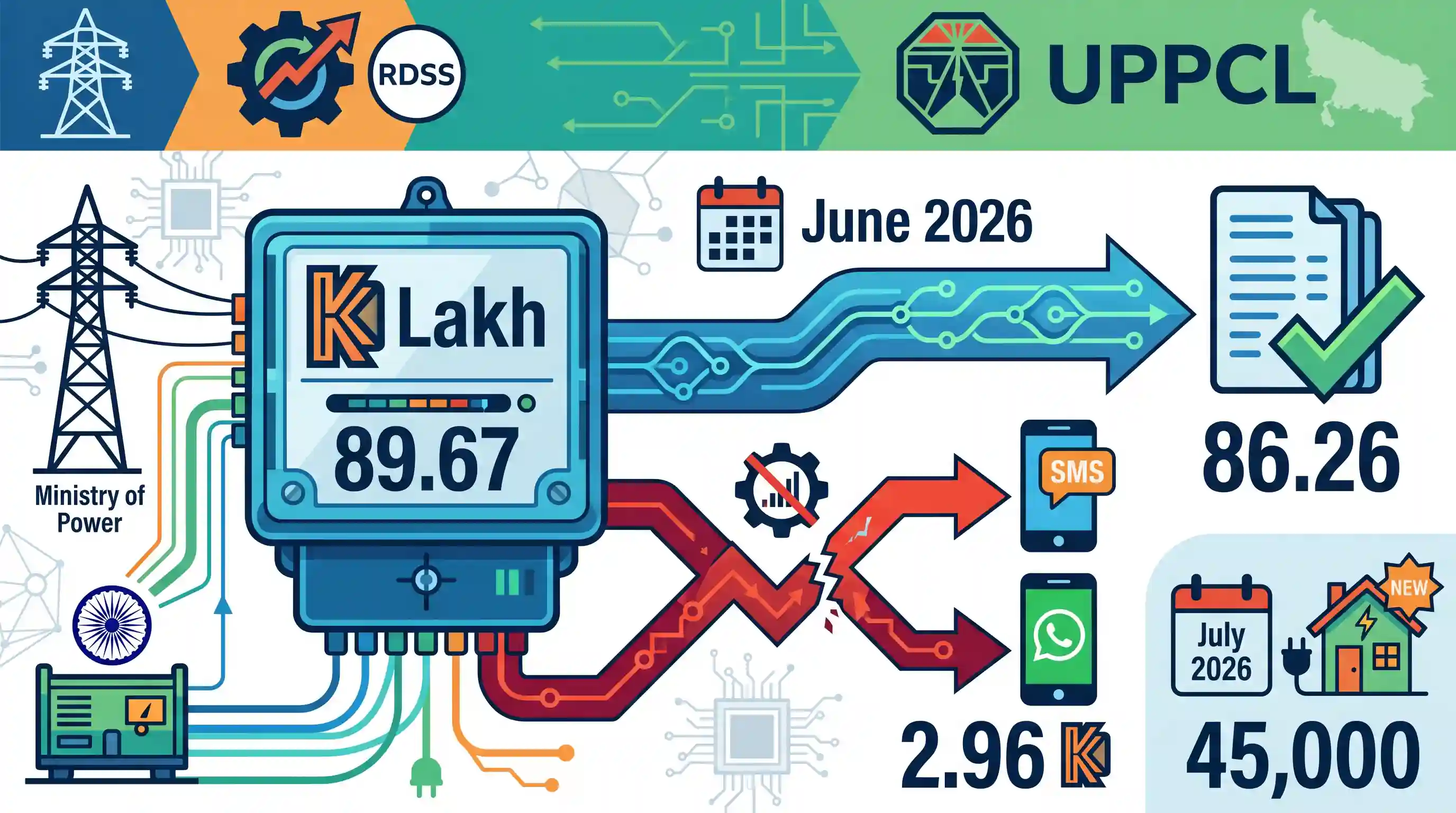
The Uttar Pradesh Power Corporation Ltd (UPPCL) has installed 89.67 lakh smart meters across its power distribution companies (discoms) under the Ministry of Power's Revamped Distribution Sector Scheme (RDSS). Postpaid electricity bills for June 2026 have been generated for 86.26 lakh of these consumers, while alternative billing methods (SMS/WhatsApp) are being utilized for 2.96 lakh consumers due to minor technical and communication glitches in data retrieval. Another 45,000 new connection holders will receive their first bills in July 2026.
Key Points
- UPPCL has successfully installed 89.67 lakh smart meters across its distribution companies (discoms) in Uttar Pradesh.
- The smart meter deployment is being carried out under the Central Government's Revamped Distribution Sector Scheme (RDSS).
- For the month of June 2026, postpaid bills were successfully generated for 86.26 lakh smart meter consumers.
- Due to technical and communication glitches, billing data could not be retrieved automatically for 2.96 lakh consumers, whose bills were sent alternative ways via SMS and WhatsApp.
- Approximately 45,000 consumers with new connections are set to receive their first smart meter bills in July 2026.
Important Terms
Revamped Distribution Sector Scheme (RDSS)

A results-linked Ministry of Power initiative launched in 2021 to improve operational efficiency and financial sustainability of state-owned DISCOMs through prepaid smart metering and infrastructure upgrading.
UPSC context
GS Paper III: Economic Development (Infrastructure, Energy), tests understanding of power-sector reforms and fiscal health of utilities.
Ujwal DISCOM Assurance Yojana (UDAY)
A financial turnaround and debt-restructuring package launched in 2015 by the Government of India to revive and find a permanent solution to the financial stress of state-owned electricity distribution companies.
UPSC context
GS Paper III: Infrastructure (Energy), tests evaluation of landmark schemes and legacy structural issues of power sector utilities.
Power Distribution Companies (DISCOMs)
Public or private-sector utilities responsible for the last-mile delivery of electricity to end consumers, managing local distribution grids, metering, billing, and revenue collection.
UPSC context
GS Paper III: Economic Development (Energy sector), tests knowledge of power value chain, AT&C losses, and privatization challenges.
Uttar Pradesh Power Corporation Ltd (UPPCL)
A state government-owned public sector undertaking responsible for electricity transmission, bulk power procurement, and distribution management through regional subsidiary discoms in Uttar Pradesh.
UPSC context
GS Paper III: Infrastructure (Energy), useful as a case study for studying state-level electricity utility management and regional smart-metering implementation.
Ministry of Power
The union ministry of India responsible for national-level policy formulation, planning, implementation coordination, and project sanctioning in the power generation, transmission, and distribution sectors.
UPSC context
GS Paper II: Executive (Government policies and interventions), tests knowledge of administrative bodies driving infrastructure development and energy security.
Prelims Trap
Under the Revamped Distribution Sector Scheme (RDSS), all installed smart meters must mandatorily operate on a prepaid basis.
While the Smart Meter National Programme initially prioritized prepaid meters, a 2026 Central Electricity Authority (CEA) amendment removed the mandatory prepayment clause, giving states billing flexibility.
Static Concepts Connected
What are AT&C losses and the ACS-ARR gap in power distribution?
- AT&C Losses: Represents the sum of technical losses (transmission/distribution dissipation), commercial losses (theft, billing errors), and collection losses.
- ACS-ARR Gap: The difference between the Average Cost of Supply (ACS) and the Average Revenue Realised (ARR). Zero gap represents complete cost recovery for DISCOMs.
- Advanced Metering (AMI): A two-way communication system (smart meters to utility) enabling real-time billing and load management, distinct from one-way Automatic Meter Reading (AMR).
How does the funding architecture of RDSS differ from legacy schemes like UDAY?
- Performance-Contingency: Unlike UDAY's debt-takeover model, RDSS funding is results-linked; DISCOMs must score at least 60% on pre-qualifying operational metrics to unlock funds.
- Subsumed Schemes: It subsumes previous individual schemes like DDUGJY (rural), IPDS (urban), and Saubhagya (household electrification) into a single unified window.
Cross-Topic Patterns
Cooperative Federalism + Infrastructure Reforms
The friction in UP over prepaid billing highlights how central energy mandates (Concurrent List, Entry 38) face local political-economy challenges, shaping center-state cooperative federalism.
Digital Public Infrastructure + Discom Solvency
Using AMI data networks integrated with consumer communication (SMS/WhatsApp) establishes a micro-level Digital Public Infrastructure (DPI) for utility billing, plugging commercial leakages.

RDSS's shift from mandatory prepayment to state flexibility and the structural parameters of AT&C losses will feature in 2026 GS-3.
Linked PYQs · 1
Linked PYQs · 1
- 2017UPPSC_PRELIMSGS1
Which of the following is not correctly matched?
