Madhya Pradesh Subsidizes Over 88000 EVs Under PM E-DRIVE Scheme
Source:ibef ↗
Why It Matters
India's transition to electric mobility is central to its economic growth and climate commitments. The PM E-DRIVE scheme is a major national initiative, and its performance at the state level (like in Madhya Pradesh) is highly relevant for questions on environmental sustainability, infrastructure, and state-centric economic developments.
Summary
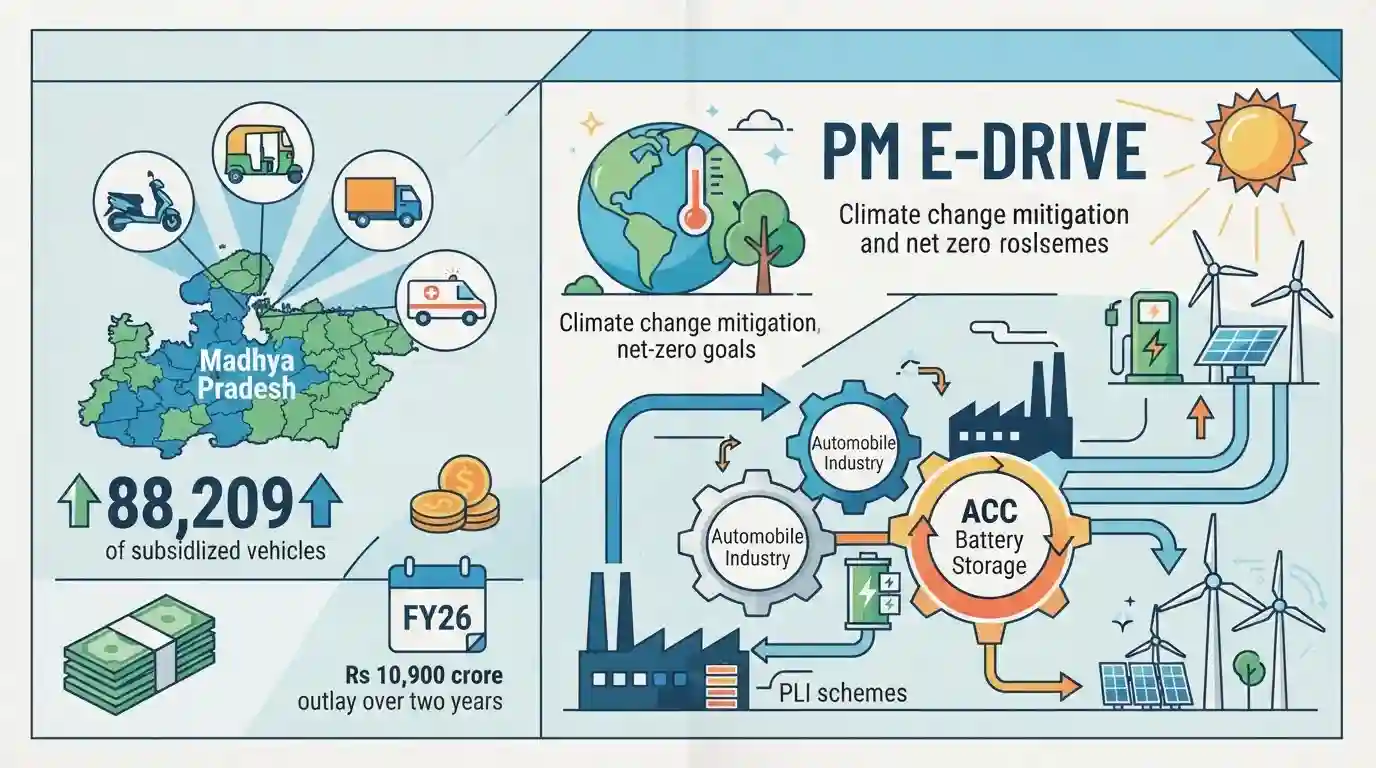
The PM Electric Drive Revolution in Innovative Vehicle Enhancement (PM E-DRIVE) scheme has subsidized 88,209 electric vehicles in Madhya Pradesh in FY26, according to the Ministry of Heavy Industries. With a Rs 10,900 crore outlay over two years, the scheme succeeds FAME II and aims to accelerate the adoption of electric two-wheelers, three-wheelers, trucks, and ambulances. Operating in tandem with the PLI schemes for automobiles and ACC battery storage, the initiative seeks to establish a robust domestic EV ecosystem, supporting India's transition to clean mobility and its net-zero emissions targets.
Key Points
- The PM E-DRIVE scheme subsidized 88,209 electric vehicles in Madhya Pradesh during FY26, highlighting the state's growing EV adoption.
- Operated by the Ministry of Heavy Industries, the PM E-DRIVE scheme has a financial outlay of Rs 10,900 crore over two years and succeeds the FAME II scheme.
- The scheme promotes various EV categories, including e-two-wheelers, e-three-wheelers, e-ambulances, and e-trucks, to reduce fossil fuel dependency.
- The initiative works in synergy with the PLI schemes for Automobiles and Advanced Chemistry Cell (ACC) battery storage to build a comprehensive domestic EV manufacturing ecosystem.
Important Terms
PM E-DRIVE Scheme

A ₹10,900 crore central scheme replacing FAME-II to accelerate EV adoption and public charging infrastructure. It provides targeted subsidies via e-vouchers for electric two/three-wheelers, trucks, and ambulances, explicitly excluding passenger cars.
UPSC context
GS Paper 3 (Infrastructure & Environment). Important for questions on government interventions in clean mobility and climate change mitigation.
FAME India Phase-II
The Faster Adoption and Manufacturing of (Hybrid &) Electric Vehicles Phase-II (2019-2024) was a demand-side incentive program with a ₹11,500 crore outlay to support EV purchases and public charging networks.
UPSC context
GS Paper 3 (Economy). Highly relevant as the foundational precursor to current EV policies; often tested in comparative policy analysis.
PLI Scheme for Automobiles
A performance-linked financial incentive program designed to boost domestic manufacturing of Advanced Automotive Technology (AAT) products, including Zero Emission Vehicles, thereby building local supply chains and generating employment.
UPSC context
GS Paper 3 (Industrial Policy). Crucial for understanding India's 'Aatmanirbhar Bharat' strategy, manufacturing scale-up, and job creation in high-tech sectors.
PLI Scheme for Advanced Chemistry Cell (ACC) Battery Storage
An ₹18,100 crore initiative targeting 50 GWh of domestic manufacturing capacity for advanced battery storage technologies. It aims to reduce import dependency and strengthen India's EV and renewable energy ecosystems.
UPSC context
GS Paper 3 (Science & Tech/Energy). Key to topics on energy security, domestic value addition, and advanced technology indigenization.
Ministry of Heavy Industries
The nodal central ministry responsible for promoting the engineering and capital goods sectors. It directly administers India's flagship automotive and EV initiatives, including PM E-DRIVE, FAME, and auto-sector PLI schemes.
UPSC context
GS Paper 2 (Governance). Prelims often test matching schemes (like PM E-DRIVE or PLI-Auto) to their correct implementing nodal ministry.
Prelims Trap
PM E-DRIVE scheme provides upfront subsidies for all electric vehicles including private four-wheeled passenger cars.
UPSC often tests scheme exclusions. PM E-DRIVE specifically excludes private four-wheeled passenger cars, focusing entirely on mass mobility, 2W, 3W, trucks, and ambulances.
Static Concepts Connected
What are the key parameters of the PLI Scheme for Advanced Chemistry Cell (ACC)?
- Technology-agnostic: Subsidizes battery manufacturing regardless of the specific cell chemistry used (e.g., Li-ion, Sodium-ion, Solid-state).
- DVA Mandate: Beneficiaries must achieve 25% Domestic Value Addition within 2 years, scaling to 60% within 5 years.
- Capacity Target: Aims to build 50 GWh of domestic manufacturing capacity to aggressively cut import reliance.
What distinguishes a Central Sector Scheme from a Centrally Sponsored Scheme?
- Funding structure: Central Sector schemes (like PM E-DRIVE) are 100% funded by the Union Government. Centrally Sponsored schemes share costs with states.
- Implementation agency: Central Sector schemes are implemented directly by Central Ministries/agencies, not by State Governments.
- Subject allocation: Typically formulated on subjects falling under the Union List, whereas Sponsored schemes usually target State List subjects.
Cross-Topic Patterns
EV Subsidies + Vehicle Scrappage Policy
PM E-DRIVE links e-truck incentives directly to a valid scrapping certificate. This integrates the clean EV transition with the circular economy and MoRTH's National Vehicle Scrappage Policy.
Clean Mobility + Critical Minerals vulnerability
The push for domestic ACC battery manufacturing highlights India's strategic vulnerability regarding critical minerals like Lithium and Cobalt, leading to efforts like the Critical Minerals Mission to secure supply chains.

Expect a multi-statement prelims question combining PM E-DRIVE vehicle exclusions, PLI-ACC DVA targets, and scrappage certificate rules.
Linked PYQs · 2
Linked PYQs · 2
- 2025MPPSC_PRELIMSGS1
What is the main goal of the Udayam Kranti Yojna?
- 2023MPPSC_PRELIMSGS1
What is the objective of Tantyia Mama Economic Welfare Scheme (New Scheme)?
