Chennai Climate Change Perception Survey and Urban Adaptation
Source:The Hindu ↗
Why It Matters
It provides crucial, context-specific case study material on the impacts of climate change on Indian coastal megacities. The data regarding public perception and localized regional vulnerabilities within a single city serves as valuable fodder for GS3 answers on urban disaster management and climate adaptation strategies.
Summary
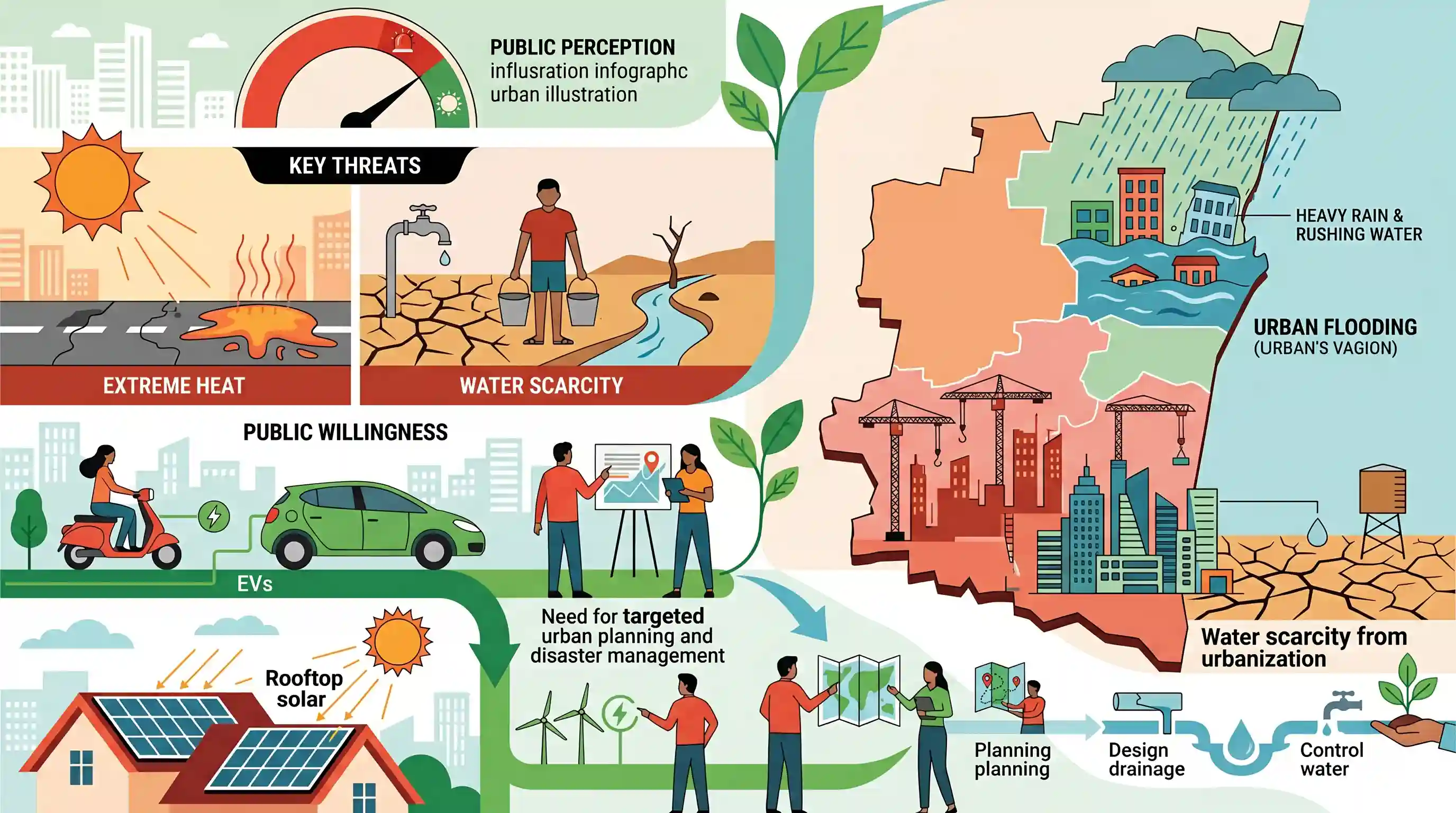
A recent survey conducted by the NGO Climate Trends reveals that a vast majority (85%) of Chennai residents perceive climate change as an immediate threat to their health and the city's infrastructure. The "Climate Change Perception Study," unveiled at the Tamil Nadu Climate Summit 4.0, highlights extreme heat and water scarcity as the dominant hazards. The survey also demonstrates significant public willingness to adopt climate mitigation measures, such as electric vehicles and rooftop solar panels. Additionally, it outlines the region-specific vulnerabilities within Chennai, from flooding in the coastal east to water stress linked to rapid urbanization in the south, emphasizing the need for targeted urban planning and disaster management.
Key Points
- A survey by Climate Trends found that 85% of Chennai residents consider climate change an immediate threat to health and essential infrastructure.
- The 'Climate Change Perception Study' was released during the Tamil Nadu Climate Summit 4.0, indicating the state's growing focus on environmental challenges.
- Extreme heat (80%) and water stress (70%) are the most prevalent climate hazards cited by the city's residents.
- There is strong public support for mitigation strategies, with 75% backing restrictions on polluting vehicles, 70% favoring EV subsidies, and high openness towards rooftop solar.
- Different regions of Chennai face varied climate stresses, such as recurrent flooding in the East, industrial pollution in the North, and water stress driven by rapid urban expansion in the South.
Important Terms
Government of Tamil Nadu

The state executive leading India's sub-national climate action through the 'Tamil Nadu Green Climate Company' and missions focusing on carbon neutrality, wetlands, and coastal restoration.
UPSC context
Relevant for GS Paper II (Governance) and GS III (Environment); illustrates cooperative federalism and state-led climate mitigation models.
Tamil Nadu Climate Summit 4.0
A biennial high-level event in Chennai (4.0 in 2026) that integrates climate action into public policy and coordinates state-wide adaptation strategies across departments.
UPSC context
GS III: Environmental Governance. Tests knowledge of regional platforms for climate diplomacy and sectoral policy integration.
State-level Determined Contributions (SDCs)
State-specific climate goals modeled after Paris Agreement NDCs, designed to reduce greenhouse gas emissions and enhance regional accountability in climate action by 2030.
UPSC context
GS III: Environment (Climate Change). Tests understanding of sub-national policy frameworks that support India’s national climate commitments (Panchamrit).
Climate Change Perception Study
A 2026 survey of 2,000 Chennai residents by 'Climate Trends' mapping public awareness, health risks from extreme heat, and willingness to adopt renewable energy.
UPSC context
GS III: Disaster Management. Highlights the importance of public perception and 'social license' in urban climate resilience planning.
Climate Trends
A research-based consulting initiative and NGO that promotes science-driven communication on environment, air quality, and sustainable development to influence public policy.
UPSC context
GS II: Role of NGOs and Civil Society in influencing environmental policy and public awareness.
Prelims Trap
State-level Determined Contributions (SDCs) are mandated for all Indian states under the National Action Plan on Climate Change (NAPCC).
SDCs are voluntary, state-driven sub-national frameworks (pioneered by states like Tamil Nadu). They are not a mandatory imposition under the central NAPCC or UNFCCC.
Static Concepts Connected
What factors contribute to the Urban Heat Island (UHI) effect in cities like Chennai?
- Albedo reduction: Concrete and asphalt surfaces absorb and retain significantly more solar radiation than natural vegetation.
- Anthropogenic heat: Emissions from vehicles, air conditioners, and industrial activities add trapped, localized heat to the urban atmosphere.
- Canyon effect: Tall, dense building structures block natural wind patterns and trap thermal radiation, preventing nighttime cooling.
What are the key ecological characteristics of the Dugong (Sea Cow)?
- Diet & Habitat: It is a strictly herbivorous marine mammal that relies entirely on seagrass meadows for food.
- Conservation Status: Classified as Vulnerable on the IUCN Red List and protected under Schedule I of the Wildlife (Protection) Act, 1972.
- Distribution: Found in the Gulf of Mannar, Palk Bay, Gulf of Kutch, and Andaman & Nicobar Islands in India.
Cross-Topic Patterns
Sub-national climate diplomacy & NDCs
Tamil Nadu’s push for State-level Determined Contributions (SDCs) mirrors global trends of 'para-diplomacy', where federal units directly align with Paris Agreement goals. This is a prime GS2/GS3 intersection for Mains.
Ward-level disaster micro-zonation
Chennai's varied threats (coastal floods in the East vs. water stress in the rapidly urbanizing South) highlight the UPSC shift from macro-disaster management to localized urban micro-zonation and ward-level action plans.

Expect a 2026 Prelims question on Dugong habitats (Gulf of Mannar) paired with sub-national initiatives like TN-SHORE or State-level DCs.
Linked PYQs · 5
Linked PYQs · 5
- 2024MainsGS3
Flooding in urban areas is an emerging climate-induced disaster. Discuss the causes of this disaster. Mention the features of two such major floods in the last two decades in India. Describe the policies and frameworks in India that aim at tackling such floods.
- 2024MainsGS3
The world is facing an acute shortage of clean and safe freshwater. What are the alternative technologies which can solve this crisis? Briefly discuss any three such technologies citing their key merits and demerits.
- 2017MainsGS3
'Climate change' is a global problem. How India will be affected by climate change? How Himalayan and coastal states of India will be affected by climate change?
- 2021MainsGS1
What are the environmental implications of the reclamation of water bodies into urban land use ? Explain with examples.
- 2023MainsGS1
Comment on the resource potentials of the long coastline of India and highlight the status of natural hazard preparedness in these areas.
