Shimla District Government Schools Lack Water and Fencing Social Audit
Source:hindustantimes ↗
Why It Matters
Provides empirical data (via social audit) on the implementation gaps in rural education infrastructure, making it highly relevant for evaluating schemes like the Sarva Shiksha Abhiyan and the Right to Education (RTE) Act in Mains answers and Prelims governance questions.
Summary
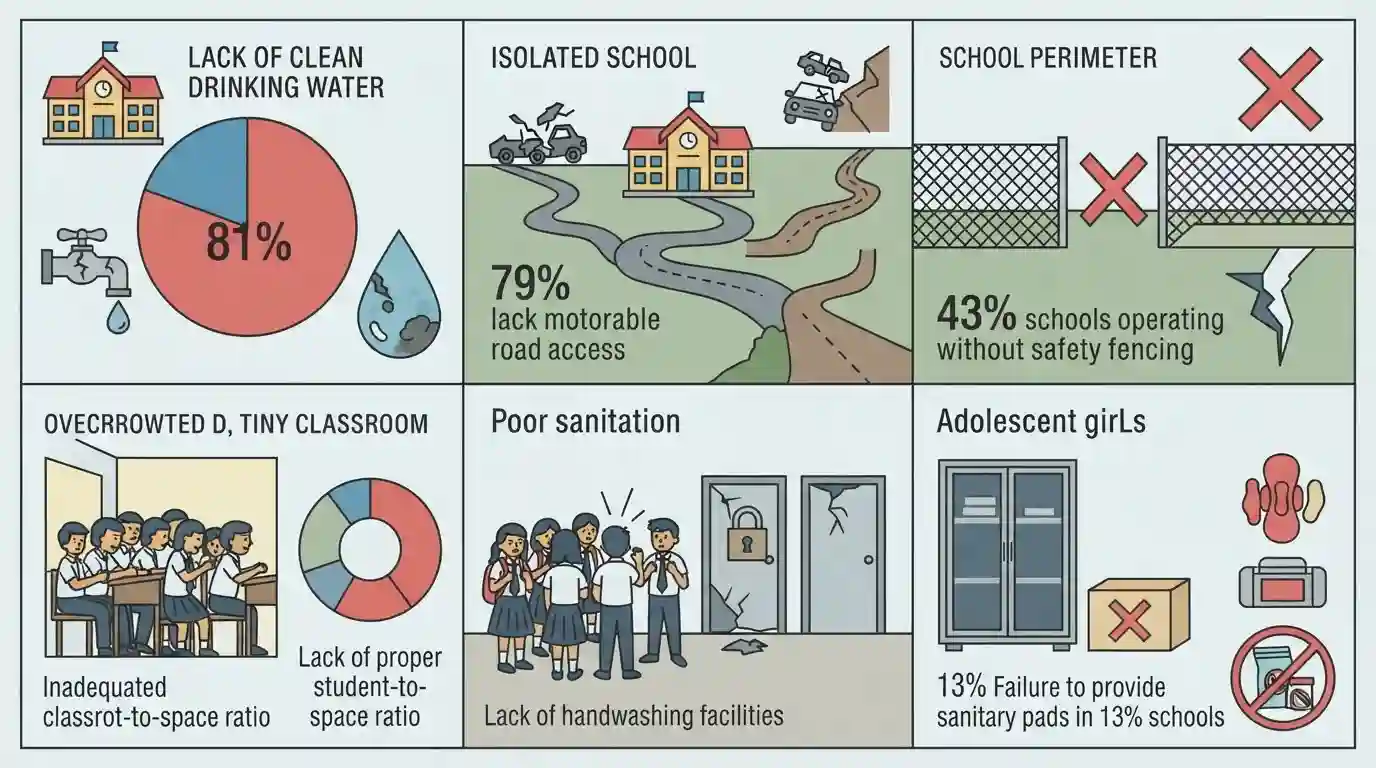
A recent social audit conducted by Himachal Pradesh University on 610 government schools under the Sarva Shiksha Abhiyan in Shimla district has exposed severe infrastructural and safety deficits. The findings reveal that a vast majority of schools lack basic amenities: 81% do not have clean drinking water, 79% lack motorable road access, and 43% operate without safety fencing. Additionally, the audit found inadequate classroom space, absent school safety committees, and poor sanitation facilities, including a failure to provide sanitary pads to adolescent girls in 13% of the schools. These stark deficiencies underscore significant implementation gaps in meeting the standards mandated by the Right to Education (RTE) Act, reflecting broader challenges in rural education infrastructure and governance.
Key Points
- A social audit of 610 government schools under the Sarva Shiksha Abhiyan in Shimla district revealed significant infrastructural deficits.
- Critical findings show that 81% of schools lack clean drinking water and 79% lack motorable road connectivity.
- Safety and sanitation are major concerns, with 43% of schools missing boundary walls, 58% lacking safety committees, and 13% failing to provide sanitary pads to adolescent girls.
- The systemic shortcomings highlight a failure to meet basic standards mandated by the Right to Education (RTE) Act.
Important Terms
Right to Education (RTE) Act

A 2009 legislative act making elementary education a fundamental right for children aged 6–14. It legally mandates minimum school infrastructure standards, including safe drinking water, separate toilets, and safety fencing.
UPSC context
HPAS GS Paper II (Social Justice, Education). Crucial for analyzing infrastructure deficits and implementation gaps in the education sector.
Sarva Shiksha Abhiyan (SSA)
India's flagship programme for universalising elementary education. It provides critical funding to states for upgrading school facilities, hiring teachers, and meeting the foundational infrastructure requirements set by the RTE Act.
UPSC context
HPAS GS Paper II (Government Policies). Evaluated for its success in improving school enrollment, infrastructure, and bridging rural educational divides.
Social Audit
A democratic process where citizens or independent bodies evaluate public programs against their intended goals. In Himachal Pradesh, it exposed severe infrastructural gaps in the execution of the Sarva Shiksha Abhiyan.
UPSC context
HPAS GS Paper II (Governance). A specifically listed syllabus topic testing administrative accountability, transparency, and public participation.
Mid-Day Meal Scheme
A nationwide school meal programme designed to improve the nutritional status of school-age children while simultaneously encouraging higher enrollment and regular attendance in government-run schools.
UPSC context
HPAS GS Paper II (Welfare Schemes). Key to topics covering child nutrition, food security, and integrated educational interventions.
Prelims Trap
The RTE Act 2009 only focuses on teacher-pupil ratios and does not statutorily mandate specific physical infrastructure.
The Schedule of the RTE Act explicitly mandates infrastructural norms, including safe drinking water, separate toilets for girls and boys, and a boundary wall or fencing.
Static Concepts Connected
What physical infrastructure is legally mandated by the RTE Act 2009 Schedule?
- Building Norms: Mandates an all-weather building with at least one classroom per teacher and an office-cum-store.
- Basic Amenities: Schools must provide safe and adequate drinking water facilities to all children.
- Safety & Sanitation: Requires separate toilets for boys and girls, and a boundary wall or fencing for security.
What is the mechanism of a Social Audit in government schemes?
- Public Vigilance: A process where intended beneficiaries and citizens directly review and verify the implementation and expenditures of a program.
- Gram Sabha Role: For rural schemes, the Gram Sabha is typically the primary forum where social audit reports are read and discrepancies discussed.
- Distinct from CAG: Unlike financial audits by the CAG, social audits focus on social impact, equity, and actual grassroots delivery.
Cross-Topic Patterns
RTE meets Swachh Vidyalaya
The absence of separate toilets and sanitary pads directly intersects with the Swachh Vidyalaya Abhiyan and the Menstrual Hygiene Scheme (MHS) objectives for adolescent girls.
Topography vs Universal Access
Himachal Pradesh's mountainous terrain severely complicates the RTE mandate of establishing all-weather road access and neighborhood primary schools, highlighting a clash between central norms and hill geography.

Expect multi-statement questions evaluating RTE Act infrastructure mandates (Section 19) against social audit realities in hill states.
Linked PYQs · 3
Linked PYQs · 3
- 2020HPAS_PRELIMSGS1
The sustainable Development Goal "Good Health and Well being" has shown improvement in India due to:
- 2022HPAS_PRELIMSGS1
Consider the following statements : (1) Telangana State has announced India's first Breakfast scheme for government school students. (2) The term Prompt Corrective Action is related to framework under which Banks with weak financial ratios are watched by RBI. (3) Amongst Union Territories Puducherry has become India's first Swachh Sujal Pradesh. (4) Prime Minister has launched national logistics policy. Which of the above statements are correct ?
- 2024HPAS_PRELIMSGS1
What is the correct order of various social service schemes in India according to year of origin ? (1) Pradhan Mantri Jan Dhan Yojana (2) Sukanya Samriddhi Yojana (3) Rashtriy Swasthya Bima Yojana (4) National Social Assistance Scheme Choose the correct answer from the options given below :
