Nepal Floods: Maharashtra Government Coordinates Tourist Rescue
Source:deccanchronicle ↗
Why It Matters
Demonstrates the vulnerability of the Himalayan region to severe flash floods and landslides, underscoring the importance of disaster management protocols and interstate/international coordination via the State Emergency Operations Centre (SEOC) and the Ministry of Home Affairs during crises.
Summary
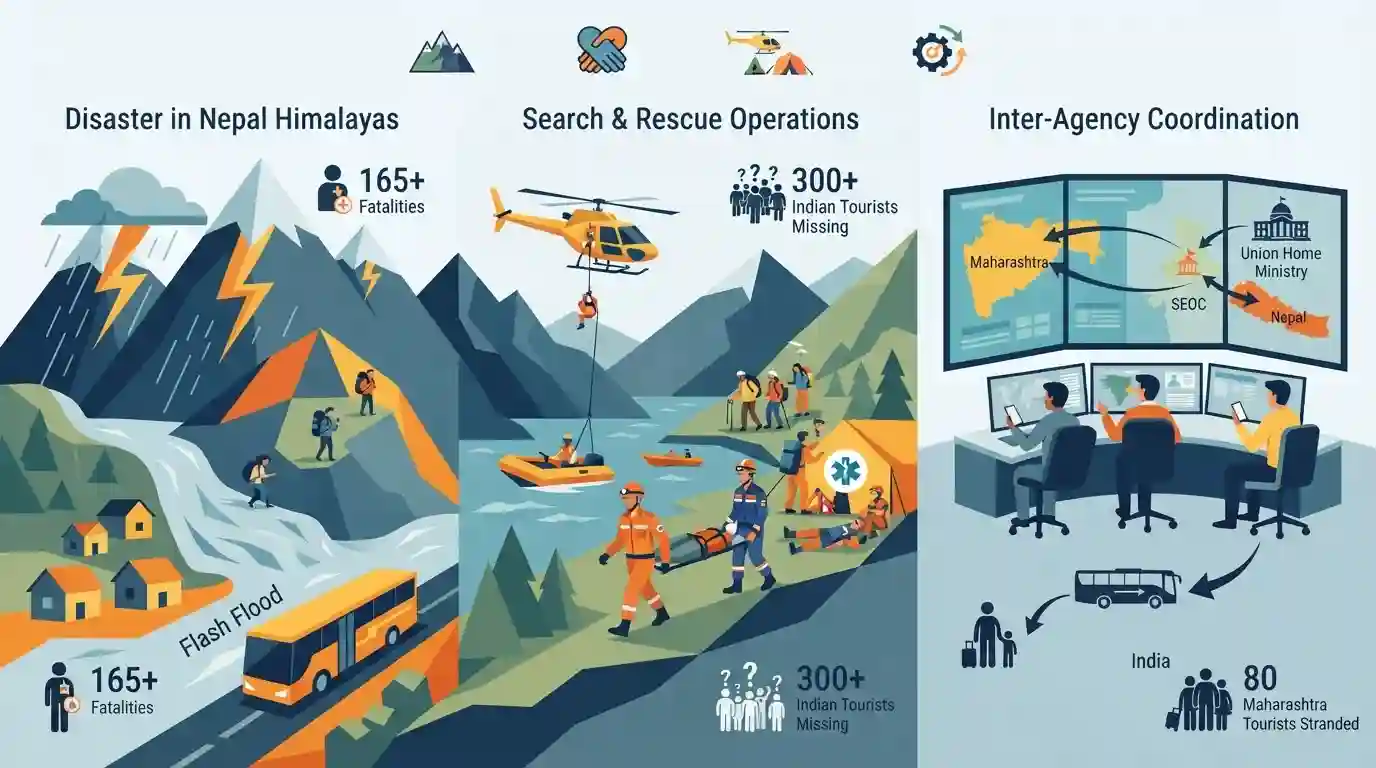
Eighty tourists from Maharashtra are stranded in Nepal after devastating flash floods and landslides struck the Himalayan nation, killing over 165 people and leaving more than 300 Indian tourists missing. The Maharashtra government has mobilized the State Emergency Operations Centre (SEOC), which is working closely with the Union Home Ministry and travel agencies to ensure the safe evacuation of the stranded individuals.
Key Points
- At least 80 tourists from Maharashtra are stranded in flood-affected regions of Nepal following severe flash floods and landslides.
- The disaster in Nepal has claimed over 165 lives, with more than 300 Indian tourists reported missing.
- The Maharashtra State Emergency Operations Centre (SEOC) is actively coordinating rescue and evacuation efforts with the Union Home Ministry's Integrated Control Room and local travel agencies.
- Helplines and help desks have been established to assist stranded tourists and provide real-time updates to their families.
Important Terms
State Emergency Operations Centre (SEOC)

Maharashtra's 24/7 central disaster command hub in Mumbai. It integrates GIS mapping, real-time data, and multi-agency communications to swiftly coordinate state-wide emergency responses, early warnings, and relief efforts.
UPSC context
GS-3 Disaster Management. Tests knowledge of state-level institutional mechanisms, SOPs, and technological integration during crisis interventions.
Union Ministry of Home Affairs
The nodal central ministry for disaster management in India. It shapes national emergency policies, oversees the National Disaster Response Force (NDRF), and coordinates domestic and cross-border relief operations.
UPSC context
GS-2 Polity & GS-3 Disaster Management. Evaluates central-level governance architectures, statutory responsibilities, and central-state coordination during crises.
Flash Floods
Rapid and highly destructive water surges triggered by extreme, short-duration rainfall, avalanches, or glacial bursts. Their speed and impact are severely amplified by the steep, narrow Himalayan topography.
UPSC context
GS-1 Geography & GS-3 Disaster Management. Tests knowledge of extreme weather events, natural hazards, and Himalayan geographic vulnerability.
Landslides
The rapid downward movement of rock, soil, and debris. In the geologically young and fragile Himalayas, they are frequently triggered by heavy rains, flash floods, or tectonic activity.
UPSC context
GS-1 Physical Geography & GS-3 Disaster Management. Covers mass-wasting processes, ecological fragility, and infrastructure challenges in mountainous regions.
Prelims Trap
State Disaster Response Forces (SDRF) are mandated to independently conduct overseas rescue operations for state residents.
State agencies (SDRF/SEOC) lack jurisdiction for overseas evacuations. They only coordinate data and communications; the Union Government (MEA/MHA) executes the international response.
Static Concepts Connected
Why are the Himalayas highly susceptible to landslides and flash floods?
- Tectonic instability: They are young fold mountains still evolving due to the ongoing collision of the Indo-Australian and Eurasian tectonic plates.
- Steep gradients: High relief and steep slopes naturally increase the velocity of water runoff and the likelihood of mass wasting.
- Anthropogenic pressure: Unplanned infrastructure construction, tunneling for hydropower, and deforestation aggravate the natural fragility of the terrain.
What is the mandate of a State Emergency Operations Centre (SEOC)?
- Command hub: Serves as the nodal control room coordinating disaster response between the Centre (MHA/NDMA) and District level (DEOC).
- Crisis communication: Operates 24/7 to manage early warnings, real-time data tracking, public helplines, and state-wide resource mobilization.
Cross-Topic Patterns
Disaster Diplomacy & Overseas Evacuations
Links state-level SEOC coordination with central MEA/MHA operations, recalling historical India-Nepal rescue missions like Operation Maitri (2015).
Himalayan Geomorphology & Climate Change
Connects shifting monsoon patterns and extreme weather events with the inherent structural instability of young fold mountains.

Expect questions linking Himalayan geomorphology (landslides) to institutional frameworks of SEOC-MHA coordination in disaster response.
Linked PYQs · 2
Linked PYQs · 2
- 2026MPSC_PRELIMSGS1
Match the Regional divisions of Himalayas (List - I) with their West-East Extension (List - II). List - I (Regional Divisions of Himalayas) (a) The Punjab Himalayas (b) The Kumaon Himalayas (c) The Nepal Himalayas (d) The Assam Himalayas List - II (West-East Extension) (i) Sutlej to Kali (ii) Kali to Tista (iii) Tista to Brahmaputra (iv) Indus to Sutlej Answer Options :
- 2023MPSC_PRELIMSGS1
Observe the following statements : A. There is loss of bio-diversity due to dumping of toxic waste into soil. B. Deforestation is responsible for frequent floods in river. C. Fransisco Mendez was known as 'Amazon Gandhi' due to his work in energy field.
