International Flight Cancellations at Delhi Airport
Source:Indian Express ↗
Why It Matters
The article provides a practical case study on how global geopolitical tensions (Iran-Israel conflict) directly impact domestic critical infrastructure (IGIA). It is relevant for GS2 (International Relations) and GS3 (Infrastructure, Economy, and Disaster Management), showcasing real-time crisis response protocols at major transportation hubs.
Summary
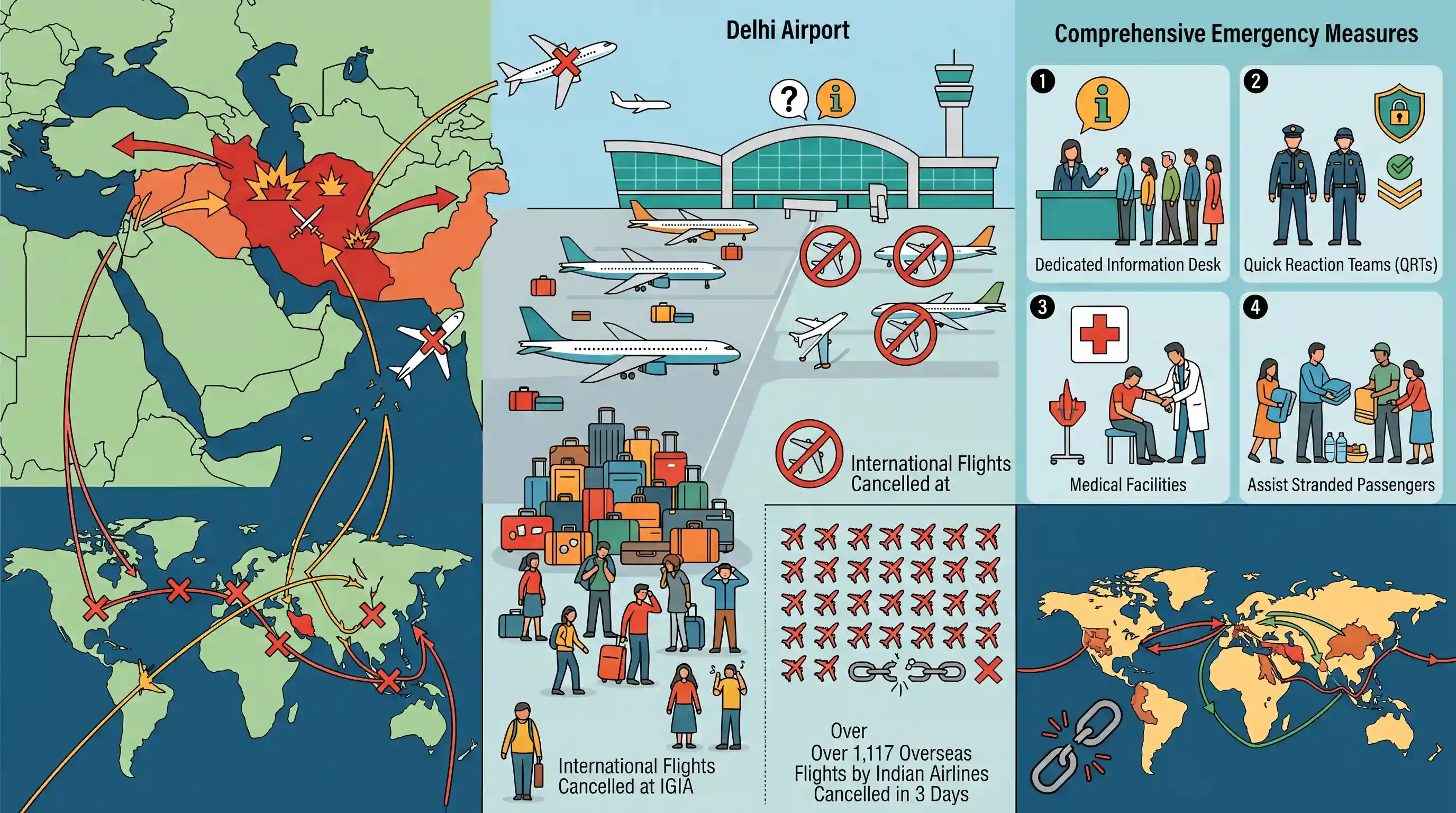
Due to the escalating conflict between Iran and Israel in the Middle East, global flight operations have faced severe disruptions, leading to the cancellation of 80 international flights at Delhi's Indira Gandhi International Airport (IGIA). In response to the crisis, Delhi International Airport Limited (DIAL) has deployed comprehensive emergency measures, including dedicated information desks, Quick Reaction Teams (QRTs), and medical facilities, to assist stranded passengers. Over 1,117 overseas flights by Indian airlines have been cancelled in just three days, underscoring the broader vulnerabilities of civil aviation infrastructure and global transport routes to regional geopolitical instability.
Key Points
- Escalating tensions between Iran and Israel have led to airspace closures, resulting in the cancellation of 80 international flights at Delhi's IGIA.
- Indian airlines have cancelled a total of 1,117 overseas flights over the past three days due to the Middle East crisis.
- Delhi International Airport Limited (DIAL) has implemented extensive emergency measures, including 24/7 information desks, Quick Reaction Teams (QRTs), and dedicated medical facilities.
- The situation highlights the vulnerability of the aviation sector and global transport networks to regional geopolitical conflicts.
Important Terms
Delhi International Airport Limited (DIAL)

A Public-Private Partnership (PPP) joint venture between GMR Group and Airports Authority of India, responsible for the operation, management, and expansion of Delhi's Indira Gandhi International Airport.
UPSC context
GS Paper 3: Infrastructure; tests understanding of PPP models and the management of critical national transportation hubs.
Civil Aviation Infrastructure
The physical and organizational systems, including airports, air traffic control, and navigation services, that facilitate commercial and private flight operations within a country.
UPSC context
GS Paper 3: Infrastructure and Economy; relevant for discussing connectivity, UDAN scheme, and logistics efficiency.
Quick Reaction Teams (QRTs)
Specialized, highly trained units designed for rapid deployment to assess, contain, and mitigate security threats or emergencies, often stationed at high-risk locations like airports.
UPSC context
GS Paper 3: Internal Security and Disaster Management; focuses on first-responder mechanisms for critical infrastructure protection.
Geopolitics of West Asia
Strategic and political interactions between states in the Middle East, currently centered on conflicts involving Iran and Israel that impact global energy security and transport routes.
UPSC context
GS Paper 2: International Relations; tests impacts of regional instability on India’s interests and global connectivity.
Global Supply Chain Disruptions
Severe breaks in the worldwide flow of goods and services caused by regional conflicts, natural disasters, or technical failures, leading to economic volatility and delays.
UPSC context
GS Paper 3: Economy; important for analyzing external shocks to trade, inflation, and energy security.
Prelims Trap
ICAO can mandate member states to keep territorial airspace open for civilian flights during regional conflicts.
Article 1 of the Chicago Convention (1944) guarantees complete and exclusive sovereignty to states over their territorial airspace; no international body can override this.
Static Concepts Connected
How is airspace sovereignty governed under international law during regional conflicts?
- Chicago Convention 1944: Article 1 grants every State complete and exclusive sovereignty over the airspace above its territory.
- Right to close: States can unilaterally restrict or close their airspace for military or national security reasons without international approval.
- Transit rights: Commercial overflights depend on 'Freedoms of the Air' agreements, which states can suspend during crises.
How are major Indian airports like IGIA structured under PPP?
- Joint Venture model: Operated by entities like DIAL, a joint venture between the Airports Authority of India (AAI) and private consortia.
- BOT framework: Follows the Build-Operate-Transfer model where private groups modernize and operate the airport for a set concession period.
- Revenue sharing: The private operator shares a predetermined percentage of gross revenue with the government-owned AAI.
Cross-Topic Patterns
Airspace chokepoints & fuel economics
The 2019 Pakistan airspace closure already made Indian aviation structurally dependent on West Asian corridors. Middle East conflicts force longer detours, inflating aviation turbine fuel (ATF) costs and impacting sector profitability.
Map reading: The Levant region
Geopolitical instability makes Israel's borders (Lebanon, Syria, Jordan, Egypt) and adjacent water bodies (Mediterranean, Red Sea, Gulf of Aqaba) highly probable targets for UPSC geography mapping questions.

Expect a multi-statement map question linking Levant border countries with airspace closures or major transport corridors (IMEC) in 2026.
Linked PYQs · 4
Linked PYQs · 4
- 2025MainsGS2
"Energy security constitutes the dominant kingpin of India's foreign policy, and is linked with India's overarching influence in Middle Eastern countries.” How would you integrate energy security with India's foreign policy trajectories in the coming years?
- 2017MainsGS3
Examine the development of Airports in India through joint ventures under Public-Private Partnership (PPP) model. What are the challenges faced by the authorities in this regard?
- 2003PrelimsGS1
Israel has common borders with
- 2013MainsGS3
How important are vulnerability and risk assessment for pre-disaster management ? As an administrator, what are key areas that you would focus on in a Disaster Management System.
