Jaipur Illegal Fireworks Factory Blast Triggers Safety Concerns
Source:times-of-india ↗
Why It Matters
This tragedy highlights the risks of hazardous industrial units operating covertly in residential zones. It brings into focus the enforcement of the Jaipur Development Authority (JDA) Act, 1982 and safety laws like the Explosives Act, which are essential topics for understanding municipal administration, disaster risk reduction, and industrial regulations in Rajasthan.
Summary
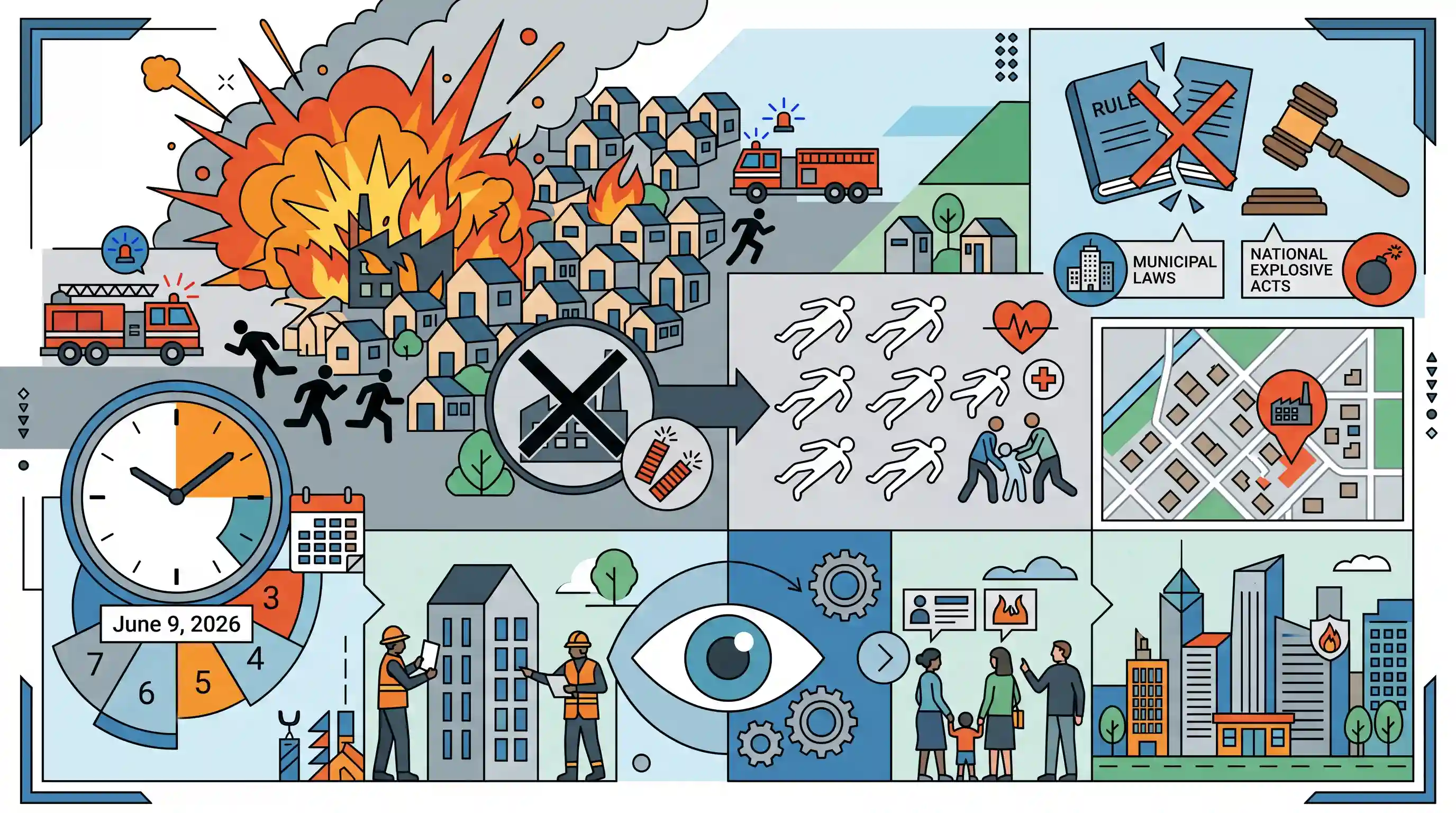
On June 9, 2026, a tragic fire at an unlicensed firecracker manufacturing and storage facility in Jaipur's residential Khoh Nagoriyan area triggered massive explosions, killing eight people and severely injuring another. The unit was operated covertly in a tightly packed residential zone, violating municipal planning guidelines under the Jaipur Development Authority (JDA) Act and national safety laws like the Explosives Act. The disaster has prompted serious concerns over local administrative oversight, hazard detection, and urban safety regulations in Rajasthan.
Key Points
- On June 9, 2026, a major fire and subsequent explosions at an illegal fireworks factory and warehouse in the Talai area of Khoh Nagoriyan, Jaipur, resulted in 8 deaths and 1 severe injury.
- The hazardous unit was operating illegally in a densely populated residential area without any license, zoning permission, or the knowledge of local police and district administration.
- Workers at the facility were filling gunpowder into prefabricated firecracker shells, with finished fireworks intended for transport outside of Jaipur.
- Jaipur Police Commissioner Sachin Mittal and senior administration officials supervised the rescue operations, launching an investigation into land-use violations, supply chains, and safety lapses.
- The incident raises critical issues regarding urban zoning enforcement, industrial fire safety, and regulatory compliance under local development authorities.
Important Terms
Explosives Act, 1884

A central colonial-era legislation in India that regulates the manufacture, possession, use, sale, transport, import, and export of explosives to ensure public safety and prevent hazardous accidents.
UPSC context
GS Paper II (Polity & Governance) and GS Paper III (Disaster Management); tests knowledge of industrial safety and regulatory frameworks.
Explosives Rules, 2008
Detailed regulatory guidelines framed under the Explosives Act, 1884, administered by the Petroleum and Explosives Safety Organisation (PESO) to enforce licensing, storage, and handling standards for hazardous materials.
UPSC context
GS Paper III (Disaster Management & Industrial Safety); tests understanding of administrative mechanisms for hazardous substance control.
Disaster Management Act, 2005
A comprehensive national law that establishes institutional frameworks, including the NDMA and SDMAs, to coordinate proactive disaster preparedness, mitigation, capacity-building, and response across India.
UPSC context
GS Paper III (Disaster Management); tests understanding of legal structures for managing natural and man-made disasters.
Jaipur Development Authority Act, 1982
A state law of Rajasthan that established the Jaipur Development Authority (JDA) to plan, coordinate, and supervise urban growth, zoning regulations, and infrastructure development in the Jaipur Region.
UPSC context
GS Paper II (Urban Governance); tests knowledge of state-level urban planning bodies and municipal regulatory frameworks.
District Administration
The primary unit of field administration in India, headed by the District Magistrate or Collector, responsible for maintaining law and order, land administration, and coordinating disaster management at the grassroots.
UPSC context
GS Paper II (Polity and Governance); tests understanding of local administration, executive functions, and grassroots implementation.
Prelims Trap
The Petroleum and Explosives Safety Organisation (PESO) operates under the Ministry of Petroleum and Natural Gas.
Despite its name, PESO is a nodal agency functioning under the DPIIT, Ministry of Commerce and Industry, not the Ministry of Petroleum.
Static Concepts Connected
What is the constitutional and regulatory framework governing "Fire Services" in India?
- Constitutional Entry: Listed under Entry 7 of the Twelfth Schedule (Article 243W), making it a municipal function under urban local bodies.
- State Subject: Fire services fall under the State List (List II) of the Seventh Schedule, meaning states enact their own regulatory laws.
- Recommendatory Standard: Part 4 of the National Building Code (NBC) 2016 by BIS provides guidelines on fire safety but requires state adoption to be legally binding.
What is the Petroleum and Explosives Safety Organisation (PESO) and its mandate?
- Administrative Control: Acts as the nodal agency under the DPIIT, Ministry of Commerce and Industry, administering the Explosives Act 1884.
- Regulatory Mandate: Approves and licenses the manufacture, storage, and transport of hazardous substances, compressed gases, and explosives.
- Green Crackers: Collaborates with CSIR-NEERI to certify formulations of reduced-emission green firecrackers to control environmental pollution.
Cross-Topic Patterns
Urban planning and informal economies
Weak enforcement of municipal zoning laws pushes hazardous chemical manufacturing into dense residential areas, linking urban governance failures to disaster vulnerability.
Devolution of municipal powers
The fire exposes structural gaps in implementing the 74th Amendment, where fire services remain underfunded and poorly integrated into local urban bodies.

PESO's administrative ministry and the devolution of fire services under the 12th Schedule will likely feature as a conceptual Prelims MCQ.
Linked PYQs · 2
Linked PYQs · 2
- 2024RPSC_PRELIMSGS1
By which Act, the Jaipur Development Authority was established?
- 2025RPSC_PRELIMSGS1
By which Act was the Jaipur Development Authority established?
