Maharashtra Active Companies Registration and Corporate Status
Source:theprint ↗
Why It Matters
The interplay between company registration statistics, corporate governance (striking off defunct firms), and hard infrastructure (transport/logistics in industrial hubs) directly impacts state economic growth and employment. This reflects GS3 themes of industrial policy, infrastructure, and ease of doing business.
Summary
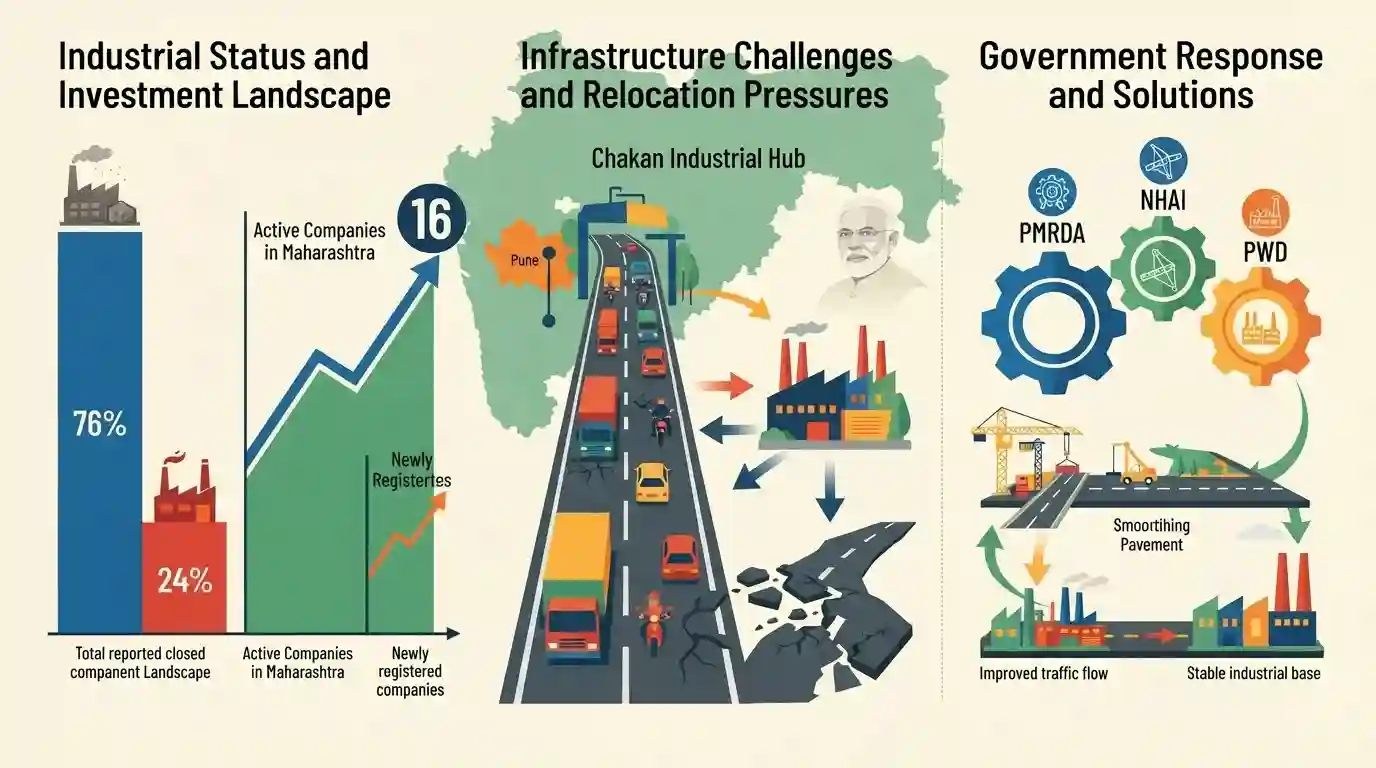
Deputy Chief Minister Devendra Fadnavis addressed concerns over industrial closures by stating that 76% of the 36,000 closed companies in Maharashtra were defunct entities that never commenced operations. Despite these closures, Maharashtra remains the top state for business, boasting the highest number of active companies (over 3.96 lakh) and seeing 41,525 new registrations in 2025-26. However, localized infrastructure deficits, notably traffic congestion and poor road conditions in Pune’s Chakan industrial hub, have prompted around 20 manufacturing firms to contemplate relocation, drawing criticism from opposition leaders. The government has pledged inter-agency coordination (involving PMRDA, NHAI, and PWD) to resolve the Chakan infrastructure crisis and secure the manufacturing base.
Key Points
- Maharashtra has the highest number of active companies in India, with over 3.96 lakh active firms, outperforming Delhi and Uttar Pradesh.
- Of the 36,000+ companies that closed down in Maharashtra, roughly 76% were defunct and never actually started operations.
- The closure figures follow Ministry of Corporate Affairs norms where an average of 20,000 to 22,000 companies close annually across India, mostly due to being defunct, amalgamated, or dissolved.
- In 2025-26 alone, Maharashtra registered the highest number of new companies (41,525) in the country.
- Concerns have emerged in the Chakan industrial area in Pune, where around 20 companies are reportedly threatening to relocate due to persistent infrastructure issues, including traffic, pollution, and poor roads.
- The state government plans to convene a meeting with PMRDA, MIDC, PWD, NHAI, and local industries to resolve the infrastructure bottleneck in Chakan.
Important Terms
Ministry of Corporate Affairs

The Indian government ministry regulating the corporate sector. It administers the Companies Act and the Insolvency and Bankruptcy Code, and oversees statutory bodies like the Competition Commission of India to ensure lawful business functioning.
UPSC context
GS Paper 2 (Governance). Crucial for topics covering corporate governance, regulatory frameworks, and ease of doing business in India.
Pune Metropolitan Region Development Authority (PMRDA)
A statutory urban planning and development authority established in 2015 by the Maharashtra government. It manages infrastructure, regional planning, and sustainable urban expansion for the Pune Metropolitan Region outside core city limits.
UPSC context
GS Paper 1 & 3 (Urbanization, Infrastructure). Highlights regional planning challenges, urban sprawl management, and coordinated infrastructure development.
National Highways Authority of India (NHAI)
An autonomous agency under the Ministry of Road Transport and Highways, established in 1995. It develops, manages, and maintains India's national highways and implements major highway infrastructure projects.
UPSC context
GS Paper 3 (Infrastructure). Essential for questions on road transport, infrastructure bottlenecks, and PPP investment models in highway development.
Public Works Department (PWD)
A state government department responsible for the planning, construction, and maintenance of public infrastructure, including state highways, local roads, bridges, and government buildings.
UPSC context
GS Paper 2 & 3 (Governance, Infrastructure). Relevant for understanding state-level infrastructure execution, local connectivity, and inter-departmental coordination challenges.
Prelims Trap
"The Companies Act, 2013 legally defines and regulates both 'shell' and 'dormant' companies."
While a "dormant company" is legally recognized under Section 455 of the Companies Act, 2013, the term "shell company" has no official legal definition under the Act.
Static Concepts Connected
What is C-PACE and how does it relate to company closures?
- C-PACE: Centre for Processing Accelerated Corporate Exit, established by the Ministry of Corporate Affairs (MCA).
- Mandate: It centralizes and expedites the striking-off process for defunct companies from the Registrar of Companies (RoC).
- Ease of Doing Business: It reduces registry burden and ensures a hassle-free, timely exit for businesses that never commenced operations.
How does Weber's Theory of Industrial Location explain the Chakan crisis?
- Agglomeration Economies: Industries initially cluster to benefit from shared infrastructure, labor, and ancillary services, lowering overall costs.
- Diseconomies of Scale: Overcrowding eventually leads to traffic congestion, high rents, and pollution, increasing operational costs for factories.
- Deglomeration: Firms threaten to relocate to escape these spatial frictions, perfectly illustrating the deglomeration phase of Weber's model.
Cross-Topic Patterns
Ease of Entry vs Ease of Exit
While states compete on fast-tracking registrations, MCA's C-PACE and the IBC highlight that 'ease of exit' for defunct/failing firms is equally crucial for efficient capital reallocation.
Agglomeration to Deglomeration
Relocations threatened in Pune's Chakan highlight the spatial limits of industrial clusters, linking Economic Geography (Weber’s deglomeration theory) to GS3 urban infrastructure deficits.

Prelims 2026 could feature a tricky statement differentiating C-PACE (MCA) for defunct firms vs NCLT (IBC) for insolvent active firms.
Linked PYQs · 3
Linked PYQs · 3
- 2023MPSC_PRELIMSGS1
In his theory of industrial location Alfred Weber tried to establish the pivotal role of which of the following factors ?
- 2025MPSC_PRELIMSGS1
Which of the following is/are reason/s for the existence of poverty even after seven decades of Independence in India ? A. More dependency of Economy on the agricultural sector. B. Shortage of employment opportunities in manufacturing sector. C. High growth rate of agriculture in comparison with developed countries.
- 2026MPSC_PRELIMSGS1
With reference to the 'National Policy on the Voluntary Sector-2007' consider the following statements regarding the characteristics of Voluntary Organization (VOs) : (a) These organizations are private in nature and separate from the Government. (b) They do not return profits generated to their owners or directors. (c) They are self-governing and are controlled by the Government. (d) They are registered organizations or informal groups with defined aims and objectives. Which of the statements given above is/are correct ?
