Financial Distress and Suicide Trends in Gujarat
Source:Indian Express ↗
Why It Matters
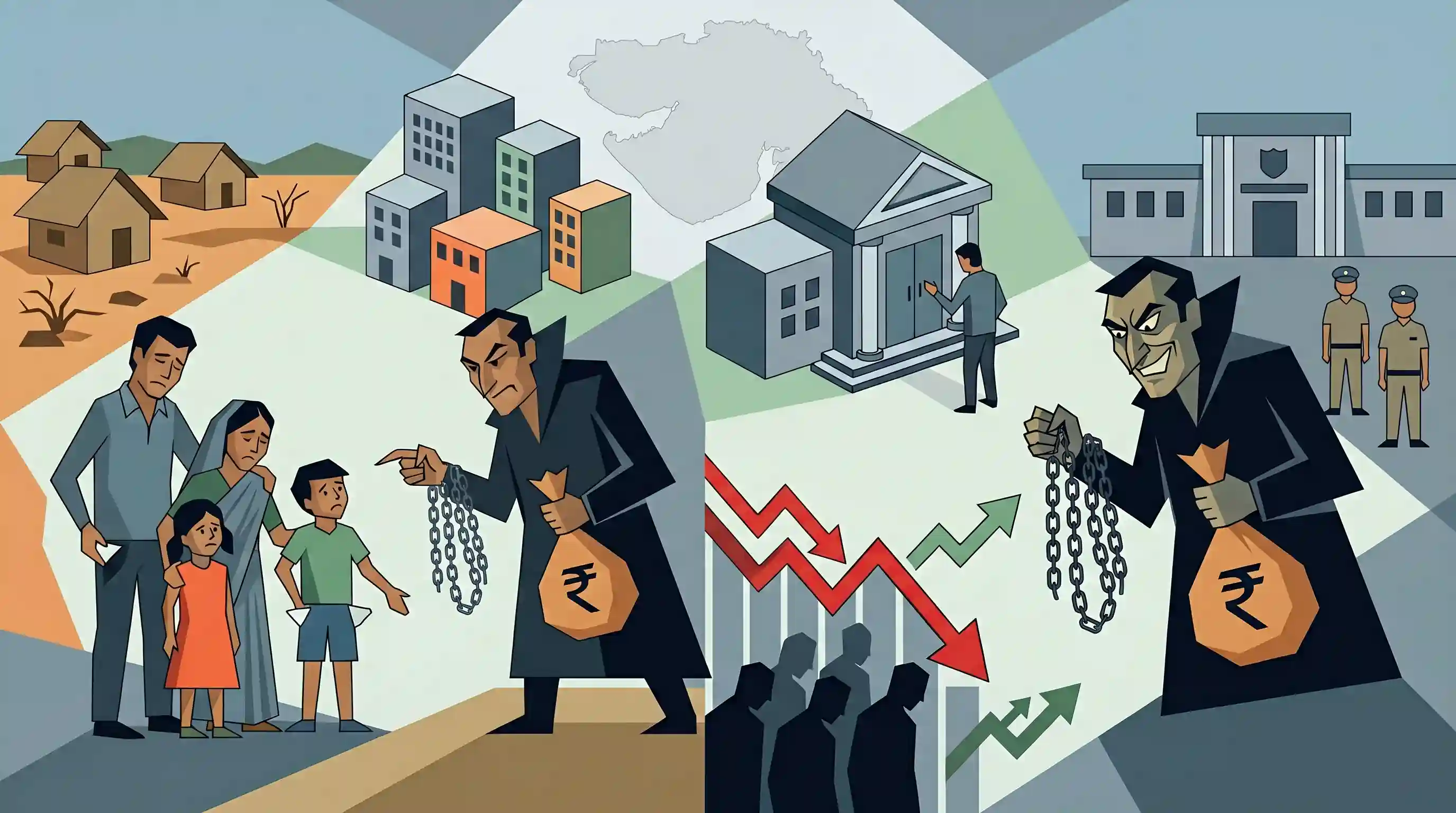
The article highlights the intersection of socio-economic vulnerability, informal credit dependence, and extreme psychological distress. For UPSC aspirants, it serves as a critical case study on how gaps in financial inclusion (reliance on 'loan mafias' instead of institutional credit) manifest as a severe social crisis (suicides and family tragedies), linking GS1 (Social Issues) and GS3 (Economy/Inclusive Growth).
Summary
The Gujarat Pradesh Congress Committee (GPCC) has raised concerns over the alarming rate of suicides in Gujarat, highlighting that 7,429 individuals took their own lives in the state over the last three years. Leaders attribute these tragedies—including a recent mass suicide by a family in Bagodara—to severe financial constraints and relentless harassment by unregulated moneylenders, often referred to as the 'loan mafia'. The opposition has criticized the state government for failing to curb predatory lending and address underlying socio-economic distress in urban and rural areas.
Key Points
- Gujarat reported an alarming 7,429 suicide deaths over the past three years, heavily concentrated in major urban centers like Ahmedabad, Surat, and Rajkot.
- The Gujarat Pradesh Congress Committee (GPCC) attributed these suicides primarily to severe financial distress and harassment by unregulated informal moneylenders, termed the 'loan mafia'.
- The issue was brought into sharp focus following an alleged 'mass suicide' of an entire family in Bagodara.
- The political opposition criticized the state government for failing to protect vulnerable households from predatory lending practices and socio-economic deprivation.
Important Terms
National Crime Records Bureau (NCRB)

The central agency under the Ministry of Home Affairs responsible for compiling national crime statistics, including the 'Accidental Deaths and Suicides in India' report.
UPSC context
GS Paper 2 (Governance/Reports); essential for quoting official data on social issues and crime trends.
Financial Inclusion
The process of ensuring access to affordable and timely financial services—like credit, insurance, and savings—to vulnerable groups through formal institutional channels.
UPSC context
GS Paper 3 (Inclusive Growth/Indian Economy); a primary solution to eliminate dependence on predatory informal lenders.
Gujarat Money Lenders Act, 2011
State-level legislation enacted to regulate private lending, mandate registration for lenders, and fix maximum interest rates to protect borrowers from exploitation.
UPSC context
GS Paper 2 (Government Policies); relevant for analyzing state-specific interventions against 'loan mafias' and predatory lending.
Debt Trap
A cycle of indebtedness where a borrower is unable to repay loans due to usurious interest, forced to borrow more to service existing debt.
UPSC context
GS Paper 3 (Economy/Agriculture); central to discussing socio-economic causes of rural and urban suicides.
Unregulated Moneylending
Lending by unregistered individuals or entities ('loan mafias') operating outside RBI or state oversight, often using coercive recovery methods and usurious rates.
UPSC context
GS Paper 3 (Financial Inclusion); tests understanding of informal credit markets and their impact on social security.
National Suicide Prevention Strategy (NSPS)
India’s first dedicated policy framework (launched in 2022) aiming to reduce suicide mortality by 10% by 2030 through multi-sectoral action.
UPSC context
GS Paper 2 (Social Justice/Health); relevant for discussing the government’s policy response to mental health crises.
Prelims Trap
"Farmers and agricultural laborers constitute the largest occupational group among suicide victims in India."
According to recent NCRB reports, 'Daily Wage Earners' actually form the largest occupational demographic of suicide victims in India, consistently surpassing the agricultural sector.
Static Concepts Connected
Who regulates individual, informal moneylenders in India?
- State Subject: Moneylending and moneylenders fall under the State List (Entry 30) of the 7th Schedule of the Indian Constitution.
- RBI Jurisdiction: RBI regulates scheduled banks, NBFCs, and formal microfinance institutions, but does NOT directly regulate individual, unorganized, local moneylenders.
What is the difference between Financial Inclusion and Financial Deepening?
- Financial Inclusion: Expanding access to basic banking services and payment systems, such as opening zero-balance accounts under PMJDY, for unbanked populations.
- Financial Deepening: The actual provision, utilization, and penetration of credit, insurance, and advanced financial products, measuring the true depth of the financial sector.
Cross-Topic Patterns
Limits of Formal Financial Inclusion
The persistence of unregulated 'loan mafias' reveals the stark gap between simply owning a PMJDY bank account and actually qualifying for institutional credit during household emergencies.
Urban Migration & Debt Traps
Concentration of suicides in industrial hubs like Surat and Ahmedabad highlights how urban migrant wage-earners face extreme financial insecurity, entirely lacking local social safety nets.

Expect a Mains GS2/GS3 question on why high PMJDY coverage hasn't eliminated exploitative informal debt traps for daily wage earners.
Linked PYQs · 3
Linked PYQs · 3
- 2023MainsGS1
Explain why suicide among young women is increasing in Indian society.
- 2022MainsGS3
Is inclusive growth possible under market economy ? State the significance of financial inclusion in achieving economic growth in India.
- 2016MainsGS3
Pradhan Mantri Jan-Dhan Yojana (PMJDY) is necessary for bringing unbanked to the institutional finance fold. Do you agree with this for financial inclusion of the poorer section of the Indian society? Give arguments to justify your opinion.
