Indonesia Molucca Sea Earthquake and Pacific Ring of Fire Tectonics
Source:The Hindu ↗
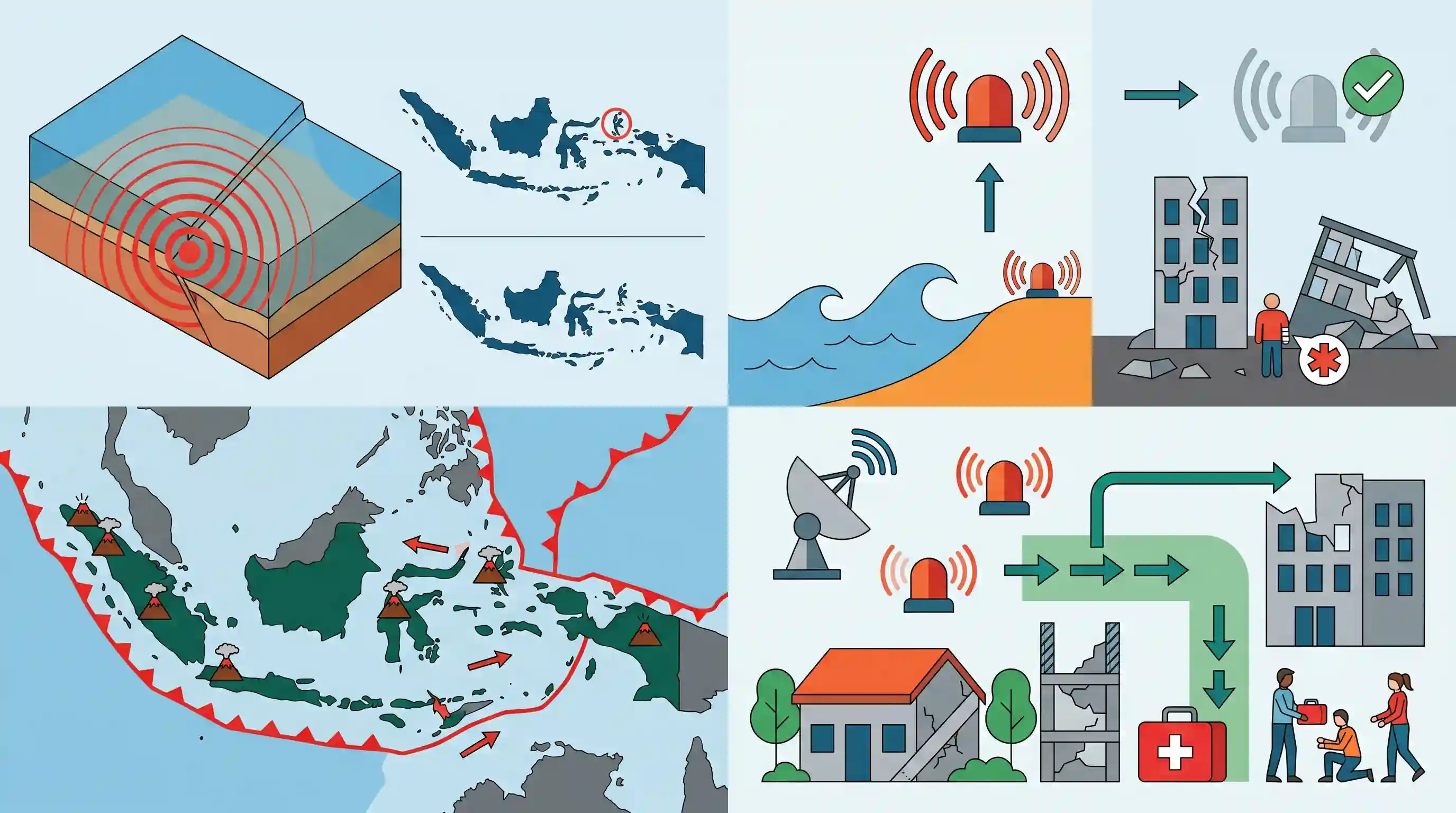
Why It Matters
The incident serves as a pertinent case study for UPSC aspirants studying physical geography and disaster management, illustrating the real-world mechanics of tectonic activity, earthquake distribution, and tsunami warning systems in highly active seismic zones like the Pacific Ring of Fire.
Summary
A shallow 7.4-magnitude undersea earthquake struck off the coast of northern Indonesia in the Molucca Sea, causing structural damage and at least one fatality. The quake triggered a brief tsunami warning after generating minor waves up to 75 cm above normal tides, but the alert was later lifted. Indonesia's high susceptibility to such natural disasters stems from its geographic location on major tectonic fault lines in the Pacific Ring of Fire, underscoring the constant need for robust disaster preparedness.
Key Points
- A shallow 7.4-magnitude earthquake struck the Molucca Sea, situated between Indonesia's Sulawesi and Maluku island groups.
- The seismic activity generated minor tsunami waves up to 75 cm, triggering a temporary tsunami warning that was subsequently lifted.
- The tremor resulted in at least one fatality, multiple injuries, and structural damage in cities such as Manado and Ternate.
- Indonesia experiences frequent earthquakes and volcanic activity due to its location on major seismic faults along the Pacific Ring of Fire.
Important Terms
Pacific Ring of Fire

A 40,000 km horse-shoe shaped area in the Pacific Ocean basin characterized by frequent earthquakes and volcanic eruptions due to tectonic plate movements.
UPSC context
GS Paper I: Important Geophysical phenomena; tests understanding of global tectonic activity and its impact on Southeast Asia.
U.S. Geological Survey (USGS)
A U.S. scientific agency that monitors global seismic activity. Its National Earthquake Information Center (NEIC) provides real-time data on earthquake magnitude and location worldwide.
UPSC context
GS Paper III: Disaster Management; global monitoring networks for early warning and international scientific cooperation.
Indonesia's Disaster Management Agency (BNPB)
(Badan Nasional Penanggulangan Bencana) The central Indonesian body for disaster risk reduction, coordinating preparedness, response, and recovery for natural disasters like earthquakes.
UPSC context
GS Paper III: Disaster Management; comparative study of institutional frameworks for handling large-scale natural hazards.
Indonesia's Search and Rescue Agency (BASARNAS)
(Badan Nasional Pencarian dan Pertolongan) Indonesia’s national agency responsible for executing search and rescue operations during maritime, aviation, and natural disaster emergencies.
UPSC context
GS Paper III: Disaster Management; focuses on immediate response mechanisms and life-saving operations during crises.
Philippine Institute of Volcanology and Seismology (PHIVOLCS)
A Philippine service institute mandated to monitor and mitigate disasters arising from volcanic eruptions, earthquakes, and tsunamis in the region.
UPSC context
GS Paper I & III: Geography and Disaster Management; regional monitoring and mitigation of geotectonic hazards.
Prelims Trap
"Deep-focus underwater earthquakes are the primary trigger for massive tsunamis due to higher energy release."
Shallow-focus earthquakes (<70 km) actually have higher tsunami-generating potential because they cause the sudden vertical displacement of the seafloor needed to displace massive water volumes.
Static Concepts Connected
What tectonic mechanisms primarily trigger massive ocean tsunamis?
- Reverse faulting: Tsunamis require sudden vertical displacement of the ocean floor, typically at convergent plate boundaries.
- Shallow-focus necessity: Earthquakes under 70km deep displace water effectively; deeper quakes dissipate energy before reaching the surface.
- Column displacement: The sudden tectonic jolt transfers energy to the entire water column, generating extremely long-wavelength waves.
Why is the Indonesian archipelago exceptionally prone to severe seismic activity?
- Triple plate convergence: It sits at the complex convergence of the Indo-Australian, Eurasian, and Philippine Sea tectonic plates.
- Ring of Fire: It forms a critical arc of the horseshoe-shaped belt of continuous subduction zones and deep ocean trenches.
- Double subduction: The Molucca Sea Plate features a rare phenomenon where it subducts simultaneously in opposite directions.
Cross-Topic Patterns
Tsunamis + India's Early Warning (INCOIS)
UPSC often links global geophysical phenomena to India's institutional response. Expect questions combining Pacific seismicity with INCOIS's DART buoy network.
Plate Tectonics + Divergent Double Subduction
The rare 'divergent double subduction' of the Molucca Sea plate is a prime candidate for a tough statement-based physical geography question on plate boundaries.

Expect a 2026 prelims question linking earthquake focal depth to tsunami genesis, paired with India's INCOIS early warning infrastructure.
Linked PYQs · 3
Linked PYQs · 3
- 2025MainsGS1
What are Tsunamis? How and where are they formed? What are their consequences? Explain with examples.
- 2014MainsGS1
Why are the world's fold mountain systems located along the margins of continents? Bring out the association between the global distribution of fold mountains and the earthquakes and volcanoes.
- 2017MainsGS3
On December 2004, tsunami brought havoc on fourteen countries including India. Discuss the factors responsible for occurrence of tsunami and its effects on life and economy. In the light of guidelines of NDMA (2010) describe the mechanisms for preparedness to reduce the risk during such events.
