NASA Roadmap for Permanent Lunar Base Establishment
Source:Indian Express ↗
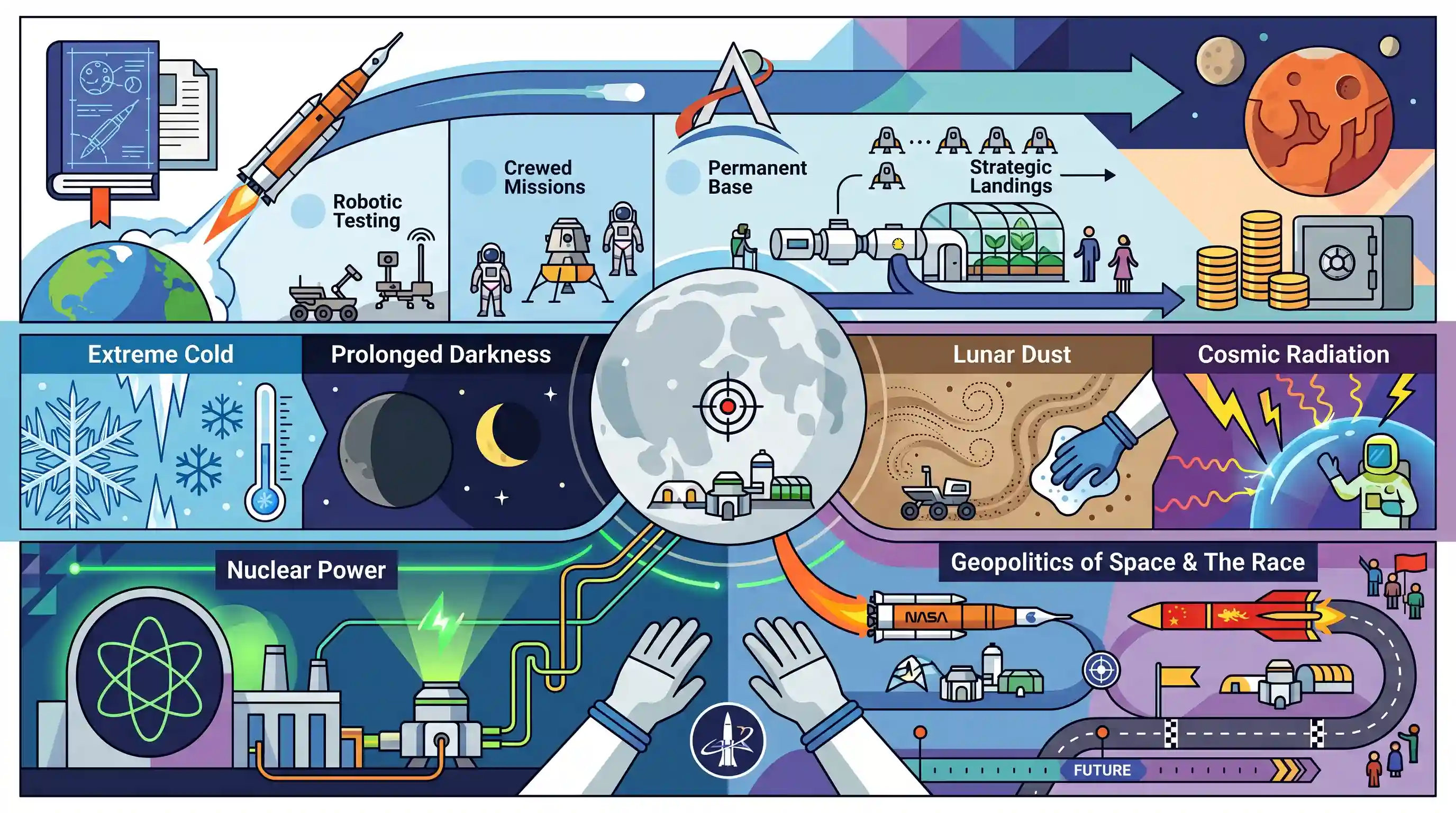
Why It Matters
Transitioning from unmanned to manned space missions is a critical theme for UPSC. The article highlights the technological, logistical, and biological obstacles (like radiation, gravity, and life-support) involved in long-term space colonization, which directly correlates to India's own Gaganyaan mission and space aspirations. Additionally, the growing "Space Race 2.0" between the US and China has geopolitical implications for global space governance and resource exploitation.
Summary
NASA has unveiled its "Moon Base User's Guide," a comprehensive roadmap to establishing a permanent human settlement on the Moon through 73 strategic landings. The initiative will be executed in three phases over the next decade and beyond, starting with rigorous robotic testing and scaling up to occasional crewed missions, ultimately achieving sustained human habitation. Situated near the lunar south pole, the proposed base faces significant environmental hurdles, including extreme cold, prolonged darkness, lunar dust, and cosmic radiation, which demand novel technological solutions like nuclear power generation. The ambitious $100 billion Artemis endeavor is propelled by long-term goals for Mars exploration but is racing against technological gaps and international competition, notably from China's plan to establish its own lunar base by 2030.
Key Points
- NASA has released a 'Moon Base User's Guide' outlining a strategy involving 73 lunar landings to establish a permanent human presence and build a moon base.
- The plan unfolds in three phases: Phase 1 (until 2029) focuses on 21 robotic/uncrewed landings to test systems; Phase 2 (2029-2032) begins occasional crewed missions; Phase 3 targets a sustained permanent human presence.
- The base is planned near the Moon's south pole, an area posing severe challenges like persistent low sunlight, long shadows, and extreme cold, necessitating advanced electricity generation such as nuclear sources.
- Long-term survival and operational risks persist due to underdeveloped hazard detection systems, lunar dust, cosmic radiation, and low gravity.
- NASA faces competitive pressure from China, which aims for a crewed moon base by 2030, alongside internal challenges of budget constraints and Artemis mission costs nearing $100 billion.
Important Terms
Artemis program

A NASA-led international mission aiming to establish a sustainable human presence on the Moon and serve as a stepping stone for sending the first astronauts to Mars.
UPSC context
GS Paper III: Science & Technology. Crucial for understanding modern human spaceflight, international collaborations, and deep-space exploration objectives.
Moon Base User's Guide
An April 2026 NASA strategy document detailing 73 strategic landings over three phases to construct a permanent, sustainable $20 billion lunar base by 2032.
UPSC context
GS Paper III: Space Missions. A contemporary roadmap testing India's awareness of evolving lunar exploration timelines and infrastructure requirements.
Lunar South Pole
A strategic region on the Moon targeted for its water ice and permanent shadows; it requires advanced power solutions due to extreme cold and low sun angles.
UPSC context
GS Paper III: Science & Technology. Significant due to Chandrayaan-3 and the global race for in-situ resource utilization (ISRU) in lunar colonies.
International Lunar Research Station (ILRS)
A China-Russia led initiative to establish a permanent lunar station by the 2030s, acting as the primary geopolitical and scientific competitor to the US-led Artemis program.
UPSC context
GS Paper II: International Relations/Geopolitics. Tests understanding of space-based blocs and the 'Space Race 2.0' between major global powers.
Artemis Accords
A US-led non-binding set of principles for peaceful, transparent, and cooperative outer space exploration; India is a signatory to this multilateral framework.
UPSC context
GS Paper II: International Relations. Essential for questions on space governance, international treaties (like the Outer Space Treaty), and India's strategic alignment.
Fission Surface Power
Small-scale nuclear reactor technology designed to provide reliable, continuous electricity for lunar or Martian bases, specifically during long nights where solar power is unviable.
UPSC context
GS Paper III: Energy and Technology. Relevant for applications of nuclear energy in extreme environments and overcoming survival challenges in deep space.
Prelims Trap
Future lunar south pole bases will rely entirely on advanced solar panels for continuous electricity generation.
Prolonged 14-day lunar nights and shadowed craters at the south pole make solar power insufficient. Continuous power requires nuclear sources like RTGs or fission reactors.
Static Concepts Connected
Why is the Lunar South Pole the primary target for modern moon missions?
- Water Ice: Permanently shadowed craters hold deep reserves of frozen water, crucial for life support systems.
- In-Situ Fuel: Harvested water can be split into hydrogen and oxygen to produce rocket propellant locally, drastically reducing mission costs.
- Solar Peaks: Certain elevated crater rims receive near-constant sunlight, providing an early advantage for solar power generation.
How do Radioisotope Thermoelectric Generators (RTGs) differ from Fission reactors in space?
- Passive Decay Heat: RTGs generate electricity by converting the heat from the natural radioactive decay of isotopes like Plutonium-238.
- Active Fission: Compact fission reactors actively split uranium atoms, generating megawatt-scale electricity needed for large human settlements.
- Lunar Night Survival: Both provide continuous power without sunlight, essential for surviving the extreme cold of the 14-day lunar night.
Cross-Topic Patterns
Artemis Accords vs. China's ILRS
The push for lunar bases highlights a new space race, splitting global powers between the US-led Artemis Accords (which India joined) and the China-Russia International Lunar Research Station (ILRS).
ISRU and Outer Space Law
Extracting lunar water for rocket fuel (In-Situ Resource Utilization) tests the legal limits of the 1967 Outer Space Treaty regarding sovereign appropriation of extraterrestrial resources.

Expect a 2026 Prelims question comparing space power sources (RTG vs Fission) and environmental hazards of lunar south pole missions.
Linked PYQs · 3
Linked PYQs · 3
- 2023MainsGS3
What is the main task of India's third moon mission which could not be achieved in its earlier mission? List the countries that have achieved this task. Introduce the subsystems in the spacecraft launched and explain the role of the Virtual Launch Control Centre' at the Vikram Sarabhai Space Centre which contributed to the successful launch from Sriharikota.
- 2017MainsGS3
India has achieved remarkable successes in unmanned space missions including the Chandrayaan and Mars Orbitter Mission, but has not ventured into manned space missions. What are the main obstacles to launching a manned space mission, both in terms of technology and logistics? Examine critically.
- 2025PrelimsGS1
Consider the following space missions : I. Axiom-4 II. SpaDeX III. Gaganyaan How many of the space missions given above encourage and support micro-gravity research?
