PGIMER Chandigarh Marks 62 Years of Healthcare Excellence
Source:Indian Express ↗
Why It Matters
Serves as a real-world example of both the successes (handling massive scale, integrating health coverage schemes) and systemic vulnerabilities (severe staff shortages, research gaps) of India's tertiary public healthcare institutions. Useful for GS2 answers on health policies, human resource development, and the performance of national institutes.
Summary
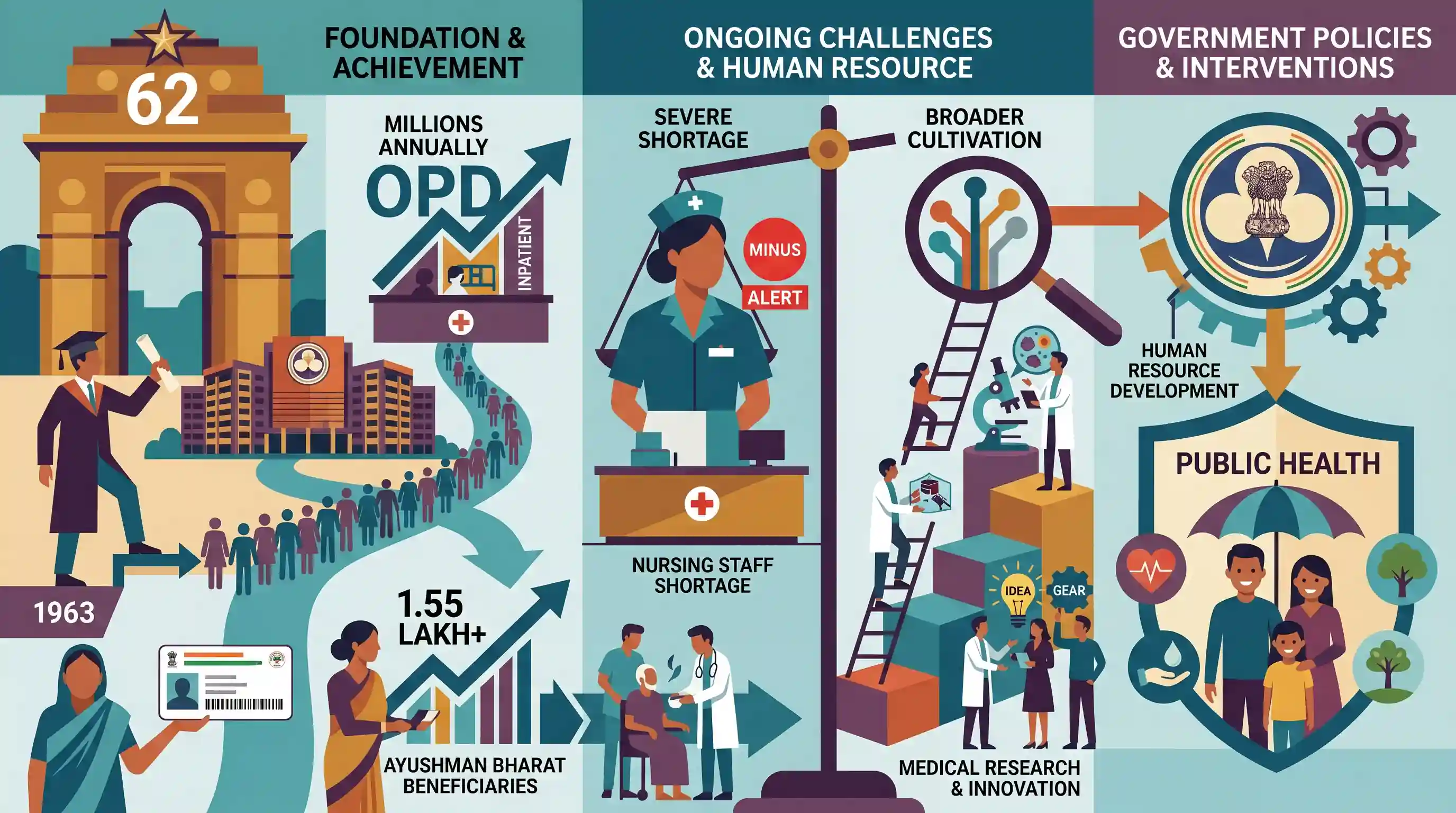
PGIMER Chandigarh is commemorating its 62nd Institute Foundation Day. Recognizing its journey from being inaugurated in 1963 to becoming an Institute of National Importance, the event highlights both PGIMER's monumental contribution to public healthcare—treating millions annually and over 1.55 lakh Ayushman Bharat beneficiaries—and its ongoing challenges. Chief among these issues is a severe shortage of nursing staff and the broader necessity to cultivate more medical researchers and innovators in India's tertiary healthcare ecosystem.
Key Points
- The Post Graduate Institute of Medical Education and Research (PGIMER) in Chandigarh is celebrating its 62nd Institute Foundation Day.
- The institute faces an overwhelming daily patient load, with about 10,000 outpatients and 3 million visits annually, underscoring the high demand on India's public healthcare infrastructure.
- PGIMER has actively implemented the Ayushman Bharat scheme, providing treatment to over 1.55 lakh beneficiaries.
- Despite its premier status as an 'Institute of National Importance', PGIMER grapples with severe human resource constraints, including a shortage of nearly 3,000 nursing staff.
- Policymakers at the event highlighted an urgent need to foster more physicians, scientists, and medical innovators within India's leading medical institutes.
Important Terms
Ayushman Bharat

India's flagship health initiative providing ₹5 lakh annual insurance per family for secondary/tertiary care (PM-JAY) and primary care via Ayushman Arogya Mandirs. Recently extended to all citizens aged 70+.
UPSC context
GS Paper II (Government Policies/Health) and Prelims; tests understanding of universal health coverage and social safety nets.
PGIMER
A premier medical research and educational institution in Chandigarh, established in 1962 and designated an Institute of National Importance. It provides advanced tertiary healthcare and specialized postgraduate training.
UPSC context
GS Paper II (Health Infrastructure) and Prelims; relevant for studying premier public healthcare and research institutions.
ICMR
The apex body for the formulation, coordination, and promotion of biomedical research in India. Operating under the Ministry of Health, it drives national health priorities and evidence-based policy.
UPSC context
GS Paper II (Health) and GS III (Science/Technology); focuses on institutional frameworks for medical research and pandemic response.
National Academy of Medical Sciences
An advisory body to the Government of India on health policy and planning. It promotes academic excellence and serves as a nodal agency for Continuing Medical Education (CME).
UPSC context
GS Paper II (Health Policy); tests knowledge of professional and advisory bodies in India's medical ecosystem.
Institute of National Importance
A status granted by an Act of Parliament to premier higher education institutions (like IITs, AIIMS, PGIMER) that develop highly skilled personnel and receive special funding.
UPSC context
Prelims and GS II; focuses on the classification and legislative framework of India's elite educational institutions.
Planning Commission
A former extra-constitutional body (1950–2014) that formulated India’s Five-Year Plans and allocated funds to states. It was replaced by NITI Aayog to foster cooperative federalism.
UPSC context
GS III (Economy/Planning) and Prelims; crucial for understanding the evolution of India's development strategy and federal relations.
Prelims Trap
"Institutes of National Importance are designated by the UGC or the Ministry of Education."
INI status is conferred exclusively by an Act of Parliament, not by executive order or educational bodies. It grants the power to hold exams and grant degrees independently outside UGC control.
Static Concepts Connected
What defines an 'Institute of National Importance' (INI) in India?
- Legislative origin: Conferred exclusively by an Act of Parliament, not by executive bodies or the UGC.
- Academic autonomy: Grants premier institutions heightened academic autonomy, allowing them to conduct exams and grant degrees independently.
- Central funding: These institutes receive substantial and direct funding from the Central Government to develop highly skilled personnel.
What is the three-tier structure of India's public healthcare system?
- Primary care: Sub-centres and PHCs handling basic maternal/child health and common illnesses; recently upgraded to Health and Wellness Centres (HWCs).
- Secondary care: Community Health Centres (CHCs) and District Hospitals acting as first referral units and offering basic specialist services.
- Tertiary care: Advanced institutions (like AIIMS or PGIMER) handling super-specialty medical care, advanced research, and complex treatments.
Cross-Topic Patterns
Missing primary tier burdens tertiary care
The overwhelming patient load at tertiary institutes like PGIMER reflects the structural weakness of primary health centers, forcing basic health seekers to rely on crowded super-specialty hospitals.
Doctor-centric metrics mask nursing deficits
While policy often focuses on the doctor-population ratio, severe shortages in allied healthcare professionals—like the 3,000-nurse deficit at PGIMER—cripple actual service delivery and PM-JAY implementation.

Expect a prelims statement differentiating the statutory backing and autonomy of 'Institutes of National Importance' versus 'Deemed Universities'.
Linked PYQs · 4
Linked PYQs · 4
- 2024MainsGS2
In a crucial domain like the public healthcare system the Indian State should play a vital role to contain the adverse impact of marketisation of the system. Suggest some measures through which the State can enhance the reach of public healthcare at the grassroots level.
- 2015MainsGS2
Public health system has limitations in providing universal health coverage. Do you think that the private sector could help in bridging the gap? What other viable alternatives would you suggest?
- 2023MainsGS2
The crucial aspect of development process has been the inadequate attention paid to Human Resource Development in India. Suggest measures that can address this inadequacy.
- 2014MainsGS2
Should the premier institutes like IITs/IIMs. be allowed to retain premier status, allowed more academic independence in designing courses and also decide mode/criteria of selection of students. Discuss in light of the growing challenges.
