Rajasthan government addresses reports of schools lacking buildings
Source:hindustantimes ↗
Why It Matters
The article highlights critical deficits in public education infrastructure in Rajasthan, relevant to the state's educational policies, governance issues, and schemes like the Samagra Shiksha Abhiyan. It is important for candidates to be aware of state-level social sector indicators and the status of educational infrastructure.
Summary
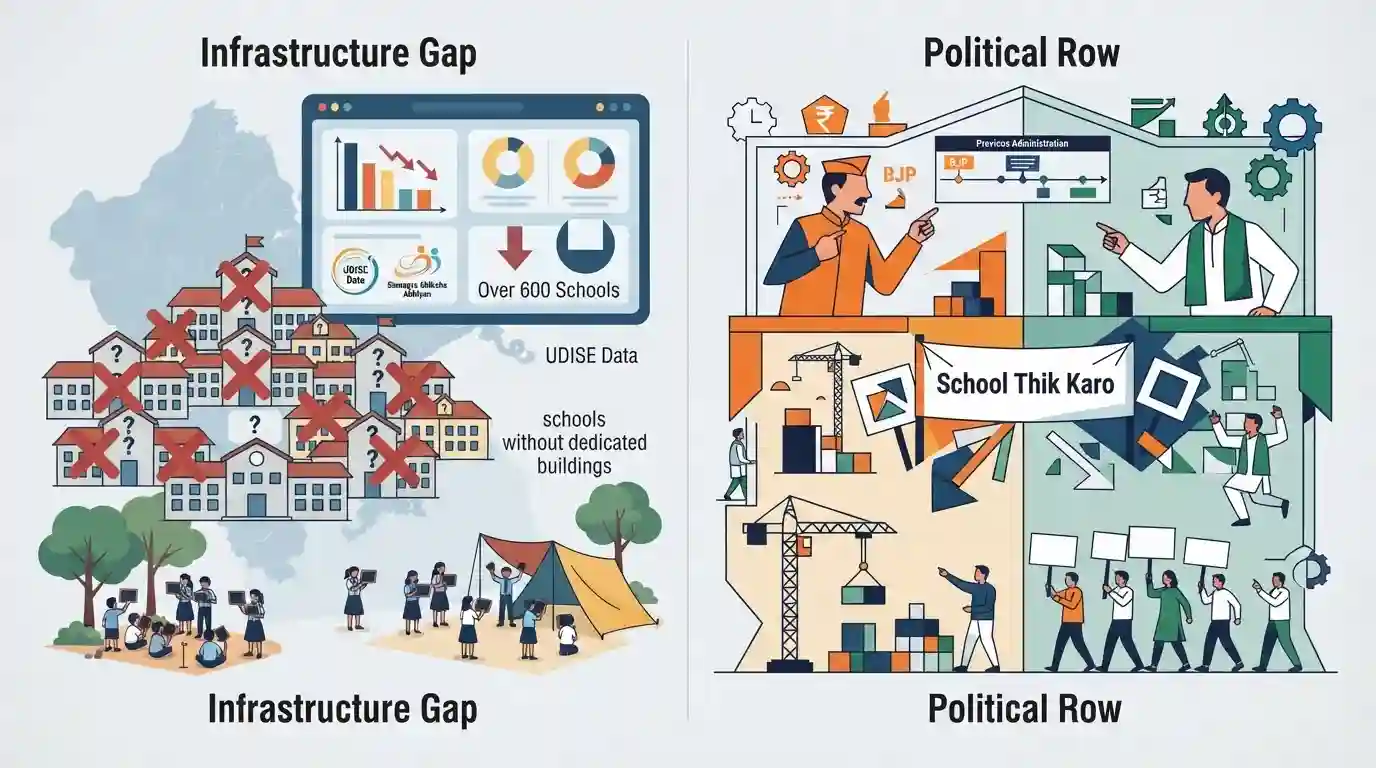
Over 600 government schools in Rajasthan operate without dedicated buildings, sparking criticism from political parties. UDISE data for 2025-26 under the Samagra Shiksha Abhiyan highlights the significant infrastructure gap, which the ruling BJP attributes to neglect by the previous Congress government led by Ashok Gehlot. A political row has escalated following the CJP's 'School Thik Karo' campaign.
Key Points
- UDISE 2025-26 data reveals that 611 government schools in Rajasthan are functioning without proper buildings.
- The data was released under the Samagra Shiksha Abhiyan, highlighting critical gaps in social infrastructure.
- The Cockroach Janta Party (CJP) has launched the 'School Thik Karo' campaign to highlight these educational lapses.
- The BJP-led state government has blamed the lack of infrastructure on the preceding Congress administration under Ashok Gehlot.
- The issue was underscored by a tragic incident last year when a school building collapsed in Jhalawar.
Prelims Trap
Samagra Shiksha Abhiyan is a 100% centrally funded scheme to upgrade school infrastructure.
Samagra Shiksha is a Centrally Sponsored Scheme (CSS). The funding pattern is shared between the Centre and States (usually 60:40 for Rajasthan), not completely borne by the Centre.
Static Concepts Connected
What is the "Integrated Shala Darpan" portal in Rajasthan?
- Core Purpose: A centralized dynamic database mapping all government schools, enrolled students, and teaching staff across the state.
- Governance & Transparency: Ensures real-time monitoring of school infrastructure gaps, teacher availability, and student progression metrics.
- Integration: Merged elementary and secondary education data to facilitate holistic management and effective e-governance in education.
What are the physical infrastructure norms mandated by the RTE Act, 2009?
- All-weather building: Schools must possess an all-weather building with at least one classroom for every teacher and an office-cum-store room.
- Basic Amenities: Mandatory provision of separate, functional toilets for boys and girls, along with safe drinking water facilities.
- Playground & Boundary: Every school must have a playground and secure boundary walls or fencing for student safety.
Cross-Topic Patterns
RTE Mandates vs State Fiscal Capacity
The infrastructure gap highlights the tension between Central mandates (RTE Act) and the limited capital outlay available to states, leading to heavy reliance on shared schemes like Samagra Shiksha.
e-Governance driving Social Accountability
UDISE+ and state portals like Shala Darpan shift political debates from anecdotal claims to data-driven accountability, making digital platforms central to tracking social sector delivery.

Multi-statement questions will likely integrate RTE Act infrastructure mandates with the operational features of the Shala Darpan portal.
Linked PYQs · 1
Linked PYQs · 1
- 2018RPSC_PRELIMSGS1
The Rajasthan government has established the first skill university in the state. Where is it located?
