Google Employees Oppose Military Artificial Intelligence Contracts
Source:The Hindu ↗
Why It Matters
This issue highlights the critical ethical and security dilemmas surrounding the integration of advanced Artificial Intelligence into military domains. It is highly relevant for GS-3 (Science & Technology and Security) regarding the dual-use nature of AI and autonomous weapons, as well as GS-4 (Ethics) concerning corporate social responsibility and the ethical governance of emerging technologies.
Summary
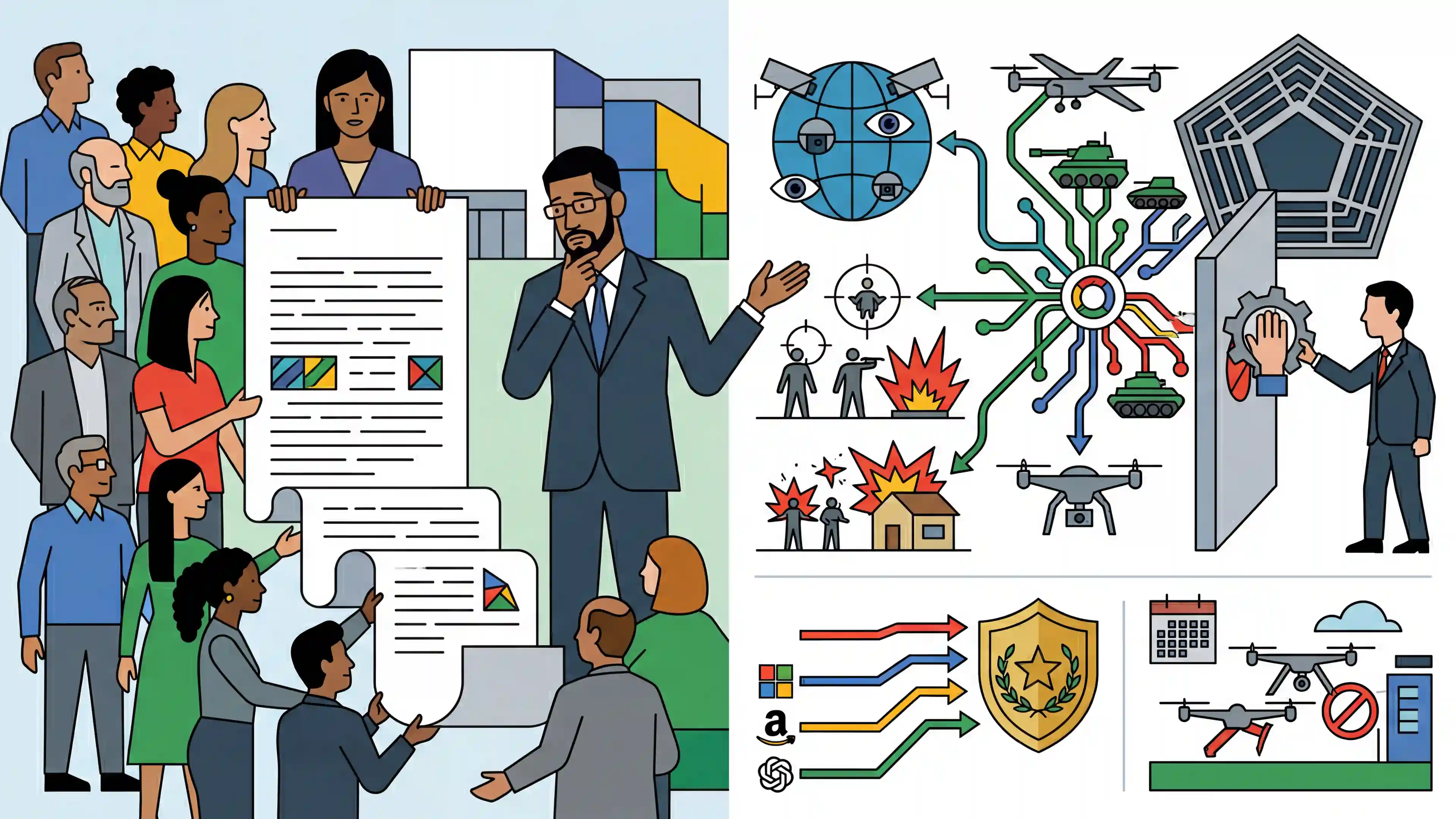
More than 600 Google employees, including senior executives, have signed a letter urging CEO Sundar Pichai to reject a proposed Pentagon contract that would integrate the company's Gemini AI model into classified military operations. The staff cited severe ethical concerns, arguing that deploying opaque AI in military contexts could lead to mass surveillance, the targeting of innocent civilians, and automated warfare. Although Google proposed safeguards requiring human oversight, employees argue these are unenforceable given the Pentagon's policies against external controls. The movement reflects ongoing debates over the ethical responsibilities of tech giants, echoing Google's 2018 withdrawal from the military drone initiative Project Maven, and underscores the strategic race among companies like OpenAI, Microsoft, and Amazon for defense cloud computing contracts.
Key Points
- Over 600 Google employees petitioned CEO Sundar Pichai to reject a Pentagon contract that would deploy the Gemini AI model in classified military operations.
- Employees expressed ethical concerns over the potential use of AI for mass surveillance, targeting innocent civilians, and automated warfare without public scrutiny.
- The Pentagon is pushing for broad unregulated access, while Google's proposed safeguards mandating human control are viewed by staff as technically unenforceable.
- The protest mirrors the 2018 staff movement that successfully pressured Google to abandon 'Project Maven', a Pentagon AI drone program.
- The development highlights intense competition among tech giants (Microsoft, Amazon, OpenAI) for lucrative defense contracts, amid contrasting stances like Anthropic's refusal of unconditional military AI use.
Important Terms
Project Maven

A 2017 US military program using Google’s AI for drone footage analysis; sparked major ethical debates and Google's 2018 withdrawal from such contracts.
UPSC context
GS III (S&T/Security); tests understanding of ethical precedents in tech-military partnerships and 'Algorithm Warfare'.
genAI.mil
The Pentagon's enterprise platform providing generative AI capabilities to millions of defense personnel for mission support, intelligence, and administrative tasks.
UPSC context
GS III (Defense); focuses on the institutionalization of AI in national security and strategic modernization.
Lethal Autonomous Weapons Systems (LAWS)
Advanced weapon systems that select and engage targets without human intervention, raising significant humanitarian, legal, and international security concerns.
UPSC context
GS II/III; critical for international law (IR) and ethical debates on 'meaningful human control' in warfare.
Joint Warfighting Cloud Capability (JWCC)
A $9 billion multi-vendor US defense contract providing secure, enterprise-wide cloud services across all security domains to maintain a military technological advantage.
UPSC context
GS III (Security/S&T); tests knowledge of strategic tech infrastructure and the role of private tech firms in defense.
Gemini AI
Google’s multimodal AI model; its military deployment is contested due to concerns over 'opaque' workloads in classified, surveillance, or lethal operations.
UPSC context
GS III (S&T); tests awareness of generative AI's application and risks in sensitive, non-public defense environments.
Dual-use Technology
Technologies like AI that serve both civilian and military purposes, complicating the regulatory landscape and corporate accountability.
UPSC context
GS III (Security); essential for discussing export controls and the ethics of private innovation in defense.
Prelims Trap
Lethal Autonomous Weapons Systems (LAWS) are completely banned globally under the UN Convention on Certain Conventional Weapons (CCW).
LAWS are not yet banned globally. While discussions are ongoing under the UN CCW framework, no binding international protocol currently prohibits fully autonomous weapons.
Static Concepts Connected
What is the "Human-in-the-loop" (HITL) concept in AI weapons?
- Definition: Requires active human oversight and authorization before an AI system can execute critical decisions, such as engaging a target.
- Key distinction: Differs from "Human-on-the-loop" (human can override an automated action) and "Human-out-of-the-loop" (fully autonomous systems).
- Ethical significance: Considered essential to maintain ethical governance and ensure compliance with international humanitarian law by closing the accountability gap.
How do Autonomous Weapons challenge International Humanitarian Law (IHL)?
- Principle of Distinction: AI systems currently struggle to reliably differentiate between active combatants and non-combatant civilians in complex, chaotic environments.
- Principle of Proportionality: Algorithms cannot easily make qualitative ethical judgments on whether expected civilian harm outweighs the anticipated military advantage.
- Accountability Gap: It remains legally ambiguous who is responsible (the programmer, commander, or the machine) for war crimes committed by autonomous systems.
Cross-Topic Patterns
GS4: Corporate Ethics vs. National Security
The Google employee protest serves as a classic GS4 case study, highlighting the clash between a tech corporation's fiduciary duty (lucrative defense contracts) and moral accountability (preventing automated warfare).
AI Surveillance & Article 21 Privacy Rights
Deploying military-grade AI for surveillance connects to GS2 constitutional concerns, posing threats to the fundamental Right to Privacy (Puttaswamy judgment) and highlighting the need for robust data protection laws.

GS3/GS4 crossover in 2026: Expect a Mains question evaluating the 'accountability gap' of Lethal Autonomous Weapon Systems (LAWS).
Linked PYQs · 4
Linked PYQs · 4
- 2023MainsGS3
The use of unmanned aerial vehicles (UAVs) by our adversaries across the borders to ferry arms/ammunitions, drugs, etc., is a serious threat to the internal security. Comment on the measures being taken to tackle this threat.
- 2017MainsGS4
Corporate social responsibility makes companies more profitable and sustainable. Analyse.
- 2024MainsGS4
The application of Artificial Intelligence as a dependable source of input for administrative rational decision-making is a debatable issue. Critically examine the statement from the ethical point of view.
- 2023MainsGS3
Introduce the concept of Artificial Intelligence (AI). How does Al help clinical diagnosis? Do you perceive any threat to privacy of the individual in the use of Al in healthcare?
