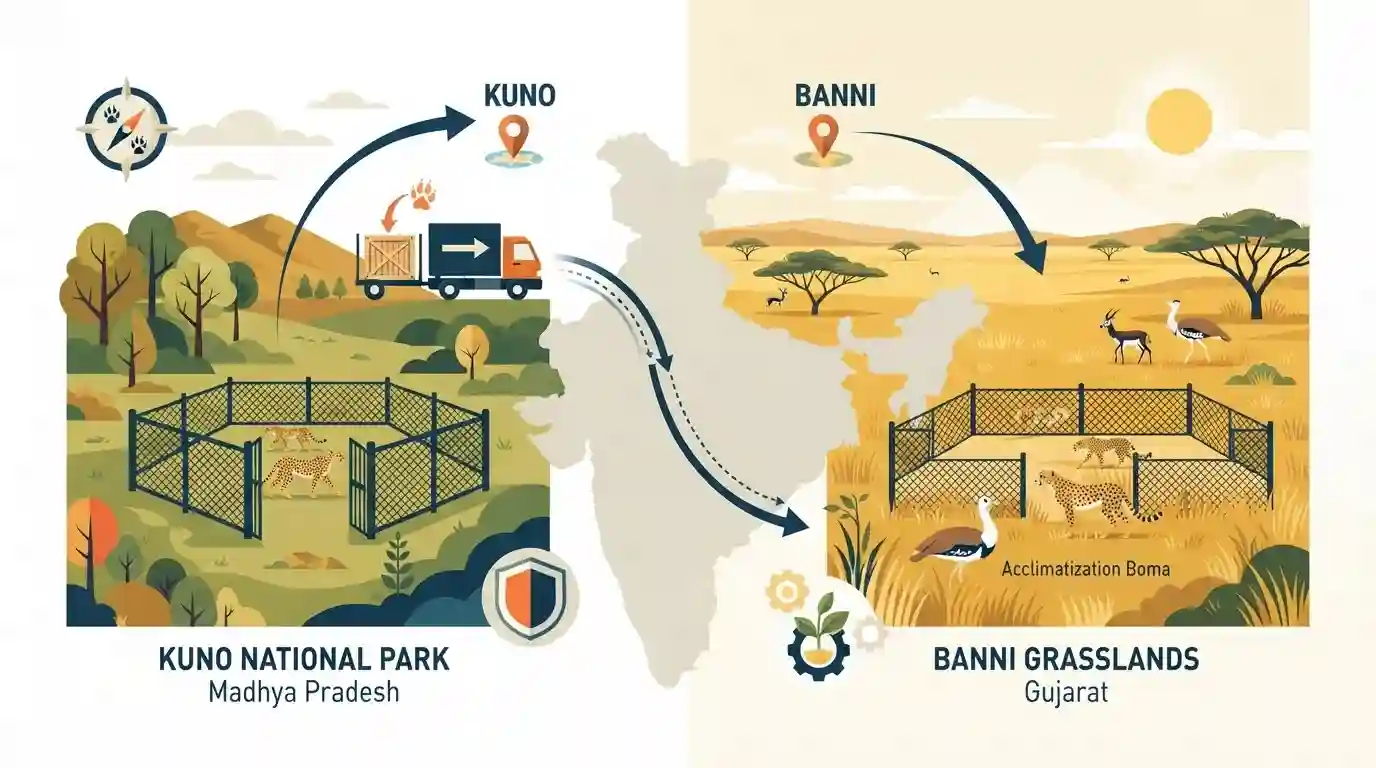
Cheetah Translocation From Kuno To Banni Grasslands Gujarat
Source:indianmasterminds ↗
Why It Matters
This development is significant for state-level and national environmental governance, highlighting wildlife translocation strategies, the ecological importance of Banni grasslands, and Project Cheetah's expansion in western India.
Summary
The article details the initiative to shift cheetahs from Kuno National Park to the Banni grasslands in Gujarat as part of India's ongoing Project Cheetah wildlife conservation efforts, aiming to create a secure alternative habitat for the species.
Key Points
- Plans are underway to relocate cheetahs from Kuno National Park in Madhya Pradesh to the Banni grasslands in Gujarat's Kutch district.
- The Banni grasslands provide a suitable semi-arid landscape and historical habitat context for the reintroduction of cheetahs in India under Project Cheetah.
- The move aims to establish a second alternative home for the relocated African cheetahs in India, expanding the geographical range of the conservation project.
Important Terms
Project Cheetah

India's ambitious intercontinental wildlife reintroduction program launched in 2022 to restore the extinct cheetah population, initially utilizing Kuno National Park and expanding to alternative habitats like Banni grasslands.
UPSC context
Important for Environment & Ecology, wildlife conservation, and species reintroduction strategies in General Studies Paper III.
Kuno National Park
A protected area in Madhya Pradesh chosen as the primary initial site for India's Project Cheetah intercontinental wildlife translocation program.
UPSC context
Important for Biodiversity and Wildlife Conservation, geography of Madhya Pradesh, and protected area networks in Prelims and Mains.
Banni Grasslands
Asia's largest tropical grassland located in Gujarat's Kutch district, chosen as a secure alternative habitat for relocating cheetahs under Project Cheetah.
UPSC context
Important for Geography of Gujarat, ecosystem management, and regional wildlife conservation initiatives in GPSC and UPSC exams.
Prelims Trap
Banni grasslands in Gujarat were the original and primary site selected for the launch of Project Cheetah in India.
Project Cheetah did not originate in Banni; Banni is being developed as a *second* alternative home, while Kuno in Madhya Pradesh remains the primary initial release site.
Static Concepts Connected
What are the key ecological and geographical features of the Banni grasslands in Gujarat?
- Ecosystem Scale: Largest Grassland: Banni is Asia's largest natural grassland, spread over 2,600 sq km in Kutch district, Gujarat.
- Flora & Soil: Soil & Vegetation: Characterized by arid/semi-arid conditions, saline flats (Rann influence), and dominant halophytic grasses like Sporobolus and Dichanthium.
- Maldhari Culture: Pastoralists: Inhabited for centuries by Maldhari pastoral communities renowned for their livestock breeds (e.g., Banni buffalo, Kankrej cattle).
Cross-Topic Patterns
Banni Grasslands & Maldhari Pastoralism Integration
Banni's pastoralist communities (Maldharis) require conflict-mitigation models similar to Gir's Maldhari resettlement strategy for Asiatic lions.
Intercontinental Translocation & Global Rewilding Precedents
India's intercontinental translocation mirrors international reintroduction programs like Yellowstone's wolf rewilding or Australia's marsupial recoveries.

Expect a multi-statement prelims question on Banni's ecology (largest grassland, salinity, Maldharis) paired with Project Cheetah facts.
Linked PYQs · 3
Linked PYQs · 3
- 2025GPSC_PRELIMSGS1
What are Banni, Rabari and Bavalia in Gujarat?
- 2026GPSC_PRELIMSGS1
The 'Great Indian Bustard (GIB)' (Ghorad) is frequently seen in the news in the context of wildlife conservation efforts in western India. Consider the following statements regarding this species: 1. Currently, the highest surviving wild population of the Great Indian Bustard in India is located in the semi-arid grasslands of Gujarat. 2. It is a long-distance migratory bird that travels from Central Asia to the Indian subcontinent to escape harsh winters. Which of the above statement(s) is/are correct?
- 2026GPSC_PRELIMSGS1
Consider the following statements regarding the drainage system of Kutch: 1. Most rivers in the Kutch region are ephemeral and non-perennial, carrying water only during the brief monsoon season. 2. The rivers originating from the central hilly tracts of Kutch invariably drain into the Arabian Sea directly. 3. The Luni River, after traversing through Rajasthan, dissipates into the marshy lands of the Rann of Kutch. Which of the above statements are correct?
