Banni Grasslands Translocation Project for Cheetah Conservation
Source:indianmasterminds ↗
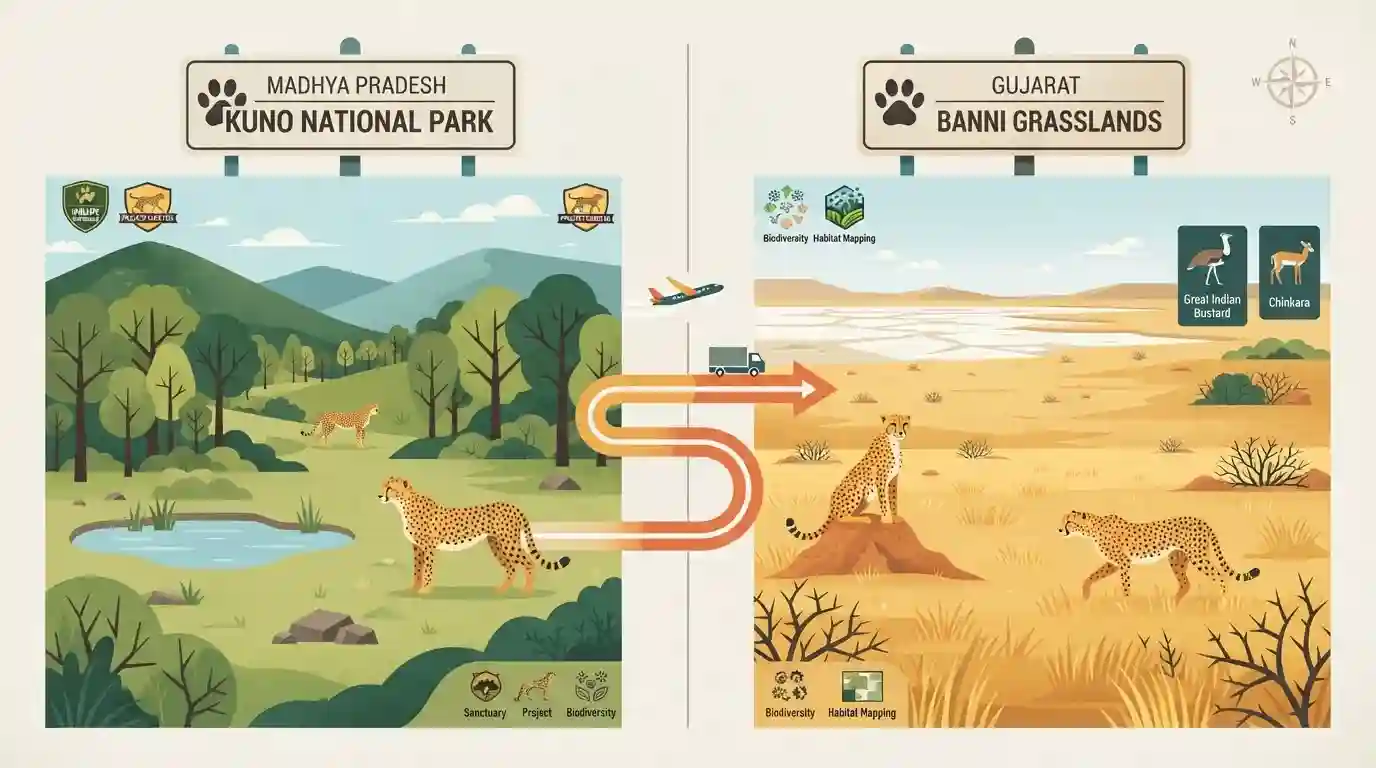
Why It Matters
Important for understanding wildlife relocation initiatives, specifically Project Cheetah and the ecological significance of the Banni grasslands in Gujarat.
Summary
Plans are underway to shift six cheetahs from Madhya Pradesh's Kuno National Park to the Banni grasslands in Gujarat's Kutch region, establishing a new home for the species under Project Cheetah.
Key Points
- Six cheetahs are planned to be translocated from Kuno National Park in Madhya Pradesh to the Banni grasslands in Kutch, Gujarat.
- Banni grasslands are being prepared as an alternative second home for cheetah conservation in India.
- The move aims to expand the cheetah reintroduction project habitat scope in western India.
Important Terms
Project Cheetah

India's pioneering wildlife reintroduction program launched to restore the Asiatic cheetah or its African counterpart following the extinction of the species in India in 1952.
UPSC context
Important for Environment and Ecology under GS Paper III; tests knowledge of species conservation and wildlife management.
Kuno National Park
A protected sanctuary and national park located in Madhya Pradesh, chosen as the initial primary reintroduction site for African cheetahs under Project Cheetah.
UPSC context
Important for Biodiversity and Conservation under GS Paper III; tests knowledge of protected area networks and wildlife habitats.
Banni Grasslands
A vast, semi-arid grassland ecosystem situated in the Kutch district of Gujarat, identified as a secondary site and alternative habitat for relocating cheetahs.
UPSC context
Important for Gujarat Geography and Ecology; tests knowledge of regional ecosystems and wildlife relocation initiatives.
Prelims Trap
Direct importation of African cheetahs into Banni grasslands, Gujarat.
Aspirants may assume Gujarat is getting the cheetahs directly from African nations, whereas they are being translocated from India's first reintroduction site, Kuno National Park in Madhya Pradesh.
Static Concepts Connected
What are the ecological and geographical features of Banni Grasslands in Gujarat?
- Location & Scale: Asia's largest natural grassland, situated near the Great Rann of Kutch in Gujarat, characterized by arid and semi-arid conditions.
- Flora & Fauna: Historically dominated by native grasses like Dichanthium and Sporobolus, which support the indigenous pastoralist Maldhari community.
- Ecological Threat: Ecological degradation caused extensively by the invasive alien tree species Prosopis juliflora (locally known as Gando Baval).
Cross-Topic Patterns
Cheetah Translocation & Wildlife Protection Act
Project Cheetah highlights wildlife translocation protocols regulated under the Wildlife Protection Act, 1972, intersecting with state-level conservation funds and regional grassland ecosystem management in Kachchh.
Banni Grasslands & Pastoralist Ecology
The ecological restoration of Banni grasslands directly relates to local pastoralist (Maldhari) rights, invasive Prosopis juliflora eradication, and arid-zone climate adaptation strategies in Gujarat.

Expect a match-the-following or statement-based question linking Kuno NP, Banni grasslands, and Project Cheetah features in Gujarat/MP.
Linked PYQs · 2
Linked PYQs · 2
- 2025GPSC_PRELIMSGS1
What are Banni, Rabari and Bavalia in Gujarat?
- 2026GPSC_PRELIMSGS1
The 'Great Indian Bustard (GIB)' (Ghorad) is frequently seen in the news in the context of wildlife conservation efforts in western India. Consider the following statements regarding this species: 1. Currently, the highest surviving wild population of the Great Indian Bustard in India is located in the semi-arid grasslands of Gujarat. 2. It is a long-distance migratory bird that travels from Central Asia to the Indian subcontinent to escape harsh winters. Which of the above statement(s) is/are correct?
