State anti encroachment demolition drive and human displacement issues
Source:Indian Express ↗
Why It Matters
Provides a crucial case study for GS2 (Polity & Governance) and GS3 (Internal Security) on the balance between state action (anti-encroachment) and human rights (right to housing/rehabilitation). It serves as an example for issues concerning vulnerable sections, internal displacement, and demographic-related administrative challenges in the North-East.
Summary
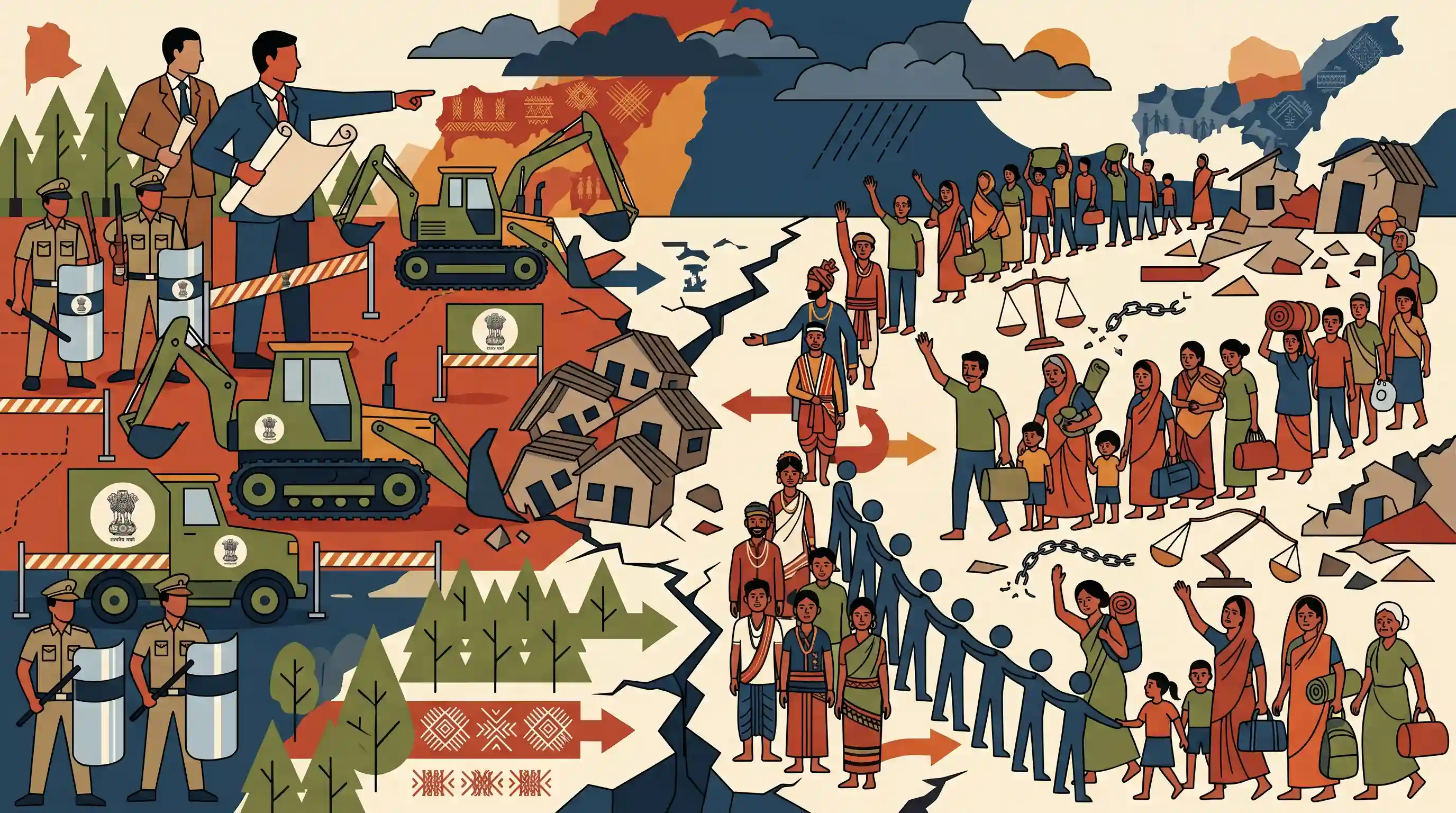
The Assam government has resumed its ongoing eviction drives, leaving 580 additional families facing displacement. The administration asserts the demolitions aim to clear alleged encroachments from state-owned land, forest areas, and protected tribal belts. However, the drives have consistently sparked concerns regarding human rights, the lack of robust rehabilitation policies for the displaced, and the welfare of vulnerable communities. This development highlights the complex intersection of land rights, demographic anxieties, and governance in Assam, reflecting the tension between state enforcement of land laws and the socio-economic rights of marginalized populations.
Key Points
- The Assam government has resumed its demolition and eviction drives, newly affecting 580 families.
- Authorities maintain the evictions are necessary to clear illegal encroachments from government land, forest reserves, and tribal blocks.
- The ongoing drives highlight recurring conflicts over land rights, internal displacement, and the demographic complexities of Assam.
- Activists and civil society raise significant human rights concerns due to the lack of adequate rehabilitation and housing options for the displaced vulnerable populations.
Important Terms
Assam Land and Revenue Regulation, 1886

A colonial-era legal framework governing land ownership and settlement in Assam, empowering the state to evict unauthorized occupants from government and forest lands.
UPSC context
GS Paper 2/3: Historical legal frameworks and administrative powers governing land in North-East India.
Tribal Belts and Blocks
Designated protected areas in Assam where land ownership is restricted to indigenous tribal communities to prevent land alienation to non-tribal populations.
UPSC context
GS Paper 2: Mechanisms for protecting vulnerable sections and indigenous land rights in the North-East.
Mission Basundhara
Assam's flagship land reform program aimed at streamlining land records and securing land rights for indigenous people through digitized services.
UPSC context
GS Paper 2/3: Governance reforms, land management, and state-led socio-economic security initiatives.
Encroachment
The unauthorized occupation of government, forest, or grazing lands; it is the primary legal justification cited for state-led eviction drives.
UPSC context
GS Paper 3: Internal security, rule of law, and land resource management.
Right to Shelter
A fundamental right derived from Article 21 (Right to Life), often cited by courts to demand rehabilitation for displaced persons during evictions.
UPSC context
GS Paper 2: Indian Constitution, Fundamental Rights, and judicial protection of marginalized groups.
Reserve Forest
Specifically designated forest land where most activities are prohibited to protect biodiversity, governed by the Indian Forest Act, 1927.
UPSC context
GS Paper 3: Environmental conservation, forest laws, and rights of forest-dwelling communities.
Prelims Trap
Under the Forest Rights Act (FRA) 2006, traditional forest-dwelling communities enjoy absolute immunity from eviction.
The FRA 2006 prohibits forced eviction only until the legal settlement and verification of claims is complete, not indefinitely if claims are rejected.
Static Concepts Connected
How does the Constitution balance the Right to Shelter and Tribal Land protection?
- Article 21: Olga Tellis (1985) expanded Right to Life to include livelihood and shelter, mandating due process and reasonable notice before evictions.
- Article 19(5): The right to reside anywhere (Art 19(1)(e)) is restricted to protect Scheduled Tribes, legally justifying the clearing of tribal belts.
How are tribal land rights legally secured in Assam?
- Sixth Schedule: Grants Autonomous District Councils (ADCs) in Assam the legislative power to regulate land allotment, occupation, or use.
- State Regulations: Chapter X of the Assam Land and Revenue Regulation, 1886 prevents land transfer to non-eligible persons in notified tribal blocks.
Cross-Topic Patterns
NRC, Demography and Border Security
Evictions in Assam overlap heavily with historical migration anxieties and the NRC, merging local land disputes directly with GS-3 internal security and border management themes.
Conservation vs. FRA 2006
The state's drive to clear 'forest areas' frequently clashes with the statutory protections afforded to traditional dwellers under the Forest Rights Act, testing GS-3 conservation ethics.

Expect a Prelims question testing the intersection of Art 19(5) (tribal protection), FRA 2006 claim settlements, and Art 21 (Shelter).
Linked PYQs · 3
Linked PYQs · 3
- 2022MainsGS2
“Right of movement and residence throughout the territory of India are freely available to the Indian citizens, but these rights are not absolute.” Comment.
- 2021MainsGS2
Though the Human Rights Commissions have contributed immensely to the protection of human rights in India, yet they have failed to assert themselves against the mighty and powerful. Analyzing their structural and practical limitations, suggest remedial measures.
- 2025MainsGS3
What are the major challenges to internal security and peace process in the North-Eastern States? Map the various peace accords and agreements initiated by the government in the past decade.
