Dehradun Administration Report Highlights Unregistered Madrasas
Source:Indian Express ↗
Why It Matters
The state's regulation of minority and religious institutions intersects with constitutional guarantees under Article 30, the Right to Education (RTE) Act, 2009, and domestic security administration. UKPSC PCS regularly tests the structure of the state executive, educational policies, and fundamental rights.
Summary
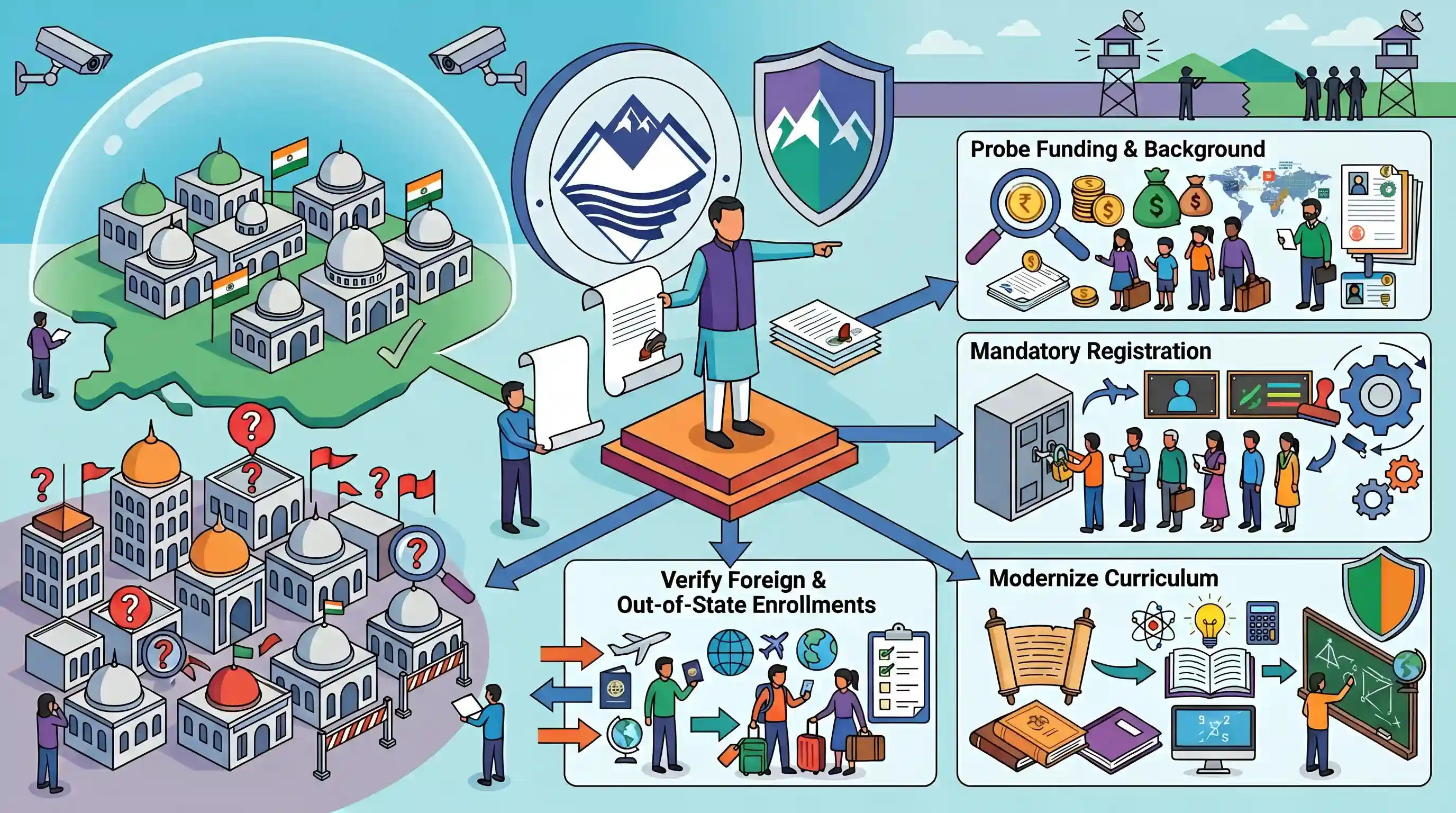
Uttarakhand Chief Minister Pushkar Singh Dhami has vowed to probe the sources of funding and the background of students and teachers of 57 unregistered madrasas operating in Dehradun. This decision follows a survey report submitted by Dehradun District Magistrate Sonika, which revealed that only 61 of the 118 surveyed madrasas were registered with the Uttarakhand Madarsa Board or the Waqf Board. The state government intends to mandate registration, verify foreign and out-of-state enrollments, and modernize the curriculum to align with legal education frameworks.
Key Points
- A district administration survey in Dehradun revealed that out of 118 surveyed madrasas, 57 were running without registration under either the Uttarakhand Madarsa Board or the Waqf Board.
- The survey report was officially compiled and submitted by the Dehradun District Magistrate (DM) Sonika.
- Uttarakhand Chief Minister Pushkar Singh Dhami stated that the government will launch a thorough investigation into the sources of funding, financial transactions, and the background/origins of teachers and students of these unregistered madrasas.
- The state government's initiative aims to curb security risks, verify the identities of out-of-state students, and streamline religious and modern education (including the integration of the NCERT curriculum) across all madrasas in the state.
Important Terms
Constitution of India (Article 30)

A fundamental right in the Indian Constitution guaranteeing religious and linguistic minorities the right to establish and administer educational institutions of their choice without state discrimination.
UPSC context
GS Paper II (Polity); essential for understanding fundamental rights, minority protection, and state regulation of education.
Right to Education (RTE) Act, 2009
A landmark law operationalizing Article 21A to guarantee free and compulsory elementary education to children aged 6 to 14, while exempting minority religious institutions.
UPSC context
GS Paper II (Social Justice); crucial for debates on standardizing primary education versus protecting minority educational autonomy.
Waqf Board
A statutory corporate body established under the Waqf Act, 1995 to manage, protect, and administer properties permanently dedicated for Muslim religious or charitable purposes.
UPSC context
GS Paper II (Governance); tests knowledge of statutory bodies, religious endowments, and minority asset regulation.
Uttarakhand Madarsa Board
The former state-level regulatory body for Islamic schools, abolished in July 2026 and replaced by the State Minority Education Authority to standardize curricula.
UPSC context
GS Paper II (State Governance); relevant for analyzing structural educational reforms and minority educational integration.
86th Constitutional Amendment Act, 2002
A key constitutional amendment that inserted Article 21A, establishing the right to education as a Fundamental Right for children aged 6 to 14.
UPSC context
GS Paper II (Polity/Constitution); vital for tracing the evolution of fundamental rights and educational policies.
Prelims Trap
Madrasas and Vedic pathshalas must strictly adhere to the infrastructure and curriculum norms mandated under the Right to Education (RTE) Act, 2009.
Section 1(5) of the RTE Act explicitly exempts madrasas, Vedic pathshalas, and institutions primarily imparting religious instruction from the Act's provisions.
Static Concepts Connected
What is the scope of State regulation over Minority Educational Institutions under Article 30?
- Article 30(1): Guarantees religious and linguistic minorities the right to establish and administer educational institutions of their choice.
- Permissible Regulations: The State can prescribe academic standards, teacher qualifications, health, sanitation, and safety guidelines as conditions for recognition.
- Supreme Court View: Regulations must be cooperative and aimed at academic excellence, rather than destroying the minority character of the institution.
What is the legislative competence of States to regulate Madrasa education?
- Concurrent List: Under Entry 25 of the Concurrent List (List III), both Parliament and State Legislatures have the power to legislate on education.
- SC 2024 Judgment: Upheld the state's legislative competence to enact laws standardizing madrasa education and ensuring basic secular learning.
- RTE vs State Acts: While exempt from the RTE Act, madrasas must still comply with state-level boards and educational directives for valid certification.
Cross-Topic Patterns
National Security and Minority Funding
State audits of unregistered religious schools connect Article 30 safeguards with internal security concerns like foreign funding (FCRA) and border-area demographic shifts.
Federalism and Concurrent List Overlaps
Regulating religious institutions tests the boundary between state public order (List II) and concurrent education standards (List III), highlighting federalism conflicts.

The intersection of Article 30, state regulatory power under Entry 25, and RTE Act exemptions is prime for a 2026 multi-statement MCQ.
Linked PYQs · 2
Linked PYQs · 2
- 2025UKPSC_PRELIMSGS1
Consider the following statements about 'Right to Education' and choose the correct answer : 1. It try to achieve the aim of 'Education for All'. 2. Earlier a provision of free and compulsory education was provided in Part IV of the Constitution. 3. It became Fundamental Right after 91ˢᵗ Constitutional Amendment.
- 2025UKPSC_PRELIMSGS1
Consider the following statements with reference to Uttarakhand and choose the correct answer: 1. The executive of Uttarakhand includes Governor as the head of the state. 2. It also includes the Chief Minister and his/her council of ministers.
