Stadium Project Threatens Heritage Trees and Biodiversity in Mysuru
Source:The Hindu ↗
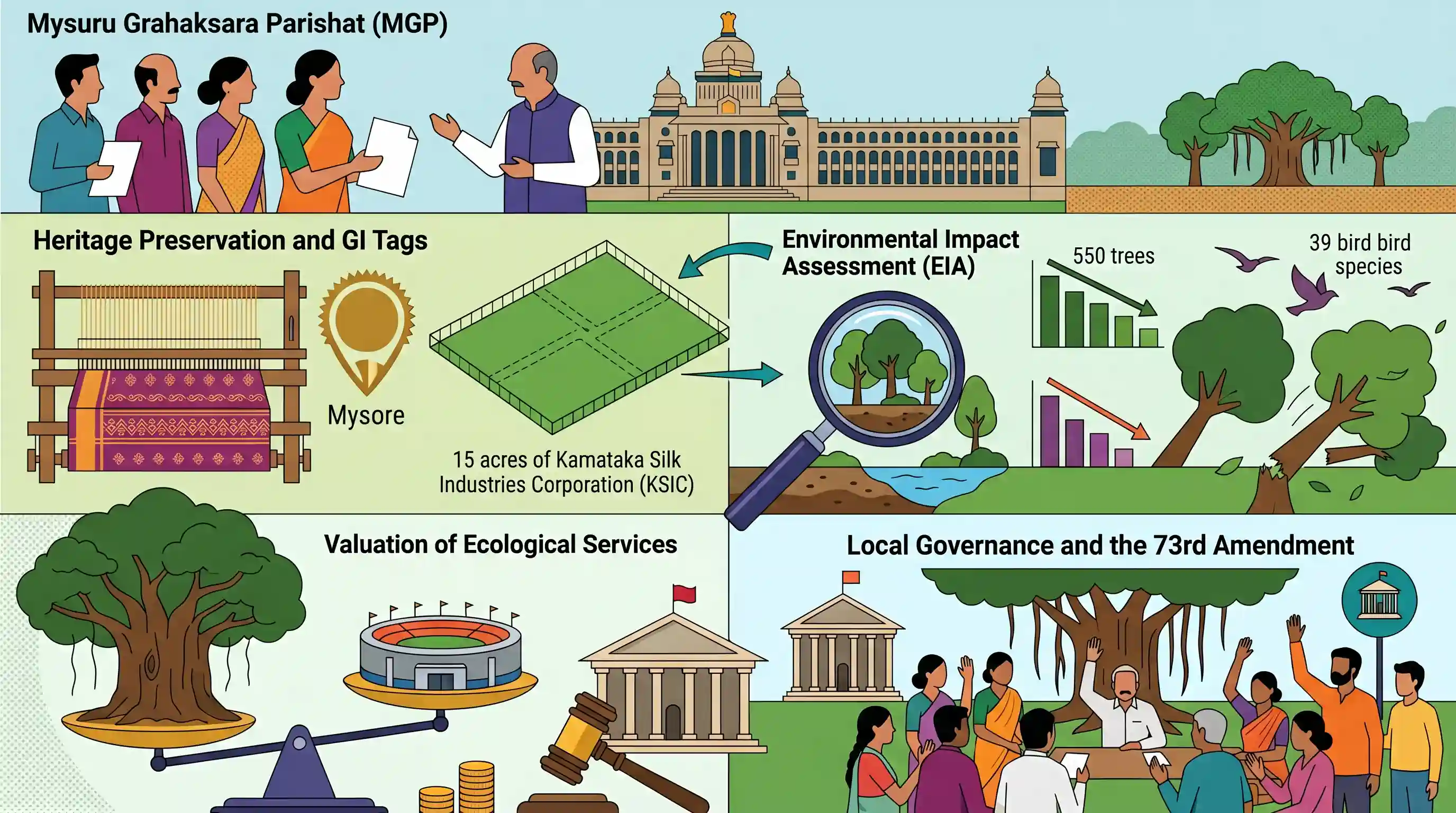
Why It Matters
The article serves as an excellent contemporary case study for Mains answers on the role of civil society in demanding Environmental Impact Assessments (EIA), the valuation of ecological services (monetizing tree benefits), and the intersection of local governance (Gram Sabhas) with environmental decision-making.
Summary
The Mysuru Grahakara Parishat (MGP) has urged Karnataka Chief Minister Siddaramaiah to reconsider a proposed sports stadium in T. Narasipura. The project threatens a 15-acre plot owned by the Karnataka Silk Industries Corporation (KSIC)—a heritage institution famous for GI-tagged Mysore Silk. MGP emphasized the need for a full Environmental Impact Assessment (EIA), noting the potential loss of 550 trees and 39 bird species. Citing a Supreme Court committee's valuation of mature trees, the group argued the ecological damage outweighs the project's economic cost and demanded local public consultation as mandated by the 73rd Constitutional Amendment.
Key Points
- Mysuru Grahakara Parishat (MGP) has opposed a proposed sports stadium in T. Narasipura, citing the lack of a comprehensive Environmental Impact Assessment (EIA) and threats to 550 mature trees and 39 bird species.
- MGP highlighted a 2021 Supreme Court expert committee report valuing a 100-year-old tree at around ₹1 crore, arguing that the project's ecological cost far exceeds its ₹6-12 crore economic budget.
- The NGO demanded public consultation through the Gram Sabha, invoking the democratic spirit of the 73rd Constitutional Amendment for local developmental projects.
- The proposed site is owned by Karnataka Silk Industries Corporation (KSIC), a heritage institution founded in 1912 by Nalvadi Krishnaraja Wadiyar, known for producing GI-tagged Mysore Silk sarees.
Important Terms
Environmental Impact Assessment (EIA)

A statutory process under the Environment Protection Act, 1986, to identify and evaluate the potential environmental and socio-economic impacts of proposed developmental projects before granting clearance.
UPSC context
GS-III Environment & Ecology; tests understanding of sustainable development, environmental governance, and the EIA Notification, 2006.
73rd Constitutional Amendment
The 1992 Act that granted constitutional status to Panchayati Raj Institutions (PRIs), mandating a three-tier governance system and empowering local bodies to manage resources and development plans.
UPSC context
GS-II Polity/Governance; essential for topics on democratic decentralization, grassroots democracy, and the functions of Gram Sabhas.
Geographical Indication (GI) Tag
A sign used on products with a specific geographical origin that possess qualities or a reputation due to that place, protected under the 1999 Act.
UPSC context
GS-III Economy/IPR; tests knowledge of Intellectual Property Rights and the preservation of traditional heritage and livelihoods.
Valuation of Ecosystem Services
A method of assigning monetary value to benefits provided by nature; recently, an SC-appointed committee valued heritage trees based on oxygen, carbon sequestration, and bio-fertilizer production.
UPSC context
GS-III Environment/Economics; relevant for environmental ethics, "Green Accounting," and judicial activism in conservation.
Karnataka Silk Industries Corporation (KSIC)
A Karnataka government undertaking that holds the sole GI registration for Mysore Silk; it manages the entire value chain from silk reeling to weaving.
UPSC context
GS-I/III Heritage & Economy; example of a state-run heritage industry and its role in regional economic identity.
Mysuru Grahakara Parishat (MGP)
A prominent non-profit organization based in Mysuru that advocates for consumer rights, environmental protection, and transparent governance through public interest litigation and activism.
UPSC context
GS-II Governance; illustrates the "Role of NGOs/Civil Society" in holding authorities accountable and protecting public interests.
Prelims Trap
Gram Sabha consent is strictly mandatory for all state-sponsored infrastructure projects.
While the 73rd Amendment promotes consultation, mandatory Gram Sabha *consent* for land acquisition is primarily required under PESA (in Scheduled Areas) and the Forest Rights Act, not uniformly across all states.
Static Concepts Connected
What is the legal framework for Environmental Impact Assessment (EIA) in India?
- Statutory backing: EIA Notification 2006 is issued under the Environment (Protection) Act, 1986.
- Categorization: Divides projects into Category A (appraised by the Centre/MoEFCC) and Category B (appraised by State-level authorities).
- Public Hearing: Mandatory for Category A and B1 projects. Conducted by the State Pollution Control Board, though Category B2 projects are exempt.
How does the GI framework protect traditional products like Mysore Silk?
- TRIPS compliance: Governed by the Geographical Indications of Goods Act, 1999, enacted to comply with the WTO's TRIPS agreement.
- Tenure & Rights: Registration is valid for 10 years, renewable indefinitely. It confers collective/institutional rights rather than individual innovation rights.
- Proprietorship: KSIC is the sole registered proprietor for the Mysore Silk GI; unauthorized use by competitors attracts legal penalties.
Cross-Topic Patterns
Monetizing ecosystem services
The Supreme Court's 2021 monetization of tree services (oxygen generation, soil conservation) marks a judicial shift toward integrating "green accounting" and ecosystem service valuation into infrastructure cost-benefit analyses.
Gram Sabha in environmental governance
NGOs invoking the 73rd Amendment for infrastructure projects parallels the statutory use of Gram Sabha consent under PESA and the Forest Rights Act to challenge top-down land use.
Princely states and indigenous industry
The Wadiyar dynasty's 1912 establishment of KSIC reflects the historical role of progressive princely states in pioneering indigenous industrialization, sericulture, and laying foundations for modern GI tags.

Ecosystem service valuation linked to EIA public hearing exemptions and PESA Gram Sabha consent could form a composite 2026 question.
Linked PYQs · 4
Linked PYQs · 4
- 2024MainsGS3
What role do environmental NGOs and activists play in influencing Environmental Impact Assessment (EIA) outcomes for major projects in India? Cite four examples with all important details.
- 2014MainsGS3
Environmental Impact Assessment studies are increasingly undertaken before a project is cleared by the Government. Discuss the environmental impacts of coal-fired thermal plants located at coal pitheads.
- 2024MainsGS2
Analyse the role of local bodies in providing good governance at local level and bring out the pros and cons merging the rural local bodies with the urban local bodies.
- 2018PrelimsGS1
India enacted The Geographical Indications of Goods (Registration and Protection) Act, 1999 in order to comply with the obligations to
