Parliamentary uproar over the 1962 Sino-Indian War disclosures
Source:Indian Express ↗
Why It Matters
The historical event is highly relevant for UPSC aspirants as it lies at the intersection of India's foreign policy (India-China border dispute) and internal governance (transparency, Official Secrets Act vs. RTI, and parliamentary privileges). It offers a rich case study on democratic accountability concerning national security.
Summary
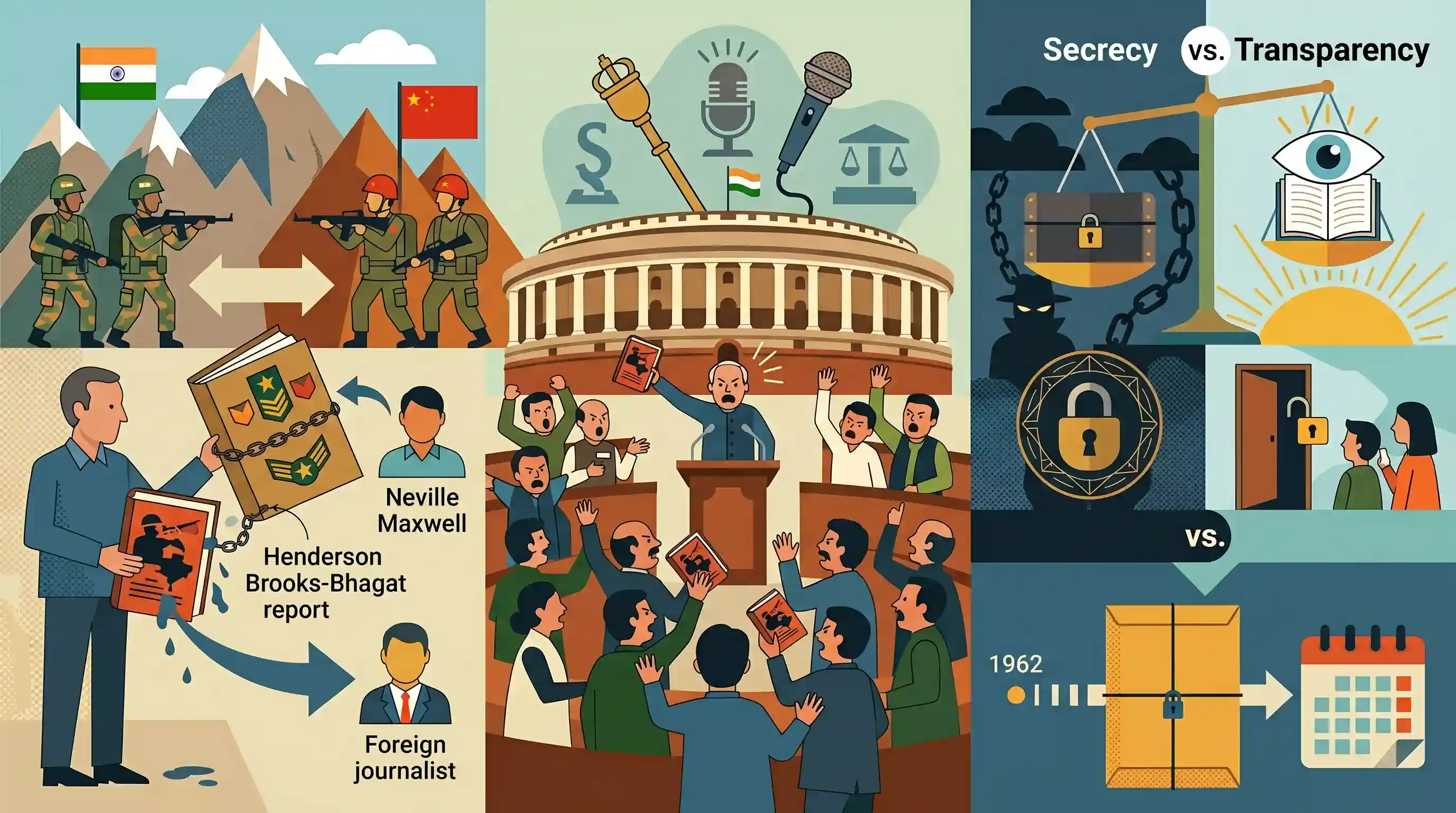
Fifty-five years ago, the publication of Neville Maxwell's controversial book, 'India's China War,' triggered a massive uproar in the Indian Parliament. The book was highly critical of India's 'Forward Policy' and placed the primary blame for the 1962 Sino-Indian War on New Delhi. What particularly infuriated Parliament was Maxwell's extensive use of the classified Henderson Brooks-Bhagat report—a top-secret internal army review of the 1962 military debacle that had been strictly withheld from Indian lawmakers and the public for national security reasons. The controversy highlighted critical issues regarding the Official Secrets Act, transparency in government, national security, and parliamentary privilege, as MPs demanded accountability for how a foreign journalist obtained classified state secrets. The event remains a landmark in the ongoing discourse around declassifying military history and balancing national defense secrecy with democratic accountability, especially since the report remains classified today.
Key Points
- In 1970, Neville Maxwell published 'India\\'s China War', controversially placing the blame for the 1962 Sino-Indian War on India\\'s 'Forward Policy' rather than Chinese aggression.
- The book caused a massive uproar in the Indian Parliament because Maxwell evidently had access to the highly classified Henderson Brooks-Bhagat Report, an internal military assessment of India\\'s 1962 defeat.
- Lawmakers were outraged that a foreign journalist obtained top-secret documents while the Indian Parliament and citizens were denied access on 'national security' grounds.
- The episode sparked intense debates concerning the Official Secrets Act, parliamentary privileges, and the balance between government transparency and national security.
- The Henderson Brooks-Bhagat report remains officially classified to this day, illustrating India\\'s enduring reluctance to declassify sensitive military history.
Important Terms
Official Secrets Act (OSA), 1923

A colonial-era law designed to protect state secrets and prevent espionage. It criminalizes the unauthorized communication of classified information that could prejudice national security or interests.
UPSC context
GS Paper II (Polity/Governance) and Paper III (Security). Tests balance between state secrecy, fundamental rights, and the Right to Information.
Forward Policy
A strategic military directive adopted by the Nehru government in 1961, establishing small, isolated Indian outposts in disputed border territories to block Chinese advancements and assert sovereignty.
UPSC context
GS Paper I (Post-Independence History) and GS III (Security). Tests understanding of strategic failures and causes of the 1962 conflict.
Henderson Brooks-Bhagat Report
An internal "Operations Review" commissioned by the Indian Army to analyze the 1962 military defeat. It reportedly critiques the Forward Policy and civil-military coordination; it remains classified today.
UPSC context
GS Paper II and III. Concerns administrative accountability, military history declassification, and the impact of systemic leadership failures on national security.
Parliamentary Privilege
Special rights and immunities (Article 105) granted to Members of Parliament and the House collectively to ensure they can perform legislative duties without fear of external legal interference.
UPSC context
GS Paper II (Polity). Tests the legislature's power to demand government accountability versus the executive's mandate to protect national security secrets.
1962 Sino-Indian War
A month-long border conflict between India and China primarily over the disputed Aksai Chin and North-East Frontier Agency (NEFA) regions, resulting in a humiliating military defeat for India.
UPSC context
GS Paper I (Post-Independence) and Paper II (International Relations). Analyzes the shift in India's non-alignment policy and subsequent modernization of the Indian Army.
Civil-Military Relations
The institutional interaction and power balance between the civilian political leadership and the professional military establishment regarding national defense and strategic policy formulation.
UPSC context
GS Paper III (Internal Security). Tests understanding of military accountability to the democratic government and the impact of political interference on operational readiness.
Declassification
The process by which a government removes the "secret" or "classified" status of older state documents, allowing them to be viewed by the public or researchers.
UPSC context
GS Paper II (Governance/Transparency). Relates to the "Public Records Act, 1993" and the ongoing debate over historical transparency versus operational security.
Prelims Trap
"The 'Forward Policy' was adopted by India to secure its borders immediately following the 1962 defeat."
The Forward Policy was actually initiated in 1961, before the war. It involved establishing outposts in disputed areas and acted as a catalyst for the conflict.
Static Concepts Connected
How does the RTI Act, 2005 interact with the Official Secrets Act (OSA), 1923?
- Section 22 overrides: The RTI Act explicitly overrides the OSA; if inconsistencies exist between the two statutes, RTI provisions are legally designed to prevail.
- Section 8(1)(a) exemption: The government can legally withhold documents if their disclosure prejudicially affects India's national security, sovereignty, or strategic interests.
- Public Interest Test: Under Section 8(2), a public authority may allow access to OSA-protected information if the public interest outweighs the harm.
What was India's 'Forward Policy' leading up to the 1962 Sino-Indian War?
- 1961 Initiation: A strategic military directive to establish Indian outposts in disputed territories, pushing troops up to the borders claimed by New Delhi.
- Key Geographies: Focused heavily on contested boundary regions, particularly in Aksai Chin (western sector) and NEFA (eastern sector).
- Logistical failure: The policy was executed without adequate logistical or combat support, leaving isolated posts highly vulnerable to the Chinese military assault.
Cross-Topic Patterns
1960s Forward Policy vs Vibrant Villages
India's 1961 Forward Policy failed partly due to missing infrastructure. Today's Vibrant Villages Programme and massive BRO construction reverse this historical vulnerability by integrating civilian and military logistics at the LAC.
Colonial Continuity in State Secrecy
The enduring use of the 1923 Official Secrets Act to shield the Henderson Brooks report highlights the tension between colonial-era administrative secrecy and post-2005 democratic accountability under the RTI.

Mains GS1/GS3: Expect a question contrasting the strategically flawed 1961 'Forward Policy' with India's current LAC infrastructure push.
Linked PYQs · 3
Linked PYQs · 3
- 2014MainsGS2
With respect to the South China sea, maritime territorial disputes and rising tension affirm the need for safeguarding maritime security to ensure freedom of navigation and over flight throughout the region. In this context, discuss the bilateral issues between India and China.
- 2012MainsGS2
Do you think that China's emergence as one of the largest trading partners of India has adversely affected the settlement of the outstanding border problem?
- 2020MainsGS2
Recent amendments to the Right to Information Act will have profound impact on the autonomy and independence of the Information Commission". Discuss.
