Uttarakhand Wildlife Conflicts: Casualties and State Data
Source:timesofindia-indiatimes ↗
Why It Matters
Crucial for understanding environmental challenges, biodiversity management, and rural safety in Uttarakhand for state-level civil services exams.
Summary
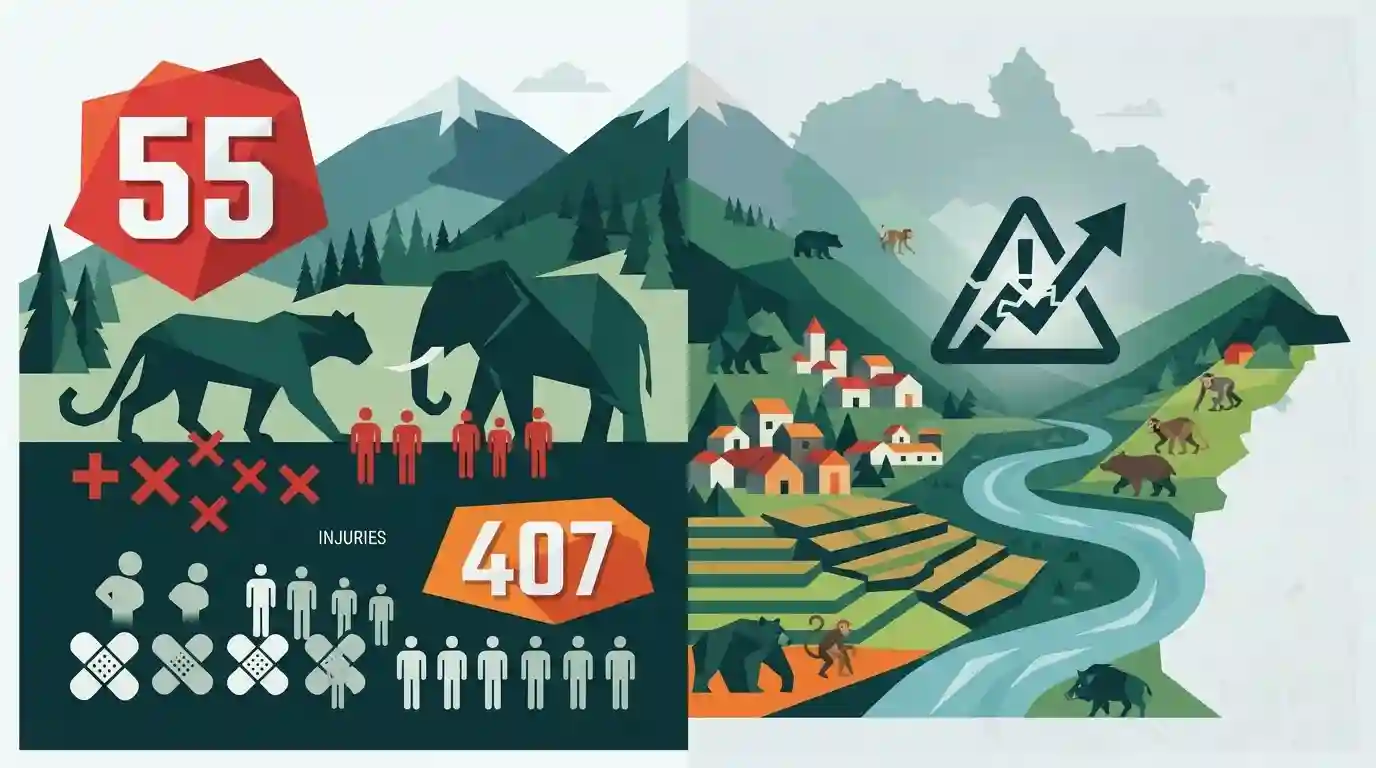
A report highlights that 55 people have been killed and 407 injured in wildlife conflicts across Uttarakhand this year, underlining the escalating human-wildlife crisis in the hill state.
Key Points
- 55 people killed and 407 injured in wildlife conflicts in Uttarakhand this year.
- Human-wildlife conflict remains a major socio-ecological challenge in the hilly state, affecting rural livelihoods and safety.
- The state forest department faces mounting pressure to mitigate attacks by wild animals such as leopards, elephants, and tigers.
Important Terms
Forest Department Uttarakhand

The state government body responsible for protecting and managing Uttarakhand's forests, wildlife, and implementing policies related to man-animal conflict mitigation, eco-tourism, and compensation distribution.
UPSC context
Important for UKPSC Mains (GS Paper III - Environment & Ecology/State Administration), testing knowledge of institutional mechanisms handling environmental challenges.
Human-Wildlife Conflict Relief Distribution Fund Rules
State framework guiding financial relief and compensation payouts for victims of leopard, elephant, and other wildlife attacks, recently amended to increase death compensation to ₹10 lakh.
UPSC context
Crucial for UKPSC exams (Uttarakhand-specific governance, welfare policies, and environmental management schemes).
Static Concepts Connected
What are the legal provisions and institutional mechanisms for wildlife conflict management in India?
- Legal Framework: Under the Wildlife Protection Act, 1972, Schedule II species involved in fatal attacks can be targeted under specific orders issued by the Chief Wildlife Warden.
- Compensation Scheme: Ex-gratia financial relief is provided to victims or their families by state forest departments, funded partly through central schemes like Integrated Development of Wildlife Habitats.
- Mitigation Tools: Mitigation techniques include bio-fencing, early-warning systems, elephant trenches, and translocation of habitual maneaters following strict SOPs.
Cross-Topic Patterns
HWC and Uttarakhand's Rural Migration Crisis
Human-wildlife conflict intersects with rural out-migration and ghost villages, as abandoned agricultural fields become scrublands that act as breeding grounds and transit corridors for leopards.
Wildlife Protection Act and State Powers
Under the Wildlife Protection Act, 1972, states can declare certain nuisance animals as vermin under specific conditions, creating complex federal-state policy debates on conservation vs safety.

UKPSC frequently tests Uttarakhand-specific environment statistics. Expect a statement-based question combining HWC mortality data and key species.
Linked PYQs · 1
Linked PYQs · 1
- 2025UKPSC_PRELIMSGS1
Consider the following statements with reference to animal husbandry in Uttarakhand. Select the correct answer from the codes given below : 1. Animal husbandry is a supplementary occupation of agriculture. 2. Sheep rearing in the mountainous areas has been affected by environmental degradation.
