SAARC Visa Exemption Scheme Suspension and Repatriations
Source:The Hindu ↗
Why It Matters
The incident illustrates India's swift diplomatic and security countermeasures following a terror attack. The suspension of the SAARC Visa Exemption Scheme and the usage of the Attari check post for immediate repatriations underline the direct impact of cross-border terrorism on bilateral ties, regional cooperation, and border management strategies.
Summary
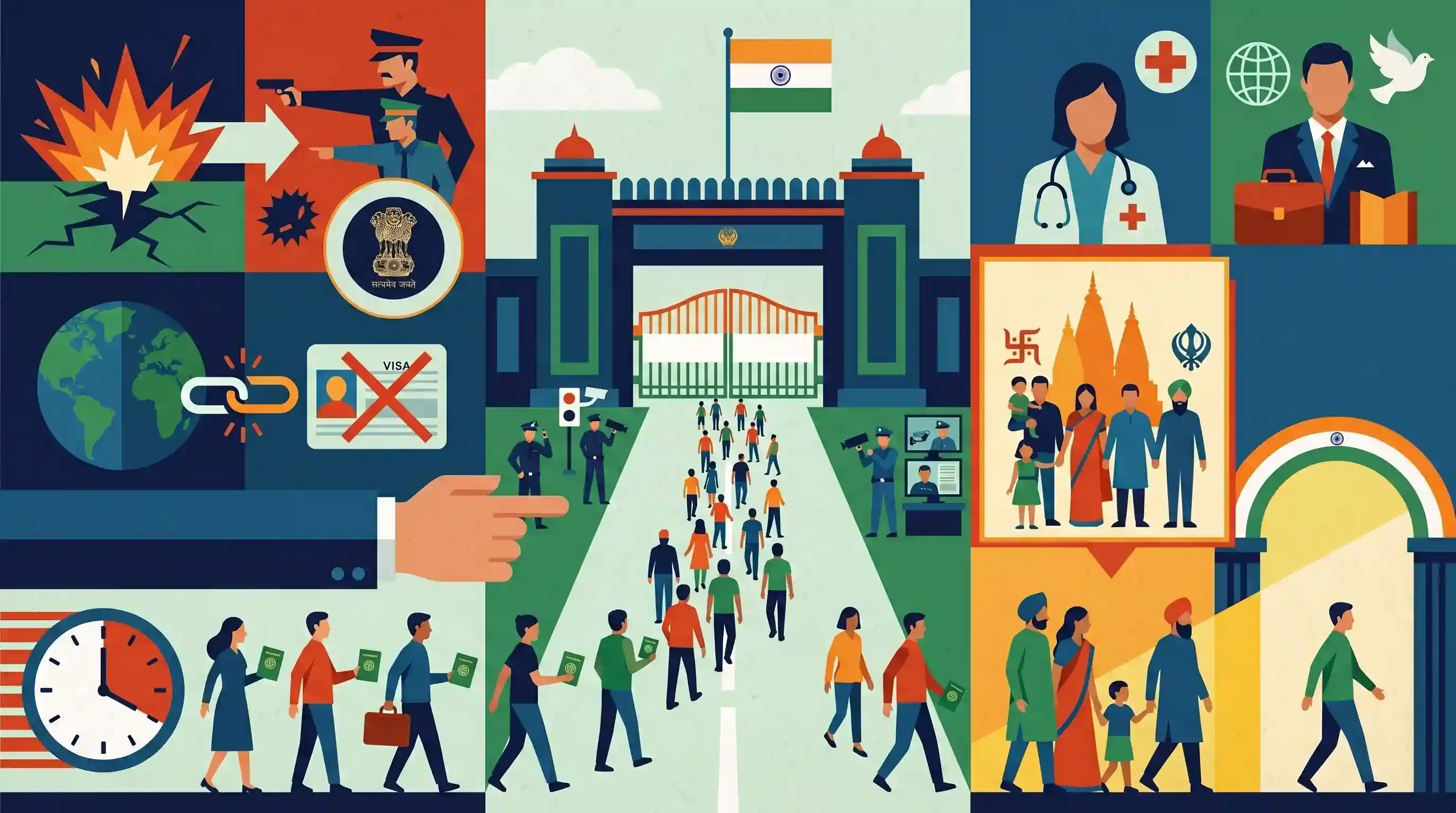
Following the Pahalgam terror attack, India implemented stringent punitive measures against Pakistan, including the suspension of the SAARC Visa Exemption Scheme (SVES) for Pakistani nationals. A strict deadline was issued for most Pakistani citizens to leave India, leading to the departure of 537 individuals via the Integrated Check Post at the Attari border. The Ministry of Home Affairs monitored the exit process, explicitly exempting individuals on medical, diplomatic, and long-term visas—the latter primarily held by Hindu and Sikh minorities seeking Indian citizenship.
Key Points
- Following the Pahalgam terror attack, India revoked visas for most Pakistani citizens, exempting those on medical, diplomatic, and long-term visas.
- As a punitive measure, Pakistani nationals have been banned from travelling to India under the SAARC Visa Exemption Scheme (SVES).
- 537 Pakistanis exited India through the Integrated Check Post (ICP) at the Attari border ahead of the 48-hour deadline set by the government.
- The Ministry of Home Affairs (MHA) has not extended the deadline, though officials indicated potential exemptions on extreme compassionate grounds.
- Long-term visas, which are typically granted to Hindu and Sikh minorities from Pakistan seeking Indian citizenship, have not been revoked.
Important Terms
SAARC Visa Exemption Scheme (SVES)

Launched in 1992, this regional mechanism allows select categories—including dignitaries, journalists, and businesspersons—to travel visa-free among member states using a 'SAARC Visa Sticker' to foster regional people-to-people contact.
UPSC context
GS Paper II (International Relations); covers neighborhood-first policy, regional diplomacy, and the impact of cross-border terrorism on multilateral agreements.
Border Security Force (BSF)
Established in 1965, it is India’s primary border-guarding organization for the Pakistan and Bangladesh borders. Termed the "First Line of Defence," it handles anti-infiltration, anti-smuggling, and ceremonial duties at land borders.
UPSC context
GS Paper III (Internal Security); essential for understanding border management, security challenges, and the role of Central Armed Police Forces.
Ministry of Home Affairs (MHA)
The nodal Indian ministry for internal security, border management, and immigration. It oversees the BSF and coordinates between administrative, security, and intelligence agencies to manage international land and coastal borders.
UPSC context
GS Paper III (Security); tests knowledge of the administrative framework responsible for national security and border policies.
SAARC
An intergovernmental organization of eight South Asian nations (Afghanistan, Bangladesh, Bhutan, India, Maldives, Nepal, Pakistan, Sri Lanka) founded in 1985 to promote regional economic, social, and cultural cooperation.
UPSC context
GS Paper II (IR); important for regional integration, India’s foreign policy challenges, and the effectiveness of multilateral South Asian forums.
Integrated Check Post (ICP)
A world-class facility at international land borders that integrates customs, immigration, and security services. It aims to facilitate the seamless movement of passengers and cargo while maintaining strict security oversight.
UPSC context
GS Paper III (Border Management); relates to infrastructure development, border trade facilitation, and securing entry/exit points against hostile interests.
Prelims Trap
Long-Term Visas (LTVs) and border immigration checkpoints are regulated by the Ministry of External Affairs.
The Ministry of Home Affairs (MHA) regulates immigration, controls Integrated Check Posts via LPAI, and issues LTVs for persecuted minorities, not the MEA.
Static Concepts Connected
What is the mandate of the Land Ports Authority of India (LPAI)?
- Statutory body: Established under the LPAI Act, 2010, functioning under the Department of Border Management, Ministry of Home Affairs.
- Core function: Develops, sanitizes, and manages Integrated Check Posts (ICPs) along India's international land borders (like Attari).
- Holistic security: Integrates customs, immigration, and border security infrastructure under a single unified administrative roof for seamless transit.
How does the SAARC Visa Exemption Scheme (SVES) function?
- Origins: Launched in 1992 to foster regional cooperation and closer people-to-people ties among SAARC member states.
- Restricted access: Not available to the general public. It is strictly limited to 24 specific categories, including dignitaries, judges, and select businesspersons.
- Mechanism: Issues a special sticker exempting the eligible holder from standard visa requirements for short-term visits.
Cross-Topic Patterns
Visa policy as coercive diplomacy
India increasingly weaponizes administrative tools—like mass visa suspensions, MFN status revocation, and SVES halts—as immediate non-kinetic diplomatic retaliation against state-sponsored cross-border terrorism.
LTVs as precursors to the CAA
Exempting LTVs during a mass visa revocation underscores India's structured protection for persecuted minorities, linking temporary border management directly to the CAA's naturalized citizenship pathways.

A 2026 Prelims question will likely test MHA's exclusive jurisdiction over Long-Term Visas and LPAI against the MEA's diplomatic mandate.
Linked PYQs · 3
Linked PYQs · 3
- 2025MainsGS3
Terrorism is a global scourge. How has it manifested in India? Elaborate with contemporary examples. What are the counter measures adopted by the State? Explain.
- 2016MainsGS2
Increasing cross-border terrorist attacks in India and growing interference in the internal affairs of several member-states by Pakistan are not conducive for the future of SAARC (South Asian Association for Regional Cooperation)." Explain with suitable examples.
- 2024MainsGS3
India has a long and troubled border with China and Pakistan fraught with contentious issues. Examine the conflicting issues and security challenges along the border. Also give out the development being undertaken in these areas under the Border Area Development Programme (BADP) and Border Infrastructure and Management (BIM) Scheme.
