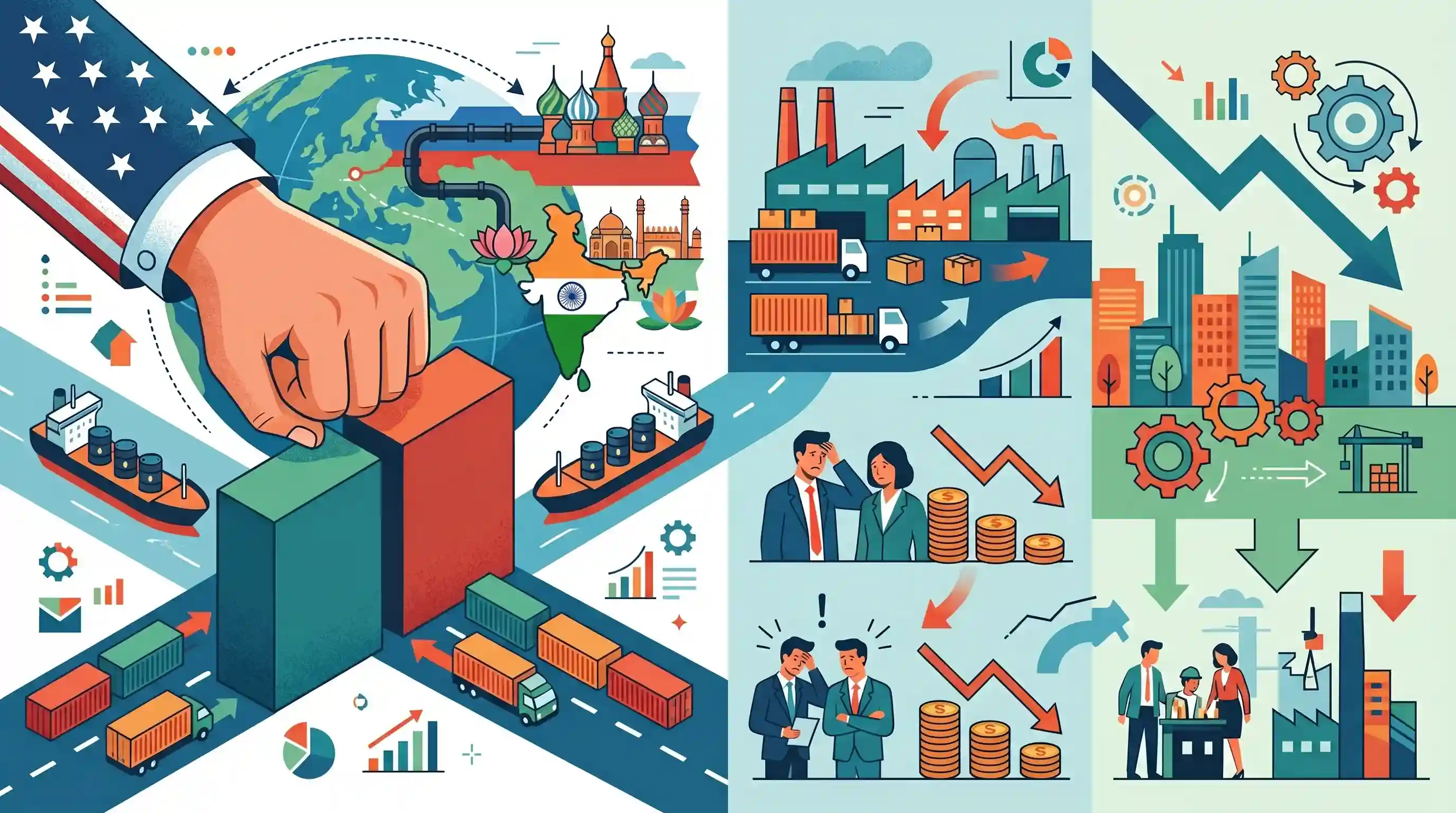
US secondary tariffs and macroeconomic vulnerability of Indian exports
Source:The Hindu ↗
Why It Matters
Highlights the vulnerability of India's export sector and macroeconomic stability to geopolitical tensions (e.g., secondary sanctions related to the Russia-Ukraine war) and rising U.S. protectionism. Highly relevant for questions on global trade regimes and economic diplomacy.
Summary
A Moody’s Analytics report warns that the combined 50% tariffs on Indian exports to the U.S. will “very substantially” reduce demand. The tariffs include an ongoing 25% duty and a new 25% secondary tariff, slated for August 27, targeting India's economic ties with Russia, notably its purchase of Russian crude oil. The protectionist measures will likely force firms to slash prices to maintain volumes, squeezing margins, wages, and investments, while creating a notable drag on economic growth and exports.
Key Points
- The U.S. is imposing a combined 50% tariff on Indian exports, comprising an existing 25% duty and a new 25% secondary tariff taking effect on August 27.
- The secondary tariff penalizes India for its ongoing economic dealings with Russia, specifically the purchase of Russian crude oil amid the Ukraine war.
- Moody's Analytics anticipates a "very substantial" reduction in U.S. demand for Indian goods, which could force Indian firms to slash prices, squeezing profit margins, wages, and investments.
- U.S. tariffs and protectionist policies are also leaving trading partners across Europe and the Asia-Pacific region "bruised," with prolonged drags expected on global growth and exports.
Important Terms
World Trade Organization (WTO)

The only global international organization dealing with the rules of trade between nations. It provides a forum for negotiating trade agreements and resolving disputes among member countries.
UPSC context
Core GS Paper III topic; relevant for trade disputes, subsidies, and the impact of protectionism on multilateralism.
Moody's Analytics
A subsidiary of Moody’s Corporation that provides economic research, data, and risk analysis. Its reports assess global trends and their specific impacts on national economies.
UPSC context
GS Paper III; relevant for understanding how external credit rating agencies and research firms influence investor sentiment and policy discourse.
Secondary Tariff
A trade penalty imposed on a country (e.g., India) specifically because of its economic dealings with a third-party nation (e.g., Russia), intended to pressure the target country's foreign policy.
UPSC context
GS Paper II and III; tests the intersection of international relations, sanctions, and trade as a tool of geopolitical leverage.
Protectionism
Economic policy of restricting imports from other countries through methods such as high tariffs on imported goods, import quotas, and a variety of other government regulations.
UPSC context
GS Paper III; central to discussions on globalization, trade wars, and India’s 'Atmanirbhar Bharat' (Self-Reliant India) initiative.
External Sector
The portion of an economy that interacts with the rest of the world. It includes exports, imports, foreign investments, and the balance of payments.
UPSC context
GS Paper III; tested via concepts like export competitiveness, trade deficit, and resilience against external economic shocks.
International Emergency Economic Powers Act (IEEPA)
A 1977 U.S. federal law granting the President authority to regulate international commerce after declaring a national emergency; it serves as the legal basis for many U.S. trade penalties.
UPSC context
GS Paper II; important for understanding how domestic laws of major powers impact global trade and India's strategic autonomy.
Reciprocal Tariff
A tariff imposed in response to another country's trade barriers or 'unfair' practices, aimed at equalizing trade terms between the two nations.
UPSC context
GS Paper III; relevant for analyzing 'tit-for-tat' trade strategies and their impact on India's export-led growth.
Prelims Trap
The US tariffs on Indian exports due to Russian oil are Countervailing Duties authorized by the WTO.
False. Countervailing duties target foreign state subsidies. The US secondary tariffs are unilateral geopolitical penalties, often violating WTO's Most-Favored-Nation (MFN) principle.
Static Concepts Connected
What distinguishes Unilateral Tariffs from WTO Trade Remedies?
- Trade Remedies: ADDs and CVDs target unfair trade practices (dumping or state subsidies) and are structurally permitted under WTO rules.
- Unilateral Tariffs: Geopolitical or protectionist duties imposed independently by a single nation, often violating the core MFN principle.
- Security Exception: Nations increasingly invoke GATT Article XXI (essential security interests) to justify unilateral trade barriers, weakening the multilateral system.
How do 'Secondary Sanctions' or 'Secondary Tariffs' work?
- Third-Party Targeting: Unlike primary sanctions, they penalize neutral third-party countries or firms (like India) for doing business with a primary sanctioned entity (like Russia).
- Extraterritorial Reach: They rely on the sanctioning nation's dominant market size or control of global financial systems to extraterritorially enforce its domestic foreign policy.
Cross-Topic Patterns
Energy Security vs Export Growth
India's purchase of cheap Russian crude protects domestic inflation but triggers US secondary tariffs, demonstrating the direct economic costs of geopolitical multi-alignment.
Margin Squeeze & Private Capex
To maintain US export volumes against 50% tariffs, Indian firms must absorb costs, reducing corporate margins and likely delaying much-needed private sector capital expenditure.

Expect a 2026 prelims question pairing the WTO’s Most-Favored-Nation exceptions (Article XXI) with US unilateral secondary tariffs.
Linked PYQs · 3
Linked PYQs · 3
- 2025MainsGS3
What are the challenges before the Indian economy when the world is moving away from free trade and multilateralism to protectionism and bilateralism? How can these challenges be met?
- 2018MainsGS3
How would the recent phenomena of protectionism and currency manipulations in world trade affect macroeconomic stability of India?
- 2018MainsGS2
What are the key areas of reform if the WTO has to survive in the present context of "Trade War', especially keeping in mind the interest of India?
