Spotted deer translocation to Surat forests for prey base
Source:deshgujarat ↗
Why It Matters
Understanding species translocation and habitat management is crucial for the Environment and Ecology syllabus. It highlights practical administrative measures taken to resolve human-wildlife conflict and conserve biodiversity under statutory frameworks like the Wildlife (Protection) Act, 1972.
Summary
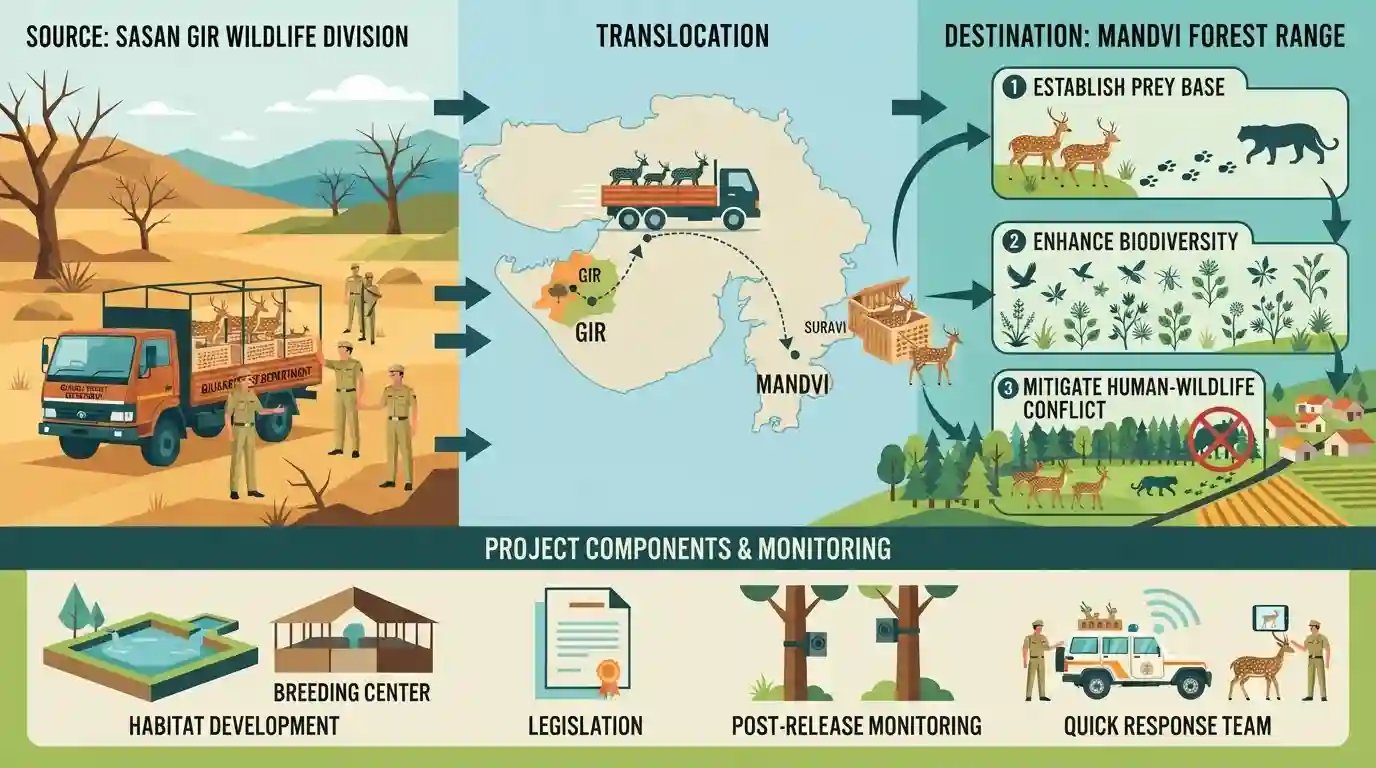
The Gujarat Forest Department has translocated 50 spotted deer from the Sasan Gir Wildlife Division to the Mandvi Forest Range in Surat district. This ecological intervention aims to establish a robust natural prey base for carnivores, enhance regional biodiversity, and mitigate human-wildlife conflicts by keeping predators within forest boundaries. Executed under the Wildlife (Protection) Act of 1972, the project also involves habitat development, including new water points and breeding centers, alongside stringent post-release monitoring using camera traps and a Quick Response Team.
Key Points
- The Gujarat Forest Department successfully translocated 50 spotted deer (Axis axis) from the Sasan Gir Wildlife Division to the Mandvi Forest Range in Surat.
- The primary objective is to strengthen the natural prey base for local carnivores (such as leopards), thereby supporting long-term ecological balance and biodiversity in South Gujarat.
- By ensuring predators can meet their food requirements within the forest, the initiative aims to significantly reduce human-wildlife conflict in surrounding settlements.
- The translocation, conducted under the provisions of the Wildlife (Protection) Act of 1972, includes habitat improvement measures like the development of 10 permanent water points.
- Post-release monitoring is being heavily emphasized with the deployment of trackers, camera traps, and a dedicated Quick Response Team (QRT) for wildlife emergencies.
Important Terms
Wildlife (Protection) Act, 1972

India's primary legislation for wildlife conservation. It establishes protected areas, regulates hunting and wildlife trade, and categorizes flora and fauna into specific schedules based on their threat levels.
UPSC context
Vital for GS 3 (Environment). UPSC frequently tests species schedules, protected area regulations, and statutory bodies like NTCA established under it.
Spotted Deer (Chital)
A medium-sized, gregarious deer species native to the Indian subcontinent, recognized by its reddish-brown coat with white spots. It serves as a critical prey base for large carnivores.
UPSC context
GS 3 (Environment). Tests knowledge of species conservation status; it is classified as 'Least Concern' (IUCN) and legally protected in India.
Prey Base Translocation
The deliberate capture and relocation of wild prey animals (like herbivores) from one habitat to another. It aims to restore ecological balance by ensuring adequate food availability for predators.
UPSC context
GS 3 (Biodiversity). Showcases scientific ecosystem management, vital for maintaining stable prey-predator dynamics and mitigating human-wildlife conflict.
Human-Wildlife Conflict (HWC)
Negative interactions between humans and wild animals. This often occurs when predators wander into human-dominated settlements in search of food due to shrinking habitats or depleted natural prey bases.
UPSC context
Core GS 3 topic. UPSC asks about its causes, consequences, and mitigation strategies like ecological restoration and Quick Response Teams.
Prelims Trap
Spotted deer are currently translocated because they are a critically endangered species facing severe habitat loss.
Spotted deer (Chital) are categorized as 'Least Concern' by the IUCN. Their translocation here is an ecological tool for ecosystem management (augmenting prey bases), not a species rescue operation.
Static Concepts Connected
What are the structural ecological methods used to mitigate Human-Wildlife Conflict (HWC)?
- Prey-base augmentation: Relocating herbivores to degraded ranges to ensure apex carnivores have sufficient food within protected forest boundaries.
- Habitat enrichment: Developing permanent water holes, removing invasive weeds, and restoring grasslands to sustain viable local herbivore populations.
- Boundary deterrents: Constructing bio-fences, solar-powered fences, and trenches at the direct interface of forests and human habitations.
How does the Wildlife (Protection) Act, 1972 regulate wildlife translocation?
- Scientific Management: Section 12 specifically allows the relocation and translocation of wild animals for population management, species recovery, and ecological balance.
- Statutory Approvals: Requires explicit prior permission from the Chief Wildlife Warden of the State, alongside veterinary supervision.
- Monitoring Mandates: Post-release protocols mandate the deployment of camera traps, trackers, and Quick Response Teams to ensure successful acclimatization.
Cross-Topic Patterns
Prey Base & Project Cheetah
Similar to Kuno National Park, augmenting the Chital prey base is a prerequisite for sustaining large carnivores and ensuring the success of major apex-predator rewilding projects.
Leopard Dispersal and HWC
The rise in leopard-human conflict in western India is directly linked to shrinking natural prey bases, which forces predators into agricultural and peri-urban landscapes to hunt livestock.

Prey-base augmentation as an ecological tool to mitigate Human-Wildlife Conflict (HWC) is a high-probability applied ecology concept for 2026.
Linked PYQs · 2
Linked PYQs · 2
- 2024GPSC_PRELIMSGS1
Which of the following are legal provisions for the implementation of the Fundamental Duties? 1. The Protection of Civil Rights Act. 2. The Unlawful Activities (Prevention) Act. 3. The Representation of Peoples Act. 4. The Wildlife (Protection) Act Select the correct answer code:
- 2026GPSC_PRELIMSGS1
The 'Great Indian Bustard (GIB)' (Ghorad) is frequently seen in the news in the context of wildlife conservation efforts in western India. Consider the following statements regarding this species: 1. Currently, the highest surviving wild population of the Great Indian Bustard in India is located in the semi-arid grasslands of Gujarat. 2. It is a long-distance migratory bird that travels from Central Asia to the Indian subcontinent to escape harsh winters. Which of the above statement(s) is/are correct?
