Rural Employment Scheme Faces Structural Hurdles and Execution Test
Source:Indian Express ↗
આ શા માટે મહત્વનું છે
Rural employment schemes are critical indicators of distress in India's hinterlands and dictate the effectiveness of social safety nets, making their analysis essential for GS3 (Inclusive Growth & Welfare Schemes).
સારાંશ
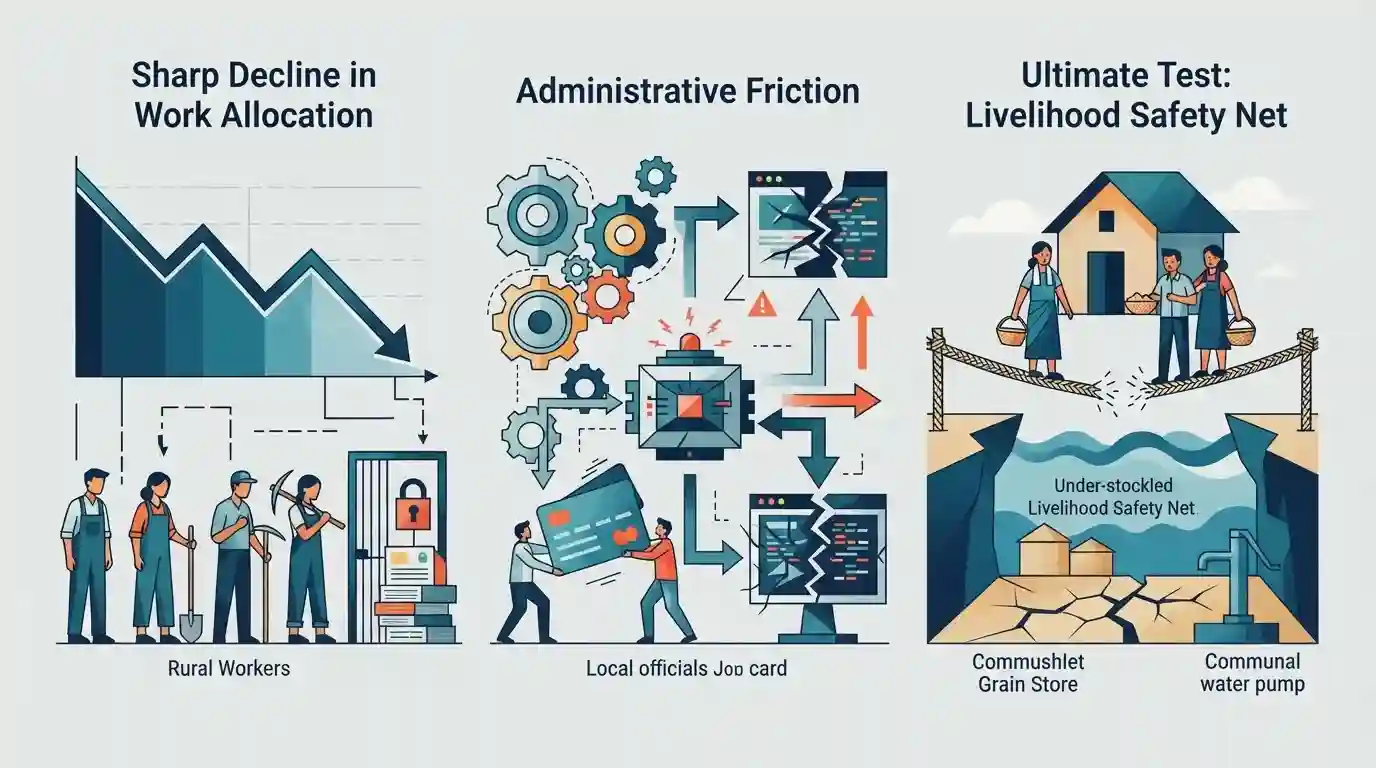
The video and analysis by the Indian Express explore the challenges confronting India's new rural jobs scheme, highlighting a sharp decline in work allocation, administrative friction, and its ultimate test as a livelihood safety net for rural households.
મુખ્ય મુદ્દા
- India's new rural jobs scheme is facing a major test amid reports of a significant decline or collapse in job generation.
- Rural employment programs are crucial safety nets for millions of agricultural laborers and marginalized households.
- Structural bottlenecks, administrative hurdles, and policy shifts impact the efficiency and reach of rural employment guarantee frameworks.
મહત્વપૂર્ણ શબ્દો
New Rural Jobs Scheme

The Viksit Bharat–Guarantee for Rozgar and Ajeevika Mission (Gramin), or VB-G RAM G, is a revamped rural employment scheme replacing MGNREGA, offering 125 days of wage employment and revised wage structures.
UPSC context
UPSC CSE Mains Paper II: Welfare schemes for vulnerable sections of the population, inclusive growth, and employment generation challenges.
MGNREGA
A landmark social welfare law enacted in 2005 guaranteeing 100 days of unskilled manual wage employment to rural households, recently replaced by the VB-G RAM G Act.
UPSC context
UPSC CSE Mains Paper II (Governance/Social Justice) and Prelims: evolution, impact, and policy shifts in rural livelihood safety nets.
Indian Express
A prominent Indian English daily newspaper providing in-depth journalism, policy analysis, and investigative coverage on socioeconomic and governance issues.
UPSC context
UPSC CSE: Source for editorial analysis, current affairs, and critical perspectives on public policy and administrative reforms.
સંલગ્ન સ્થિર ખ્યાલો
What are the core legal and operational pillars of MGNREGA?
- Legal Entitlement: Guarantees 100 days of manual wage employment per rural household every financial year on demand.
- Decentralized Execution: Gram Panchayats are mandated to execute at least 50% of the works in terms of cost.
- Wage Indexation: Statutory minimum wages under the scheme are indexed to Consumer Price Index-Agricultural Labourers (CPI-AL).
આંતર-વિષય પેટર્ન
Rural Job Cuts & Aggregate Demand Drag
Rural employment contraction directly hits rural FMCG consumption demand, creating a structural drag on broader industrial manufacturing growth and recovery.
Employment Safety Nets & Poverty Dynamics
A decline in guaranteed rural wage employment directly inflates rural poverty ratios and worsens agrarian distress metrics measured by NSSO/PLFS surveys.

MGNREGA / rural job schemes + demand-side economics + fiscal federalism will likely be combined in a Mains GS-3 question.
સંલગ્ન PYQ · 3
સંલગ્ન PYQ · 3
- 2021MainsGS3
What are the present challenges before crop diversification? How do emerging technologies provide an opportunity for crop diversification?
- 2019PrelimsGS1
The Service Area Approach was implemented under the purview of
- 2020PrelimsGS1
With reference to the Indian economy after the 1991 economic liberalization, consider the following statements: 1. Worker productivity (₹ per worker at 2004-05 prices) increased in urban areas while it decreased in rural areas. 2. The percentage share of rural areas in the workforce steadily increased. 3. In rural areas, the growth in non-farm economy increased. 4. The growth rate in rural employment decreased. Which of the statements given above is/are correct?
