US EU Trade Deal and Transatlantic Economic Integration
Source:Indian Express ↗
Why It Matters
The creation of a massive transatlantic trade bloc reshapes global commerce, potentially bypassing WTO frameworks and imposing new regulatory hurdles or opportunities for India's export economy.
Summary
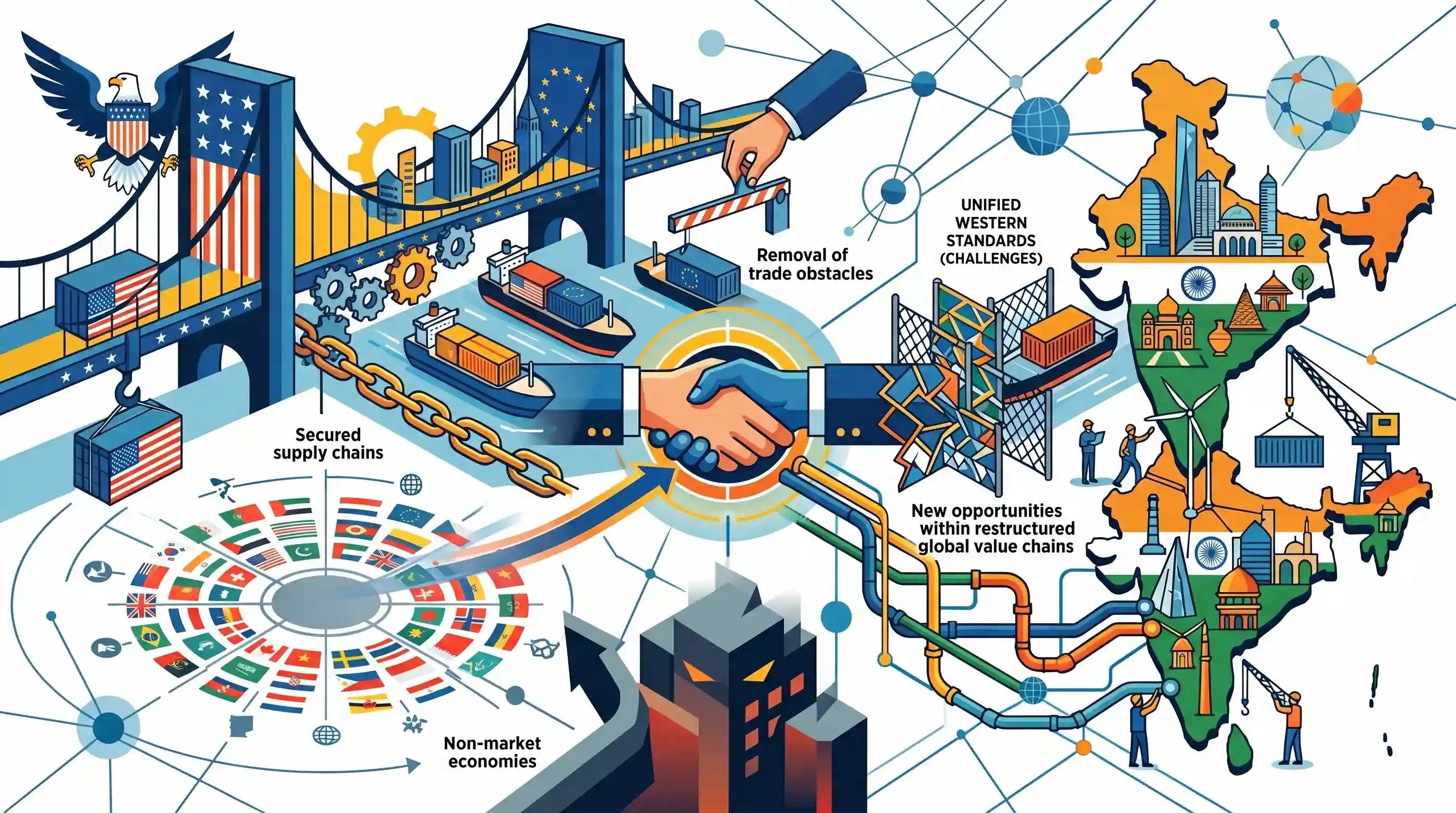
The historic US-EU trade deal seeks to deepen transatlantic economic integration by lowering tariffs, harmonizing regulatory standards, and securing critical supply chains. By establishing the world's largest bilateral trade agreement, the US and EU aim to counter the economic influence of non-market economies and reduce their reliance on the broader multilateral WTO framework. This strategic partnership poses both challenges and opportunities for India, as unified Western standards could create new non-tariff barriers for developing nations while simultaneously restructuring global value chains.
Key Points
- Unprecedented Economic Bloc: The agreement merges the US and EU into a tightly integrated economic zone to counteract the rising influence of rival powers in global trade.
- Supply Chain Security: Emphasizes the relocation and security of critical supply chains, particularly in green tech and semiconductors, away from geopolitical competitors.
- Multilateralism to Bilateralism: Highlights the ongoing global shift where major economic powers increasingly favor comprehensive bilateral deals over the stalled World Trade Organization (WTO) negotiations.
- Impact on India: A stronger US-Europe strategic partnership and harmonized trade standards require India to adapt its export strategies to avoid being marginalized by new non-tariff barriers.
Important Terms
US-EU Trade Agreement

A 2025 framework (the "Turnberry Deal") that established a 15% tariff ceiling and massive energy-investment commitments, signaling a strategic shift toward bilateralism over traditional multilateral frameworks.
UPSC context
GS Paper 2: International Relations; tests understanding of shifting global trade alliances and the strategic realignment of Western economies.
Non-tariff barriers (NTBs)
Regulatory or procedural measures—such as quality standards, environmental certifications, or licensing—that restrict imports without using direct taxes or tariffs.
UPSC context
GS Paper 3: Economy; critical for understanding "hidden" protectionism and how unified Western standards may exclude Indian exports from global markets.
Non-market economies
Nations where state intervention significantly influences production and pricing (e.g., China), allowing trading partners to impose anti-dumping duties based on third-country cost benchmarks rather than local data.
UPSC context
GS Paper 3: International Trade; relevant for anti-dumping investigations and India's response to state-led economic models in the neighborhood.
Global Value Chains (GVCs)
The fragmented network of production and distribution processes spanning multiple countries, where each stage adds specific value to a product's conception, manufacture, and delivery.
UPSC context
GS Paper 3: Indian Economy; tests India's strategic goal to integrate into global manufacturing hubs and the resilience of supply chains.
World Trade Organization (WTO)
The global intergovernmental organization regulating international trade, currently challenged by a rise in protectionism and bilateral deals that bypass its multilateral dispute-resolution and rules-based framework.
UPSC context
GS Paper 2: International Institutions; tests the crisis of multilateralism and India's advocacy for a fair global trade order.
European Union (EU)
An economic and political union of 27 European countries acting as a single market with unified regulatory standards, frequently negotiating major trade pacts as a single bloc.
UPSC context
GS Paper 2: International Relations; essential for India's bilateral trade negotiations and understanding the impact of Euro-American economic alignment.
Prelims Trap
Regional trade agreements like the US-EU pact inherently violate the WTO's Most-Favoured-Nation (MFN) principle.
GATT Article XXIV explicitly allows Free Trade Agreements and Customs Unions as an exception to the MFN rule, provided they facilitate trade and do not arbitrarily raise barriers for third parties.
Static Concepts Connected
What are the exceptions to the WTO's Most-Favoured-Nation (MFN) principle?
- Regional Trade Agreements: Under GATT Article XXIV, countries can form FTAs or Customs Unions, offering better tariffs to each other than to the rest of the WTO.
- Generalized System of Preferences: Developed countries can offer non-reciprocal preferential treatment (lower tariffs) to products from developing countries (e.g., US Generalized System of Preferences).
- National Security Exception: Article XXI allows members to breach MFN obligations to protect essential national security interests.
How do Non-Tariff Barriers (NTBs) function in international trade?
- Technical Barriers (TBT): Domestic policies regarding product size, weight, and environmental impact (like the Carbon Border Adjustment Mechanism) that make imported goods uncompetitive.
- Sanitary & Phytosanitary (SPS): Strict regulations on food safety and animal/plant health that are often used disproportionately against agricultural exports from developing nations.
Cross-Topic Patterns
Green Trade Barriers + CBDR Principle
Harmonized US-EU green standards (like CBAM) directly clash with the UNFCCC's CBDR principle, effectively weaponizing trade policy to force developing nations to bear the cost of climate mitigation.
Friend-shoring + Minerals Security Partnership
The US-EU push for secure semiconductor and green-tech supply chains mirrors the Minerals Security Partnership (MSP), deeply intertwining geoeconomic trade pacts with strategic critical mineral dominance.

Expect a 2026 GS2 question linking WTO's decline to the rise of Western mega-regional trade blocs and their impact on India.
Linked PYQs · 4
Linked PYQs · 4
- 2025MainsGS3
What are the challenges before the Indian economy when the world is moving away from free trade and multilateralism to protectionism and bilateralism? How can these challenges be met?
- 2023MainsGS2
‘The expansion and strengthening of NATO and a stronger US-Europe strategic partnership works well for India.’ What is your opinion about this statement ? Give reasons and examples to support your answer.
- 2018MainsGS3
How would the recent phenomena of protectionism and currency manipulations in world trade affect macroeconomic stability of India?
- 2016MainsGS2
The broader aims and objectives of WTO are to manage and promote international trade in the era of globalization. But the Doha round of negotiations seem doomed due to differences between the developed and the developing countries." Discuss in the Indian perspective.
