Hospital Fire Tragedy: Inquiry ordered after deaths in Muzaffarpur
Source:The Hindu ↗
Why It Matters
This incident highlights critical challenges in public and private health infrastructure safety, specifically the enforcement of fire safety audits in hospitals. For BPSC Prelims, understanding district-level administration (such as Muzaffarpur's district profile) and state-level disaster management guidelines (like standard ex-gratia compensations) is highly relevant.
Summary
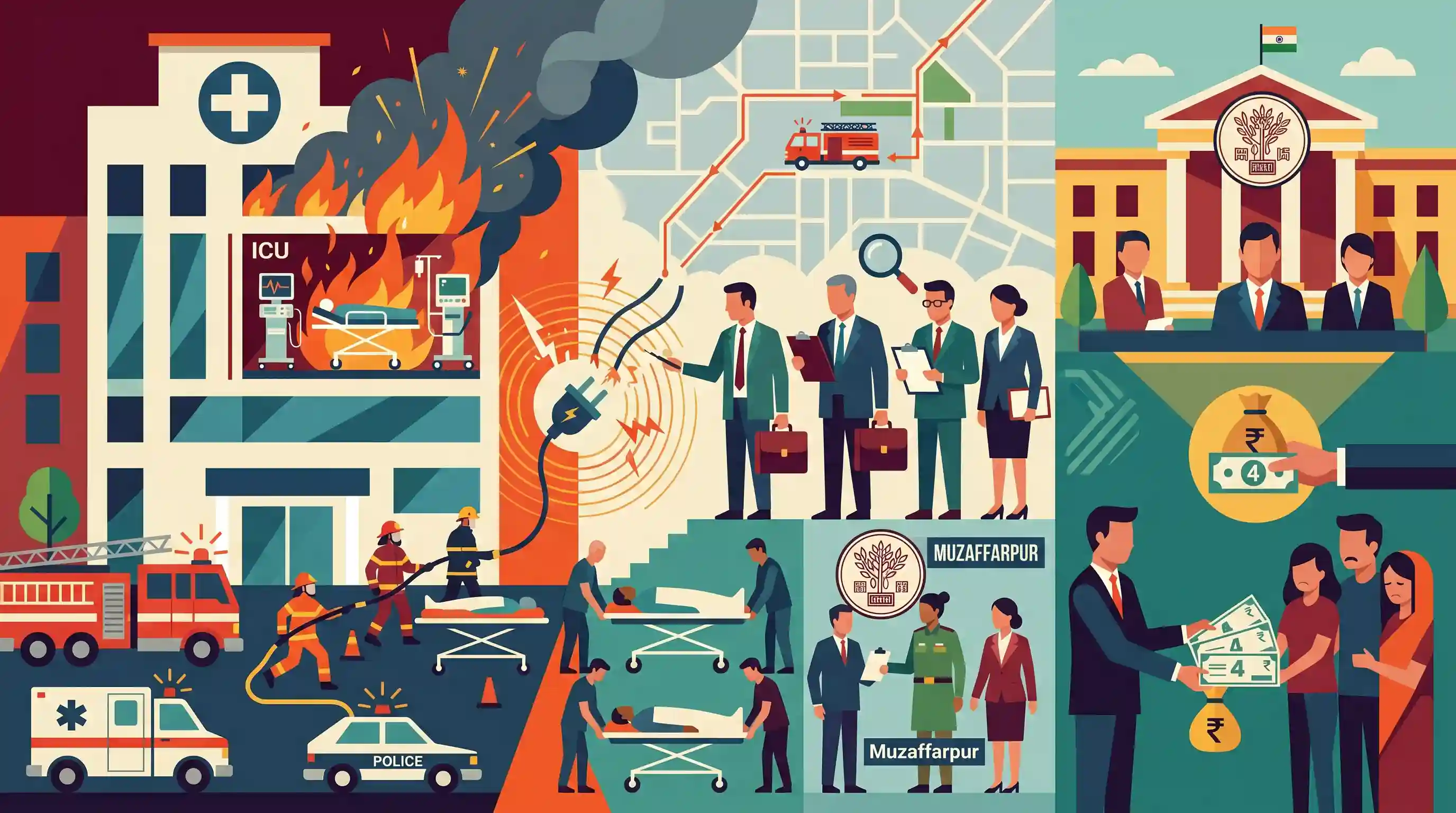
A tragic fire at the ICU of Prasad Hospital in Muzaffarpur, Bihar, claimed the lives of five patients. The incident, suspected to be caused by an electrical short-circuit, prompted the Bihar government to initiate a high-level inquiry through a five-member committee and announce an ex-gratia compensation of ₹4 lakh for the deceased families.
Key Points
- A major fire broke out at the ICU of the private Prasad Hospital in Muzaffarpur, north Bihar, resulting in the death of five patients and leaving several others injured.
- The fire occurred on the fifth floor of the hospital and was reportedly caused by an electrical short-circuit in the ICU's air conditioning system or related medical equipment.
- Muzaffarpur District Magistrate Subrat Kumar Sen coordinated the initial rescue operations and ordered an inquiry into the incident.
- Bihar Chief Minister Samrat Choudhary announced a compensation of ₹4 lakh as ex-gratia to the families of each deceased victim.
- The Bihar government has constituted a five-member high-level committee to conduct a thorough probe into the structural and safety lapses at the facility.
Important Terms
State Disaster Response Fund (SDRF)

The primary statutory fund available with state governments under the Disaster Management Act, 2005, dedicated to meeting immediate relief and response expenses during notified disasters.
UPSC context
GS Paper III (Disaster Management). Tests understanding of institutional and financial devolution for federal disaster mitigation.
Ex-Gratia Relief
A discretionary monetary payment made by the state to families of disaster victims on compassionate grounds, without any legal obligation or liability.
UPSC context
GS Paper III (Disaster Management). Tests familiarity with rehabilitation policies, welfare safety nets, and administrative relief guidelines.
Disaster Management Act, 2005
The cornerstone legislative framework in India that sets up structural and institutional machinery for disaster relief, mitigation, planning, and coordination.
UPSC context
GS Paper III (Disaster Management). Evaluates legal mandates, statutory frameworks, and the division of administrative powers.
National Building Code (NBC) of India
A national model code published by the Bureau of Indian Standards providing comprehensive guidelines for regulating building construction, structural safety, and life protection.
UPSC context
GS Paper III (Disaster Management). Crucial for examining urban safety, fire safety compliance, and infrastructure resilience.
Fire Safety Audit
A detailed technical evaluation of a facility's physical premises, systems, and processes to identify potential fire risks and evaluate compliance with safety standards.
UPSC context
GS Paper III (Disaster Management). Focuses on non-structural risk-reduction methodologies and urban hazard mitigation practices.
Prelims Trap
The National Building Code is a statutory act of Parliament making its fire safety norms automatically binding on all states.
The NBC is a model code drafted by the Bureau of Indian Standards (BIS). It holds no statutory power on its own and must be adopted into local/state building bylaws to be legally binding.
Static Concepts Connected
What is the structural and leadership setup of the District Disaster Management Authority (DDMA)?
- Statutory Mandate: Mandated under Section 25 of the Disaster Management Act, 2005, requiring every state to establish a DDMA for each district.
- Chairperson: The Collector, District Magistrate, or Deputy Commissioner of the district acts as the ex-officio Chairperson of the DDMA.
- Co-Chairperson: The elected representative of the local authority (such as the Zilla Parishad Chairperson) acts as the co-chairperson of the DDMA.
How does the National Building Code (NBC) of India regulate hospital fire safety?
- Classification: Hospitals are categorized under Group C (Institutional), Subdivision C-1, acknowledging that occupants are mostly non-ambulatory and incapable of self-preservation.
- Structural Norms: Requires exit stairways to have a minimum clear width of 2.0 meters and corridors to be at least 2.4 meters wide to facilitate bed evacuation.
- Legal Status: Published by the Bureau of Indian Standards (BIS) as a model code, meaning it acts as an advisory guidelines document until adopted by state building bylaws.
Cross-Topic Patterns
Urban governance vs. safety enforcement
Weak municipal enforcement of fire safety in private hospitals highlights systemic gaps in the devolution of urban governance under the 74th Constitutional Amendment Act.
Healthcare ethics and liability laws
Hospital fires transition the discourse from disaster management to patient rights, consumer protection, and criminal liability under the Bharatiya Nyaya Sanhita (BNS) for negligence.

2026 prelims may contrast the statutory powers of DDMA under the DM Act 2005 with the model/advisory status of the National Building Code.
Linked PYQs · 2
Linked PYQs · 2
- 2024-IBPSC_PRELIMSGS1
In which district of Bihar, Lichi production is maximum?
- 2024-IBPSC_PRELIMSGS1
In which district of Bihar, Maize production is maximum?
