Post Kanwar Yatra solid waste crisis in fragile Himalayan ecosystem
Source:freepressjournal ↗
Why It Matters
Unregulated mass religious tourism severely strains municipal infrastructure and causes devastating ecological damage in fragile regions. This crisis serves as a highly relevant case study for UKPSC Prelims and Mains regarding solid waste management, environmental pollution, and the necessity of conducting carrying-capacity assessments for Himalayan states.
Summary
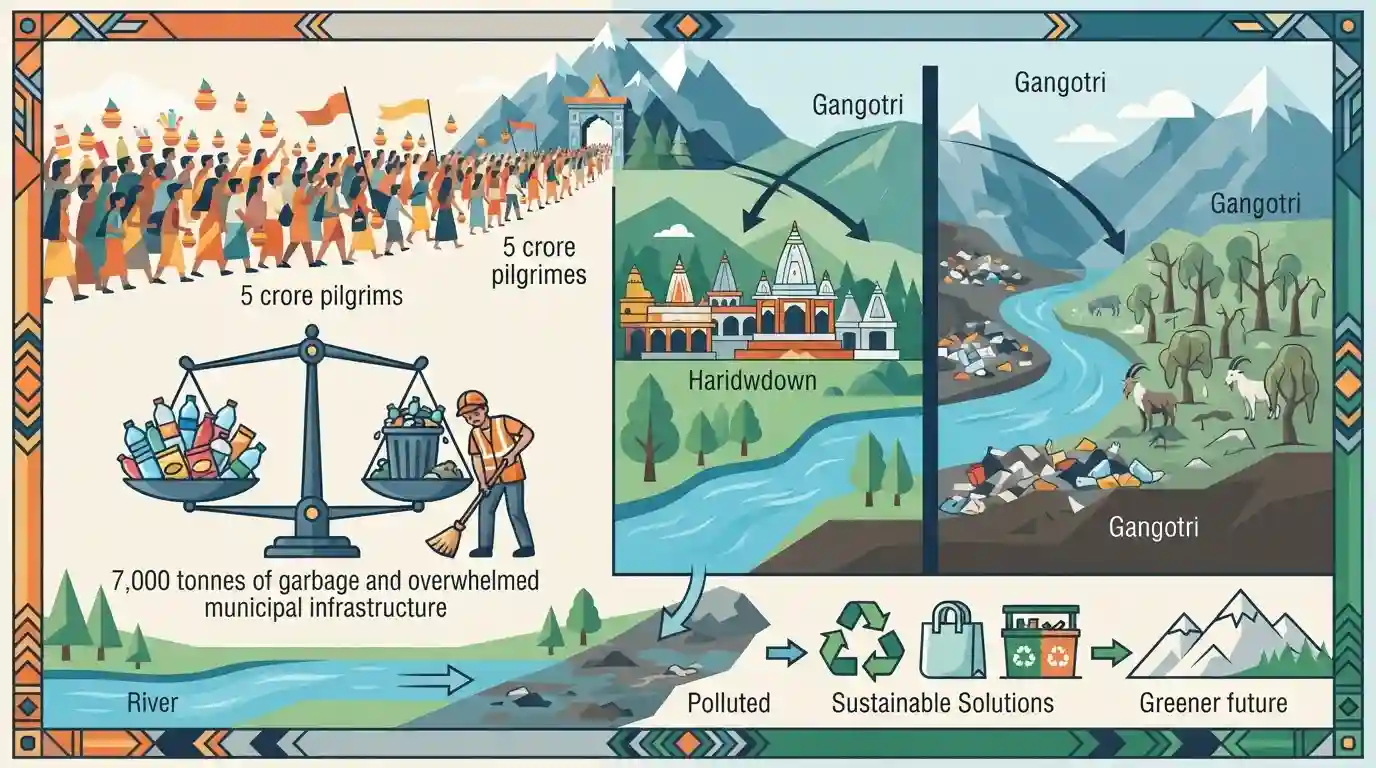
The massive influx of roughly 5 crore pilgrims during the Kanwar Yatra has triggered a severe environmental and waste management crisis in Uttarakhand. Approximately 7,000 tonnes of garbage, including heavy amounts of plastic and discarded materials, were left behind in key religious centers like Haridwar and the ecologically sensitive, high-altitude zone of Gangotri. The local municipal infrastructure was overwhelmed despite deploying additional sanitation staff. This uncontrolled pollution severely threatens the fragile Himalayan ecosystem and underscores the urgent need for sustainable pilgrimage policies and stricter enforcement of solid waste management norms.
Key Points
- The recent Kanwar Yatra drew approximately 5 crore pilgrims to Uttarakhand, generating an estimated 7,000 tonnes of solid waste in a span of two weeks.
- Massive accumulations of non-biodegradable waste, particularly single-use plastics, discarded clothes, and abandoned Kanwars, have severely polluted Haridwar and the high-altitude town of Gangotri.
- Despite local municipal bodies deploying additional sanitation workers, the sheer volume of garbage overwhelmed existing waste management infrastructure.
- The crisis exposes the flagrant violation of environmental norms in plastic-free zones and highlights the urgent need for sustainable tourism models in the fragile Himalayan ecosystem.
Important Terms
Kanwar Yatra

An annual pilgrimage by Shiva devotees who travel to fetch holy water from the Ganges at sacred sites like Haridwar and Gangotri.
UPSC context
GS 1 & 3. Highlights the conflict between mass religious/cultural tourism and strict ecological conservation.
Solid Waste Management Rules
A regulatory framework enforcing mandatory waste segregation at source, scientific disposal, and extended producer responsibility to minimize landfill usage and promote a circular economy.
UPSC context
GS 3 (Environment). Tests understanding of pollution control regulations and the statutory responsibilities of local bodies.
Himalayan Ecosystem
A highly fragile, ecologically sensitive high-altitude mountain system that supports unique biodiversity and acts as a crucial water source for South Asia.
UPSC context
GS 3 (Environment). Tests knowledge of regional vulnerabilities to climate change, disasters, and unregulated anthropogenic pressures.
Ecological Carrying Capacity
The maximum number of individuals, or tourist footprint, that a given environment can sustainably support without undergoing irreversible degradation to its natural resources.
UPSC context
GS 3 (Environment). Crucial for evaluating policies that place limits on mass tourism in ecologically fragile regions.
Sustainable Tourism
A regulated travel model that minimizes negative environmental and social impacts while maximizing economic benefits for local communities and conserving natural ecosystems.
UPSC context
GS 3 (Economy & Environment). Tests strategic solutions for balancing regional economic growth with strict ecological preservation.
Haridwar Municipal Corporation
The urban local body in Haridwar responsible for civic administration, providing local infrastructure, and enforcing sanitation and solid waste management norms during mass gatherings.
UPSC context
GS 2 (Local Governance). Evaluates the operational challenges and capacity of local civic bodies in handling infrastructural crises.
Prelims Trap
"Municipal bodies are solely legally obligated to segregate solid waste into three streams under the SWM Rules, 2016."
The Solid Waste Management Rules 2016 legally obligate the waste generators (households, tourists, event organizers) to segregate waste at the source, not just the municipalities.
Static Concepts Connected
What are the core mandates of the Solid Waste Management Rules, 2016?
- Source Segregation: Generators must segregate waste into three streams: biodegradable, non-biodegradable, and domestic hazardous at the source.
- Spot Fines: Empowers local bodies to explicitly levy user fees and collect spot fines for littering.
- Expanded Jurisdiction: Rules apply beyond municipal areas to census towns, special economic zones, and recognized pilgrimage places.
What is the National Mission for Sustaining the Himalayan Ecosystem (NMSHE)?
- NAPCC Component: It is one of the eight core missions under India's National Action Plan on Climate Change.
- Area-Specific Focus: It is the only NAPCC mission dedicated to a specific geographic region to safeguard ecology.
- Institutional Capacity: Aims to build human and scientific institutional capacities across all Himalayan States and UTs.
Cross-Topic Patterns
Carrying Capacity vs. Religious Tourism
The Supreme Court's push to evaluate the 'carrying capacity' of Himalayan towns links directly to unregulated pilgrimage surges causing civic, infrastructure, and ecological collapse.
EPR norms and FMCG Plastic Waste
The massive influx of single-use plastics during festivals exposes serious enforcement gaps in Extended Producer Responsibility (EPR) mandates for FMCG companies operating in eco-sensitive zones.

Expect a 2026 multi-statement question linking the SWM Rules 2016 generator-segregation mandate with Himalayan 'carrying capacity'.
Linked PYQs · 3
Linked PYQs · 3
- 2011UKPSC_PRELIMSGS1
Which of the following is a biodegradable pollutant?
- 2025UKPSC_PRELIMSGS1
Match the items given in Column-I and II : | Column-I | Column-II | |---|---| | A. Biomagnification | 1. Synthesis of ozone | | B. Electrostatic precipitation | 2. Solid waste | | C. Landfills | 3. Concentration build up at successive trophic levels | | D. Stratosphere | 4. Particulate matter | Codes : A B C D
- 2025UKPSC_PRELIMSGS1
Consider the following statements and select the correct answer from the options given below : Statement 1 : Uttarakhand is highly vulnerable to climate change. Statement 2 : Climate change is causing water stress and depleting biodiversity in Uttarakhand.
