MIS apple procurement dues cleared through Direct Benefit Transfer
Source:outlookbusiness ↗
Why It Matters
It demonstrates practical application of e-governance in agricultural marketing and procurement. Understanding state-specific schemes like the MIS for horticultural crops and the adoption of modern supply chain tracking is important for GS3 agricultural topics and state-level economic policies.
Summary
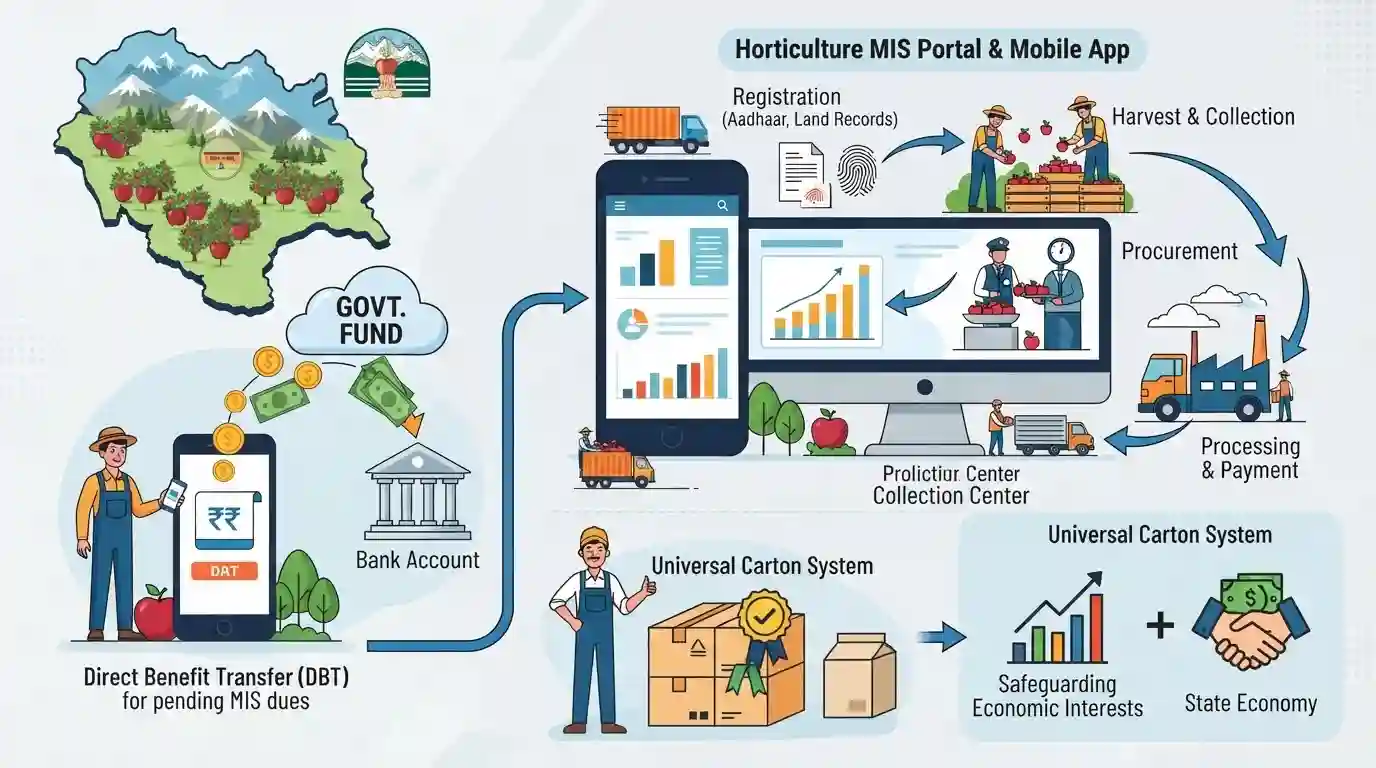
The Himachal Pradesh government has released ₹45 crore to clear the pending dues of apple growers procured under the Market Intervention Scheme (MIS) between 2022 and 2025. These dues are being transferred directly into growers' bank accounts via Direct Benefit Transfer (DBT). To further enhance transparency and efficiency, the state government launched a dedicated Horticulture MIS website and mobile application. This e-governance initiative will track the entire cycle from apple purchase to processing, utilizing Aadhaar, land records, and bank account integration. Additionally, the Chief Minister highlighted the rollout of the universal carton system as a measure to safeguard farmers' economic interests.
Key Points
- Himachal Pradesh CM Sukhvinder Singh Sukhu released ₹45 crore to clear pending MIS liabilities for apple growers from 2022 to 2025.
- The payments are being processed seamlessly through Direct Benefit Transfer (DBT) directly into the bank accounts of the growers.
- A new Horticulture MIS website and mobile app were launched to digitize the entire procurement process, from crop purchase to processing.
- The state also highlighted the successful implementation of the universal carton system to protect the interests of the farming community.
Important Terms
Market Intervention Scheme (MIS)

An ad-hoc price support mechanism protecting farmers of perishable goods (not covered by MSP) from distress sales during price crashes or bumper crops. Losses are typically shared between the Centre and states.
UPSC context
GS Paper 3 (Agriculture). Tests understanding of agricultural pricing policies, procurement regimes, and differences between MSP and MIS.
Direct Benefit Transfer (DBT)
An e-governance initiative that directly transfers government subsidies, cash assistance, and welfare payments into beneficiaries' Aadhaar-seeded bank accounts, eliminating middlemen and reducing systemic leakages.
UPSC context
GS Paper 2 & 3 (Governance/Economy). Crucial for topics on welfare schemes, e-governance transparency, and agricultural subsidy reforms.
Universal Carton System
A standardized, fixed-weight packaging system introduced in Himachal Pradesh to replace traditional telescopic cartons. It prevents the exploitative overpacking of apples, ensures fair pricing, and protects fruit quality during transit.
UPSC context
GS Paper 3 (Agricultural Marketing). Highlights state-level supply chain reforms for value preservation and safeguarding farmers' economic interests.
Prelims Trap
The Market Intervention Scheme (MIS) is a permanent, centrally funded price support mechanism automatically triggered for all horticultural crops.
MIS is an ad-hoc, request-based scheme, not automatic. Losses are shared 50:50 (75:25 for NE states) between the Center and states, not fully funded by the Center.
Static Concepts Connected
What is the Market Intervention Scheme (MIS)?
- Perishable Crops: Targeted at horticultural and agricultural commodities that are perishable and not covered under the regular MSP framework.
- Trigger Criteria: Activated on state request only when there is a 10% production increase or 10% price fall compared to normal years.
- Loss Sharing: Losses are shared on a 50:50 basis between the Union and state governments (75:25 for North-Eastern states).
How does HP's Universal Carton system reform agri-marketing?
- Standardizing Weight: Mandates a strict 20 kg packaging limit, replacing traditional telescopic cartons that allowed forced overpacking up to 35 kg.
- Eliminating Exploitation: Forces intermediaries to trade based on actual weight-based pricing, protecting horticultural farmers from arbitrary deductions by commission agents.
Cross-Topic Patterns
Agri-logistics and APMC exploitation
Standardizing packaging limits arbitrary practices by commission agents, demonstrating how physical packaging standards act as an informal APMC market reform.
Horticulture diversification and GSDP shifts
Himachal's high horticultural GSDP contribution despite falling overall agricultural share highlights the economic potential of shifting from foodgrains to high-value cash crops.

MIS trigger metrics (10% price drop) and Union-State loss-sharing ratios are likely to be tested in a multi-statement 2026 Prelims question.
Linked PYQs · 2
Linked PYQs · 2
- 2020HPAS_PRELIMSGS1
Consider the given four statements and choose the correct answer from the given options. 1. 'Jaivik Kheti Portal' is an initiative of Ministry of Agriculture, Department of Agriculture along with the Ministry of Science Technology and Climate change. 2. This portal is not an E-commerce platform. 3. This portal does not promote organic farming. 4. This portal provides price discovery mechanisms to help farmers.
- 2024HPAS_PRELIMSGS1
Consider the following statements : (1) Himachal Pradesh Government approved an outlay of 1200 crore rupees for economic services during 2022-23. (2) Himachal Pradesh Government approved an outlay of 267 crore rupees for rural development during 2022-23. (3) Himachal Pradesh Government approved an outlay of 140 crore rupees for Mahatma Gandhi National Employment Guarantee Scheme during 2022-23. (4) Himachal Pradesh Government approved an outlay of 22 crore rupees for Forestry and Wildlife during 2022-23. Choose the correct answer from the options given below :
