Urban Food Security Schemes and Subsidized Meal Models
Source:Indian Express ↗
Why It Matters
Subsidised food schemes are a critical component of state welfare models in India, addressing hunger and nutritional security for the urban poor. They highlight the practical implementation of food security policies and often feature in discussions around poverty alleviation strategies and governance.
Summary
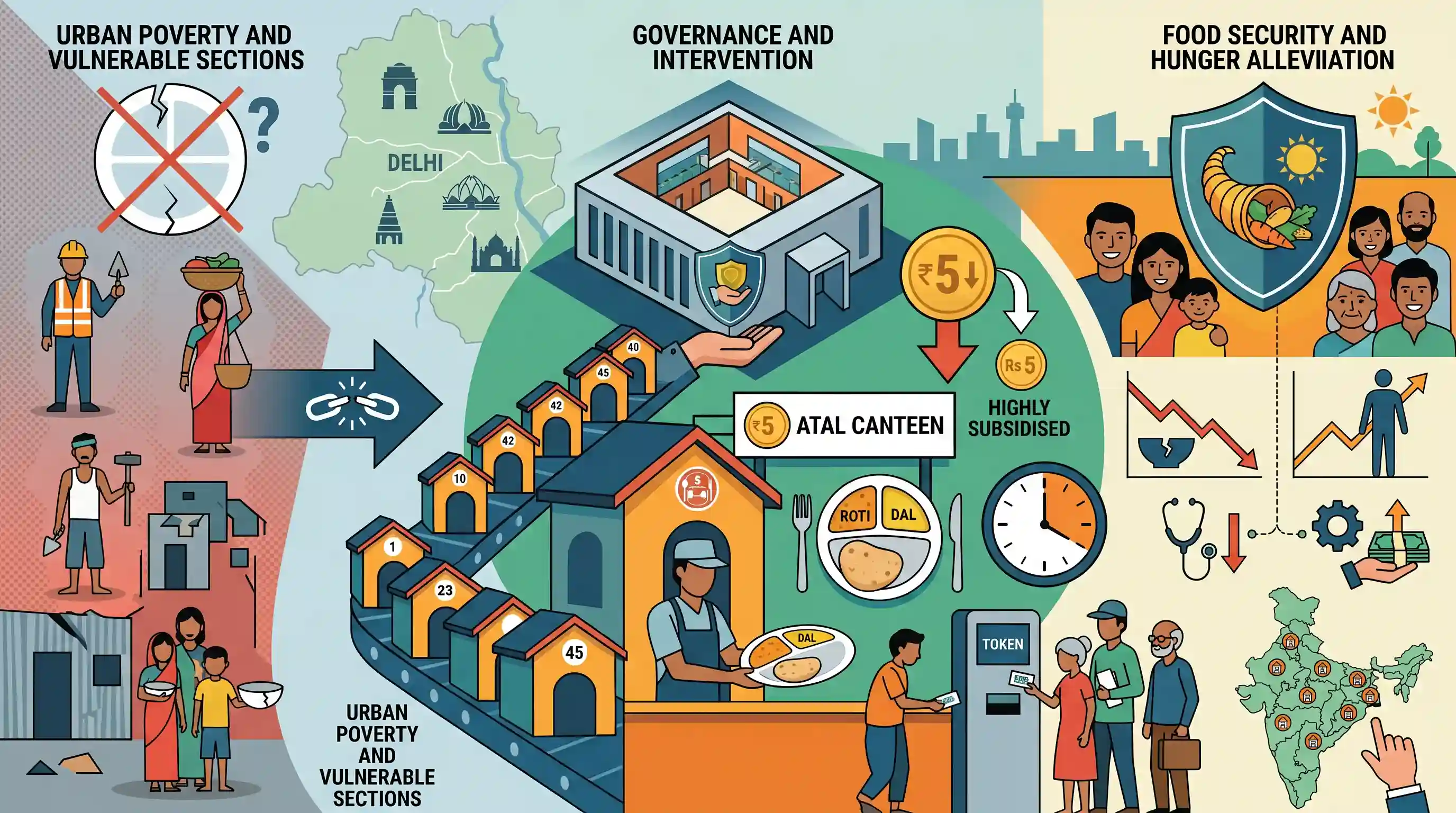
Delhi has introduced 45 'Atal Canteens' offering highly subsidised, nutritious meals (including roti and dal) for just Rs 5. The welfare initiative is aimed at ensuring food security and alleviating hunger among the urban poor, daily-wage laborers, and vulnerable sections. Modeled after similar successful subsidized food programs across various Indian states, this scheme serves as a direct intervention by the government to tackle poverty and malnutrition at the grassroots level.
Key Points
- 45 Atal Canteens have been inaugurated in Delhi to offer highly subsidized meals to the public.
- A complete meal comprising roti, dal, and more is provided at a nominal cost of just Rs 5.
- The initiative is designed to address urban hunger, directly benefiting daily wage earners, migrants, and other vulnerable sections of society.
- The canteens follow the model of other successful state-level subsidized food initiatives (like Amma Canteens in Tamil Nadu), reinforcing the state's role in welfare and food security.
Important Terms
Atal Canteen Scheme

A Delhi welfare initiative providing complete, nutritious meals (dal, rice, roti) to the urban poor and laborers at a highly subsidized price of ₹5 per plate.
UPSC context
GS Paper 2: Welfare schemes for vulnerable sections; tests knowledge of state-led food security interventions and urban poverty alleviation models.
Food Security
Ensuring all citizens have physical and economic access to sufficient, safe, and nutritious food. In India, this is legalised through the National Food Security Act (NFSA), 2013.
UPSC context
GS Paper 3: Food security and buffer stocks; crucial for questions on hunger (SDG 2) and the effectiveness of the Public Distribution System (PDS).
Urban Poor
Socio-economic group in cities lacking access to basic services and stable income, typically comprising daily-wage earners, informal sector workers, and residents of slums or JJ clusters.
UPSC context
GS Paper 1 & 2: Issues related to urbanization and poverty; tests understanding of the informal economy and targeted welfare delivery.
Food Subsidy
A governance tool where the state pays a portion of the service cost to keep prices low for the public, often used to stabilize food costs during inflation.
UPSC context
GS Paper 3: Economics of subsidies; tests ability to analyze the fiscal burden vs. social benefits of welfare spending.
Good Governance Day
Celebrated on December 25 (Atal Bihari Vajpayee’s birth anniversary) to promote accountability in government. It often serves as the launch date for major welfare schemes in India.
UPSC context
GS Paper 4: Ethics and Governance; relevant for discussing the philosophy of 'Antyodaya' and administrative accountability.
Nutritional Security
The provision of essential nutrients (proteins, vitamins, minerals) alongside calories to ensure healthy physical and mental development, preventing conditions like stunting and wasting.
UPSC context
GS Paper 2: Issues relating to Health and Hunger; tests knowledge of malnutrition interventions beyond simple grain distribution.
Prelims Trap
"Subsidized urban canteens operate under the statutory framework of the National Food Security Act (NFSA)."
Community canteens are discretionary state-specific welfare initiatives. NFSA mandates subsidized foodgrains (PDS), maternal benefits, and child nutrition, but does NOT mandate subsidized public canteens.
Static Concepts Connected
How do community canteens address the structural limitations of the PDS?
- Documentation Barriers: Daily-wage earners and transient workers often lack the updated ration cards, local residency proofs, or ONORC linkages required to access raw PDS grains.
- Cooking Infrastructure: Migrants in informal urban housing often lack the fuel, space, and time to cook raw grains, making ready-to-eat subsidized meals a practical necessity.
- Targeted Nutrition: Standardized meals (e.g., 700-800 calories, 20g protein) bypass intra-household food distribution biases, ensuring direct and targeted nutrition to the worker.
What are the core statutory entitlements under the NFSA, 2013?
- Subsidized Foodgrains: 5 kg per person per month for Priority Households at highly subsidized prices (₹3/2/1 for rice/wheat/coarse grains).
- Antyodaya Anna Yojana: Poorest of the poor households receive a fixed flat rate of 35 kg of foodgrains per household per month.
- Life-cycle Approach: Nutritional support for pregnant women/lactating mothers and children up to 14 years via ICDS and PM-POSHAN (Mid-Day Meal).
Cross-Topic Patterns
ONORC and Urban Food Security
While One Nation One Ration Card (ONORC) ensures grain portability for migrants, urban canteens act as a crucial last-mile intervention for laborers lacking cooking fuel and physical infrastructure.
Freebies vs. Merit Goods Debate
Subsidized canteens frequently feature in RBI and Finance Commission debates regarding state-level welfare expenditures, highlighting the thin line between electoral 'freebies' and essential merit goods.

Expect a prelims statement mixing NFSA statutory guarantees with state-level community kitchen schemes to test exact mandate boundaries.
Linked PYQs · 4
Linked PYQs · 4
- 2019MainsGS2
Performance of welfare schemes that are implemented for vulnerable sections is not so effective due to absence of their awareness and active involvement at all stages of policy process. Discuss.
- 2022MainsGS2
Besides the welfare schemes, India needs deft management of inflation and unemployment to serve the poor and the underprivileged sections of the society. Discuss.
- 2023MainsGS2
“Development and welfare schemes for the vulnerable, by its nature, are discriminatory in approach.” Do you agree? Give reasons for your answer.
- 2022MainsGS3
What are the major challenges of Public Distribution System (PDS) in India ? How can it be made effective and transparent ?
