Gujarat decentralization powers for district land administration
Source:webindia123 ↗
આ શા માટે મહત્વનું છે
The article provides a practical example of decentralization in public administration. Delegating financial powers to district-level authorities like the Collector and DDO is crucial for reducing red tape, improving governance efficiency, and accelerating grassroots development. This relates directly to the syllabus topics concerning local government structure, functions, and responsibilities.
સારાંશ
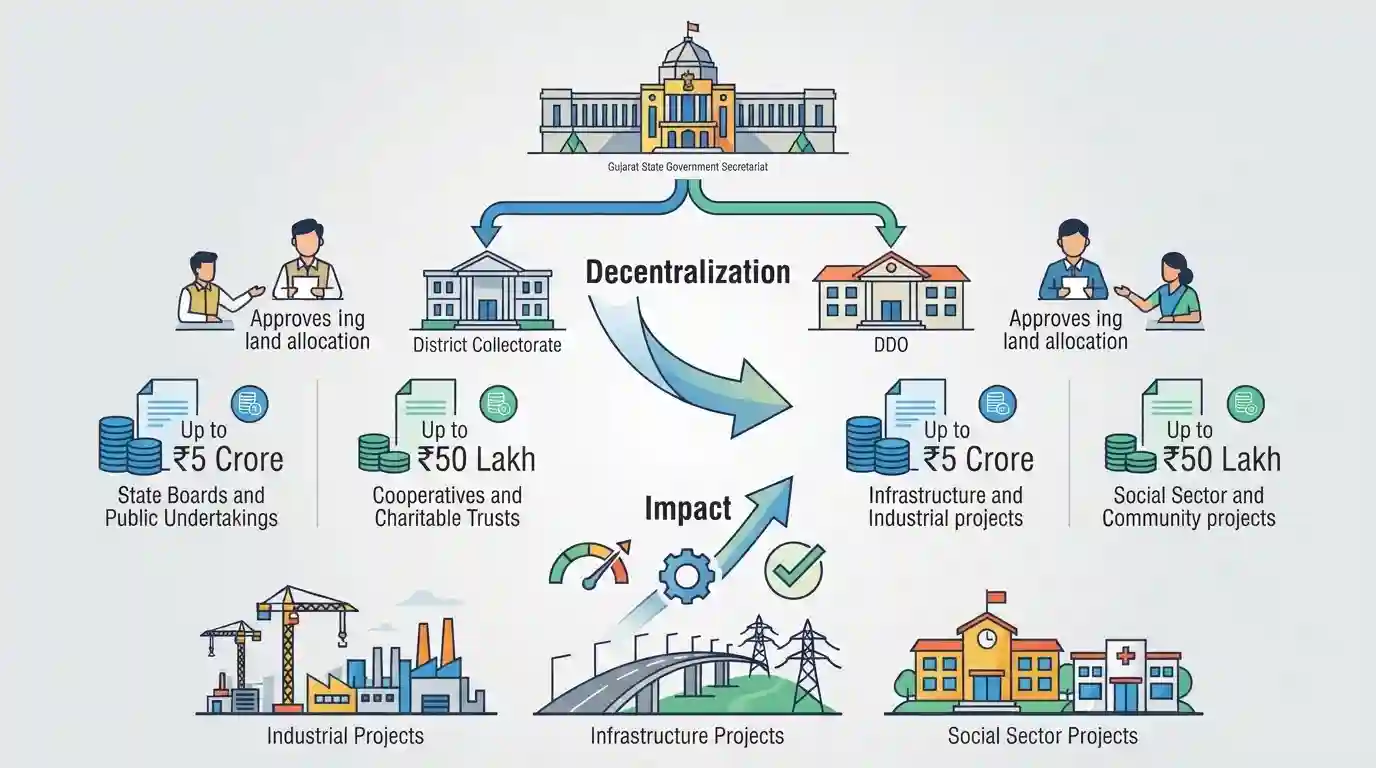
In a significant governance reform, the Gujarat government led by Chief Minister Bhupendra Patel has devolved greater financial powers to District Collectors and District Development Officers (DDOs) for allotting state-owned land. By enhancing the valuation limits for land allotment—such as allowing Collectors to allot land up to Rs 5 crore for state boards and up to Rs 50 lakh for cooperatives and charitable trusts—the state aims to reduce bureaucratic bottlenecks at the top level. This decentralization is expected to expedite infrastructure, industrial, and social sector projects, thereby improving the 'Ease of Doing Business' in the state.
મુખ્ય મુદ્દા
- Gujarat Chief Minister Bhupendra Patel has increased the financial powers of District Collectors and District Development Officers (DDOs) regarding the allotment of government land.
- The decentralization move aims to promote the 'Ease of Doing Business' by accelerating decision-making for infrastructure projects, public works, and industrial growth.
- District Collectors are now authorized to allot land valued up to Rs 5 crore to various state boards and corporations (increased from Rs 50 lakh).
- For agricultural cooperatives, educational, and charitable trusts, Collectors can now allot land valued up to Rs 50 lakh (increased from Rs 2.50 lakh).
- District Development Officers (DDOs) can now approve the sale of open land near Gamtal plots up to 500 sq. m. and valued up to Rs 50 lakh.
મહત્વપૂર્ણ શબ્દો
Gujarat Government

The subnational governing authority of Gujarat, consisting of an elected legislative assembly, a governor, and a council of ministers headed by the Chief Minister.
UPSC context
GS Paper II: Federalism, State Legislature, and local governance mechanisms.
Gujarat Water Supply and Sewerage Board
A statutory body established in 1979 by the Government of Gujarat to design, execute, and manage rural and urban water supply and sewerage services.
UPSC context
GS Paper II & III: Public infrastructure, basic services delivery, and statutory bodies.
Gujarat Urja Vikas Nigam Ltd (GUVNL)
A state-owned holding company established in 2005 that coordinates bulk power purchase, trading, transmission, and distribution across its six electricity subsidiary companies in Gujarat.
UPSC context
GS Paper III: Infrastructure, energy security, and public sector reforms.
GEB
The erstwhile state-run vertical utility responsible for electricity generation, transmission, and distribution in Gujarat, which was unbundled in 2005 to improve efficiency.
UPSC context
GS Paper III: Discom stress, power sector reforms, and unbundling.
GSFC
A leading public sector undertaking established in 1962 by the Gujarat government that manufactures agricultural fertilizers alongside essential industrial chemicals.
UPSC context
GS Paper III: Agricultural inputs, food security, and fertilizer subsidies.
GMDC
A state-owned public sector enterprise founded in 1963, primarily engaged in lignite, bauxite, and mineral mining, processing, and power generation in Gujarat.
UPSC context
GS Paper III: Mineral resources, energy security, and PSU governance.
પ્રિલિમ્સ ટ્રેપ
The District Collector is the executive head of the Zilla Parishad handling rural development uniformly across all states.
States like Gujarat and Maharashtra bifurcate these roles. A separate District Development Officer (DDO) manages Zilla Parishad development activities, while the Collector focuses on revenue.
સંલગ્ન સ્થિર ખ્યાલો
How does district administration differ in Gujarat and Maharashtra compared to other states?
- Bifurcation of Roles: Development functions are separated from revenue functions. A DDO/CEO heads the District Panchayat (Zilla Parishad) for rural development.
- Collector's Mandate: The District Collector is strictly focused on land revenue, land reforms, disaster management, and law & order.
- Balwant Rai Mehta: The Balwant Rai Mehta committee recommended the Collector as Chairman of Zilla Parishad, but these states opted for a separate executive head.
Under which constitutional list does land and land revenue fall?
- State List: Land, land tenures, collection of rents, and land revenue are strictly State subjects under Schedule VII (Entry 18 and 45).
- Legislative Autonomy: State legislatures have exclusive power to enact and amend Land Revenue Codes, explaining state-wise variations in Collector powers.
આંતર-વિષય પેટર્ન
Decentralization meets Ease of Doing Business
Delegating land allotment powers to district officials bypasses state-secretariat bottlenecks, illustrating how administrative decentralization practically accelerates industrial and infrastructure EODB.
Cooperative sector empowerment
Easing land allotment limits specifically for agricultural cooperatives aligns with the national push to strengthen cooperative societies via local resource access.

Comparative Prelims questions contrasting the Collector's role with the Collector-DDO bifurcation in Gujarat/Maharashtra are highly likely.
સંલગ્ન PYQ · 3
સંલગ્ન PYQ · 3
- 2022GPSC_PRELIMSGS1
As per the 73rd Constitutional Amendment Act of Panchayati Raj, who specifies a "Village"?
- 2017GPSC_PRELIMSGS1
According to the Balwantrai Mehata Committee, the district collector should be :
- 2025GPSC_PRELIMSGS1
Which of the following statements about Local Self-Government in India is correct? 1. The Panchayati Raj System is based on the recommendations of the Balwant Rai Mehta Committee (1957). 2. The 73ʳᵈ Amendment Act, 1992 provided for the establishment of three-tier Panchayati Raj institutions in all states. 3. The 11ᵗʰ Schedule of the Indian Constitution deals with powers and responsibilities of Panchayati Raj institutions. 4. The State Election Commission is responsible for conducting elections to both Panchayati Raj institutions and State Legislatures. Select the correct answer using the codes below:
