Fatehpur Development Projects and State Welfare Scheme Initiatives
Source:webindia123 ↗
Why It Matters
The article covers crucial UP state-specific initiatives like the One District One Product (ODOP) scheme and regional infrastructure projects in Fatehpur. It also touches upon national policies like the NEP 2020 and strict laws against examination malpractices, which are highly relevant for the UPPSC PCS Prelims General Studies syllabus.
Summary
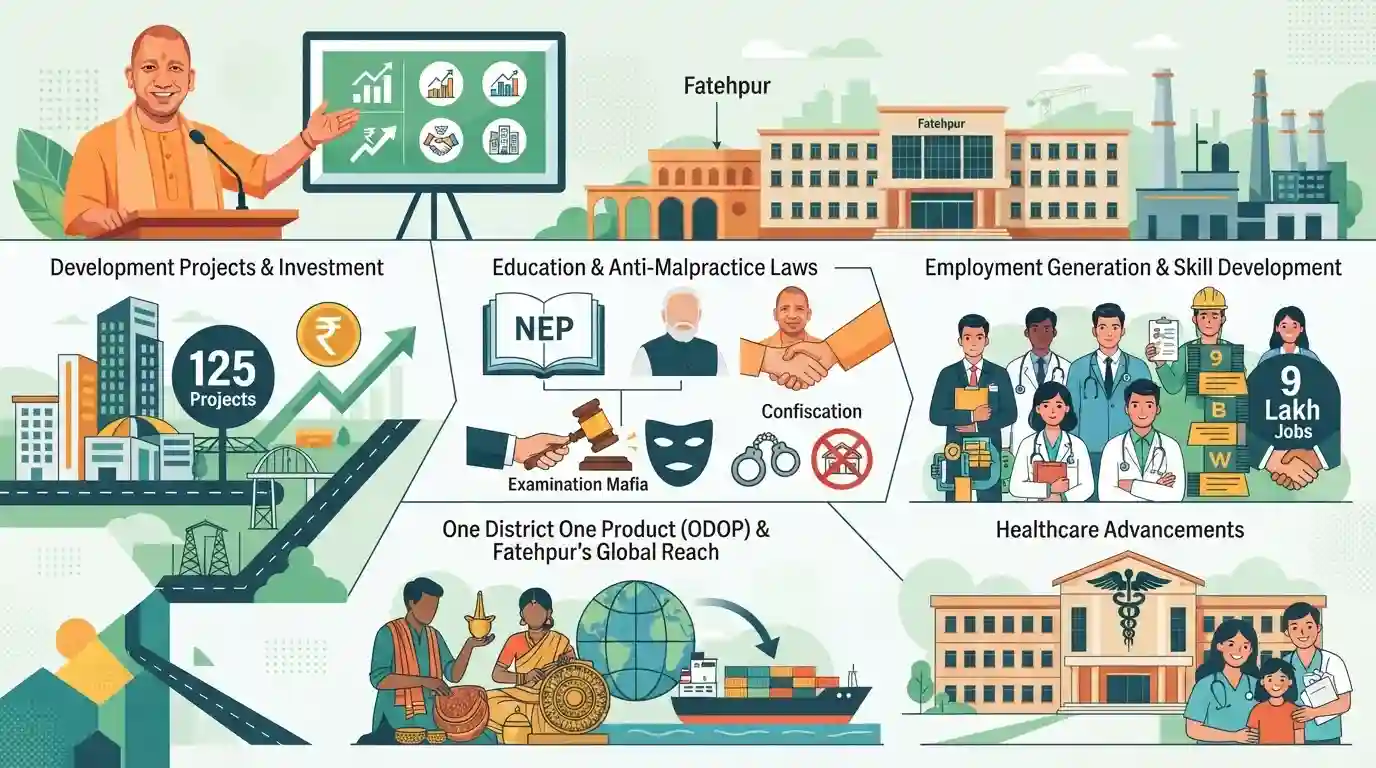
Uttar Pradesh Chief Minister Yogi Adityanath launched 125 development projects worth over Rs 489 crore in Fatehpur. During his address, he praised Prime Minister Narendra Modi for the National Education Policy (NEP) and the enactment of a strict central law to curb examination malpractices. The Chief Minister warned 'examination mafias' of severe consequences, including imprisonment and confiscation of property. He also highlighted his administration's success in providing government jobs to 9 lakh youths and praised the One District One Product (ODOP) scheme for taking Fatehpur's products to the global market. Furthermore, he noted advancements in local healthcare through the Fatehpur Medical College and emphasized that improved law and order have fostered an environment conducive to investment and large-scale employment generation.
Key Points
- UP CM Yogi Adityanath inaugurated and laid foundation stones for 125 development projects worth over Rs 489 crore in Fatehpur.
- Commended the Central Government for the National Education Policy (NEP) and the strict new law against examination malpractices.
- Emphasized the state government's strict action against 'examination mafias,' warning of jail time and property confiscation.
- Highlighted the provision of government jobs to 9 lakh youths over the past seven to nine years.
- Praised the success of the One District One Product (ODOP) scheme, stating that Fatehpur's local products are now reaching international markets.
- Mentioned the establishment of the Fatehpur Medical College and large-scale employment generation due to improved law and order and investment climate.
Important Terms
National Education Policy (NEP)

A comprehensive education framework replacing the 1986 policy. It introduces a 5+3+3+4 schooling structure, focuses on foundational literacy, promotes multidisciplinary higher education, and aims for a 100% Gross Enrolment Ratio in school education by 2030.
UPSC context
Relevant for GS Paper II (Education). Tests knowledge of structural educational reforms, human resource development, and SDG-4 alignment.
One District One Product (ODOP) Scheme
An initiative identifying, branding, and promoting one unique product from each district. Originally launched in Uttar Pradesh, it is now adopted nationally to boost local livelihoods, empower artisans, and foster balanced regional economic development.
UPSC context
Important for GS Paper III (Economy) and GS Paper II (Policies). Tests local industrialization, rural entrepreneurship, and regional growth models.
Public Examinations (Prevention of Unfair Means) Act, 2024
A central law enacting strict penalties—including up to 10 years imprisonment and massive fines—against organized paper leaks, cheating networks, and service provider malpractices in public examinations.
UPSC context
Significant for GS Paper II (Governance). Tests knowledge on legal measures to ensure meritocracy, institutional integrity, and accountability in recruitment processes.
Central Government
The supreme governing authority in India's federal structure, responsible for national-level administration. It consists of the Executive, Legislature, and Judiciary, functioning under the constitutional separation of powers.
UPSC context
Core to GS Paper II (Indian Polity). Tests understanding of federalism, Union-State relations, and the constitutional framework of the Union.
Prelims Trap
"The Public Examinations Act 2024 provides a uniform legal framework against paper leaks across all Central and State-level board exams."
The central Act strictly applies only to exams conducted by designated central authorities (UPSC, SSC, NTA, RRB, IBPS). State-level exams remain under state jurisdiction.
Static Concepts Connected
Key provisions of the Public Examinations (Prevention of Unfair Means) Act, 2024?
- Nature of offences: All offences under the Act are legally classified as cognizable, non-bailable, and non-compoundable.
- Strict jurisdiction: It applies exclusively to central examination bodies (UPSC, SSC, NTA, RRB, IBPS), not state boards.
- Investigating authority: Investigations must be conducted by officers not below the rank of Deputy Superintendent of Police (DSP) or ACP.
What is the structural framework of the Aspirational Districts Programme (ADP)?
- Nodal agency: Anchored by NITI Aayog to quickly and effectively transform districts showing relatively lesser progress in key social areas.
- Core themes: Evaluates progress across Health & Nutrition, Education, Agriculture, Financial Inclusion & Skill Development, and Basic Infrastructure.
- Delta ranking: Districts are competitively ranked monthly based on real-time incremental progress via the Champions of Change dashboard.
Cross-Topic Patterns
ODOP, GI Tags and ONDC integration
State-level ODOP schemes serve as direct pipelines for securing Geographical Indication (GI) tags, plugging rural MSMEs into national digital networks like ONDC to boost export potential.
Exam Integrity & Cyber Governance
Stringent central laws against exam malpractices parallel the push for robust digital infrastructure and cybersecurity in e-governance (like DigiLocker) to secure the integrity of public recruitment.

Expect a Prelims question on the Public Exams Act 2024, targeting the non-bailable clause and its strictly Central jurisdiction limits.
Linked PYQs · 2
Linked PYQs · 2
- 2025UPPSC_PRELIMSGS1
As per the One District One Product (ODOP) scheme of Uttar Pradesh, Moonj products are associated with which of the following districts? 1. Amethi 2. Sultanpur 3. Sant Kabir Nagar Select the correct answer from the code given below:
- 2020UPPSC_PRELIMSGS1
Consider the following statements about New National Education Policy approved by Union Cabinet of India on 29th July, 2020 : 1. It was drafted by a Committee headed by Dr. K Kasturirangan. 2. It will replace the previous Education Policy which has been followed since last 38 years. Select the correct statement(s) from the codes given below.
