Himachal Pradesh fiscal autonomy demands and Centre-State relations
Source:webindia123 ↗
Why It Matters
The demands of Himachal Pradesh underscore crucial debates in Centre-State relations, particularly concerning how federal transfers under Article 275 and Finance Commission recommendations accommodate the unique geographical vulnerabilities and environmental conservation efforts of Himalayan states.
Summary
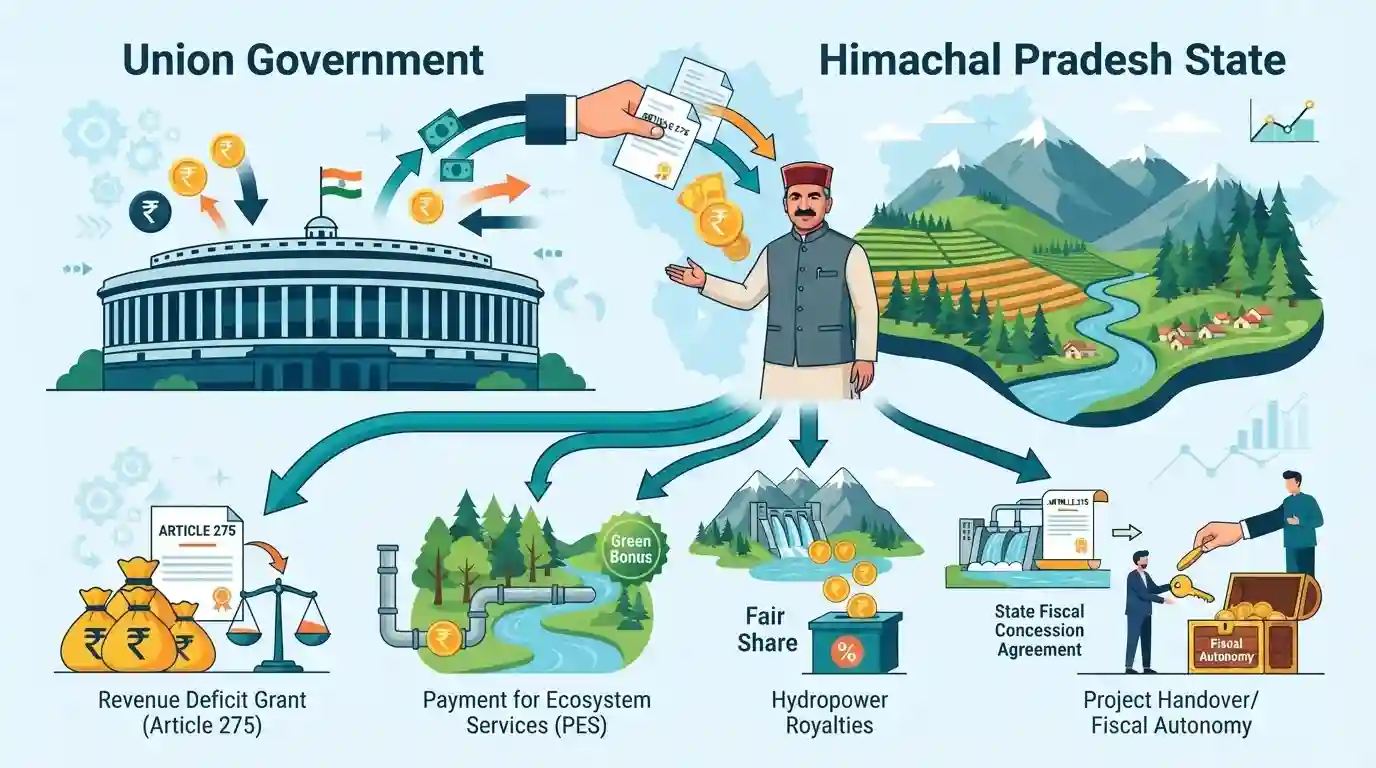
Himachal Pradesh Chief Minister Sukhvinder Singh Sukhu urged the Union Government to release the state's rightful financial dues, emphasizing the need to restore the Revenue Deficit Grant under Article 275. He also called for the Centre to provide compensation for the environmental services rendered by the hill state, which protect the region's forests and water resources. Additionally, the Chief Minister demanded a fairer share of royalty from hydropower generation and the return of hydel projects whose concession periods have ended, highlighting the need to strengthen the state's fiscal autonomy.
Key Points
- Chief Minister Sukhvinder Singh Sukhu has demanded the release of pending Revenue Deficit Grants to Himachal Pradesh, citing that its discontinuation under Article 275 adversely impacted state finances.
- The state is seeking compensation for its environmental services—protecting forests and river basins that benefit downstream states—valued at nearly Rs 90,000 crore by the Indian Institute of Forest Management.
- Himachal Pradesh has strongly advocated for an increased share of royalty from operational hydropower projects located in the state.
- The state demands that hydropower projects which have completed their concession periods must be handed back to the state government.
Important Terms
Finance Commission

A constitutional body established under Article 280, appointed every five years by the President to recommend the equitable distribution of financial resources between the Union and the States.
UPSC context
Important for GS Paper 2 & 3, covering fiscal federalism, taxation, and Centre-State relations.
Article 275 of the Constitution
A constitutional provision empowering Parliament to provide statutory grants-in-aid from the Consolidated Fund of India to specific States requiring financial assistance.
UPSC context
Relevant to GS Paper 2 (Polity). Tests the constitutional mechanisms for statutory grants and Centre-State financial ties.
Revenue Deficit Grant
Grants recommended by the Finance Commission under Article 275 to cover the residual gap in a State's revenue account after the standard devolution of central taxes.
UPSC context
Crucial for GS Paper 3 (Government Budgeting) to understand how structural deficits of fiscally constrained states are managed.
Payment for Ecosystem Services (PES)
A conservation finance model providing direct economic incentives to communities or states for sustainably managing land and protecting vital environmental services like forests and watersheds.
UPSC context
Highly relevant for GS Paper 3 (Environment/Biodiversity) for topics on sustainable development and market-based conservation strategies.
Prelims Trap
Revenue Deficit Grants are discretionary funds provided by the Union Government under Article 282.
Post-Devolution Revenue Deficit (PDRD) grants are statutory grants under Article 275. They are mandated based on Finance Commission recommendations, not arbitrary Union discretion.
Static Concepts Connected
What are the key criteria for horizontal tax devolution under the 15th Finance Commission?
- Income Distance: Highest weightage of 45%, providing more funds to states with lower per capita income to ensure regional equity.
- Forest and Ecology: Given a 10% weightage to reward states for preserving forest cover, offsetting the opportunity cost of environmental conservation.
- Demographics & Tax: Demographic performance (12.5%) rewards fertility control based on 1971-2011 data, while tax and fiscal efforts (2.5%) reward collection efficiency.
How do Statutory Grants differ from Discretionary Grants in the Constitution?
- Article 275: Provides for statutory grants charged on the Consolidated Fund of India to states in need, strictly based on Finance Commission recommendations.
- Article 282: Allows both the Centre and States to make discretionary grants for any public purpose. This was historically the route for Planning Commission funds.
Cross-Topic Patterns
Ecological criteria in fiscal devolution
The 15th FC's inclusion of 'Forest and Ecology' directly links Centre-State financial relations with climate mitigation, incentivizing Himalayan and North-Eastern states to maintain carbon sinks despite industrial opportunity costs.
Hydropower royalties as non-tax revenue
As states face restricted borrowing limits and reduced GST compensation, resource-rich states increasingly assert ownership over local resources like water (State List) to boost non-tax revenues through project royalties.

Expect a 2026 Prelims question linking Article 275 PDRD grants with the 15th Finance Commission's 'Forest and Ecology' devolution weight.
Linked PYQs · 2
Linked PYQs · 2
- 2020HPAS_PRELIMSGS1
There are two statements for each question. In the light of these two statements, choose the most appropriate answer from the options given below. Statement 1: Revenue Deficit is the excess of revenue expenditure over revenue receipts. Statement 2: Effective Revenue Deficit is the difference between Revenue Deficit and Grants for Creation of Capital Assets.
- 2022HPAS_PRELIMSGS1
Select the correct statements from the following : (i) Supreme Court of India has allowed the State for silviculture green felling of three species on experimental basis. (ii) Forests in H.P. cover an area of 37947 sq. kms of total geographical area of the state (iii) In H.P. presently 30% of the total geographical areas support forest cover. (iv) The aim of the forest department is to enhance the forest cover in the state to 35% of its geographical area by 2030.
