Uttarakhand launches Inclusive Education Mission 2030 in Dehradun
Source:webindia123 ↗
Why It Matters
The article touches upon critical state-level implementations of national frameworks like NEP 2020 and the SDGs, making it highly relevant for questions on Uttarakhand's specific governance initiatives. The mention of UCC, anti-copying laws, and migration policies directly aligns with State polity, social justice, and demographic challenges often tested in UKPSC PCS Prelims.
Summary
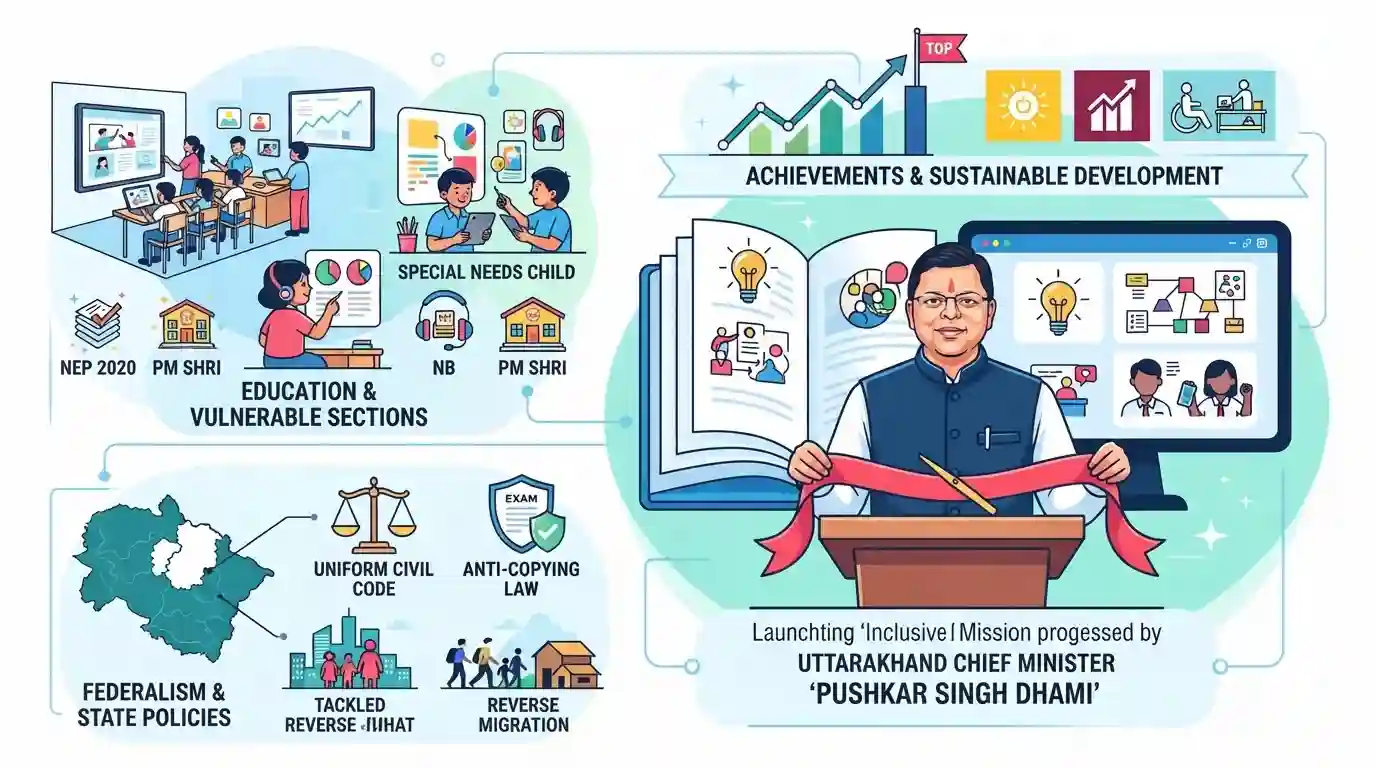
Uttarakhand Chief Minister Pushkar Singh Dhami launched Shine AV Learning's 'Inclusive Education Mission-2030' in Dehradun to support children with special needs using visual learning tools. During the event, he emphasized the state's alignment with NEP 2020 through the development of smart classrooms and PM SHRI schools. Dhami also highlighted Uttarakhand's achievements in securing the top spot in the Sustainable Development Goals (SDG) index, implementing the Uniform Civil Code (UCC), enforcing an anti-copying law, and tackling reverse migration.
Key Points
- Uttarakhand Chief Minister Pushkar Singh Dhami inaugurated Shine AV Learning's 'Inclusive Education Mission-2030' in Dehradun.
- The initiative focuses on integrating children with special needs into the mainstream through a curriculum-based visual learning system.
- CM Dhami highlighted ongoing state efforts aligned with NEP 2020, such as establishing smart classrooms, ICT labs, and PM SHRI schools.
- He noted Uttarakhand's top ranking in the Sustainable Development Goals (SDG) index as a testament to the state's inclusive policies.
- The Chief Minister also emphasized recent state actions, including the implementation of the Uniform Civil Code (UCC), a strict anti-copying law, and policies aimed at reversing migration.
Important Terms
PM SHRI Schools

A Centrally Sponsored Scheme to upgrade 14,500 existing government schools into model institutions. They showcase NEP 2020 implementation through inclusive, experiential learning, and modern digital infrastructure.
UPSC context
Highly relevant for GS-2 (Social Justice/Education) to evaluate Central interventions in human capital formation.
National Education Policy (NEP) 2020
India's comprehensive education framework focusing on holistic, multi-disciplinary, and skill-based learning. It replaces rote learning with experiential pedagogy and emphasizes equity and digital integration.
UPSC context
Core component of GS-2 (Education/Human Resources) and GS-3 (Skill Development).
Uniform Civil Code (UCC)
A common set of personal laws governing marriage, divorce, inheritance, and adoption for all citizens, irrespective of religion. Uttarakhand recently became the first state to implement it.
UPSC context
High priority for GS-2 (Polity), examining DPSP Article 44, secularism, and fundamental rights.
Inclusive Education Mission-2030
An initiative launched by Shine AV Learning in Uttarakhand to support children with special needs through customized visual learning tools and smart classroom environments.
UPSC context
Serves as a specific case study for GS-2 (Vulnerable Sections) regarding disability inclusiveness and education.
Atal Utkrisht Schools
A flagship Uttarakhand government scheme upgrading rural state schools into CBSE-affiliated, English-medium model institutions to provide quality education and bridge the rural-urban learning gap.
UPSC context
Tests knowledge on state-specific welfare schemes and federal interventions in GS-2 (Education, Social Justice).
Prelims Trap
"Uttarakhand's Uniform Civil Code applies uniformly to all state residents, including its tribal populations."
The Uttarakhand UCC expressly exempts Scheduled Tribes (STs) from its ambit. It does not apply universally to all residents of the state.
Static Concepts Connected
How is sub-national SDG progress tracked in India?
- Publisher: NITI Aayog develops the SDG India Index to monitor the progress of States and Union Territories on global goals.
- Categorization: Based on 0-100 scores, states are classified into Aspirant (0-49), Performer (50-64), Front Runner (65-99), and Achiever (100).
- Top Performers: In the 2023-24 rankings, Uttarakhand and Kerala jointly secured the highest index score (79), placing them at the top.
What is the statutory and policy backing for Inclusive Education in India?
- RPwD Act 2016: Mandates inclusive education and enforces the principle of 'reasonable accommodation' for children with special needs (CWSN).
- NEP 2020: Rejects segregation, emphasizing the full integration of CWSN into mainstream schooling through structural and pedagogical upgrades.
- Judicial Stance: The Supreme Court has repeatedly framed inclusive education and reasonable accommodation as enforceable fundamental rights (e.g., Avni Prakash case).
Cross-Topic Patterns
Uniform Civil Code vs Tribal Rights
Uttarakhand's UCC explicitly exempting Scheduled Tribes highlights the constitutional tension between Article 44 (uniform laws) and special protections for indigenous groups under the Fifth and Sixth Schedules.
Reverse Migration in Hill States
Tackling 'ghost villages' in Uttarakhand connects state economic policy with broader human geography themes of internal migration, border security, and rural socio-economic distress.

Expect a multi-statement Prelims question mixing PM SHRI scheme traits (Centrally Sponsored) with statutory mandates of the RPwD Act.
Linked PYQs · 4
Linked PYQs · 4
- 2025UKPSC_PRELIMSGS1
According to NITI Aayog's SDG India Index 2023-24, which state/states has the highest SDG index score? 1. Kerala 2. Uttarakhand 3. Goa 4. Tamil Nadu
- 2025UKPSC_PRELIMSGS1
What is the score of Uttarakhand in NITI Aayog's SDG India Index, 2023-24?
- 2025UKPSC_PRELIMSGS1
Which of the following is not an indicator for the dimension of Standard of Living in India's National Multidimensional Poverty Index?
- 2025UKPSC_PRELIMSGS1
Which programme was approved by the Union Cabinet in April, 2025 to develop border villages ?
