Uttarakhand Police Dismantles Interstate Child Trafficking Gang
Source:webindia123 ↗
Why It Matters
Understanding the administrative machinery of Uttarakhand (including district police administration led by SSPs), constitutional and statutory safeguards against child trafficking (such as Article 23, SCPCR, and UHRC), and security measures are recurrent themes in the UKPSC PCS Prelims GS Paper.
Summary
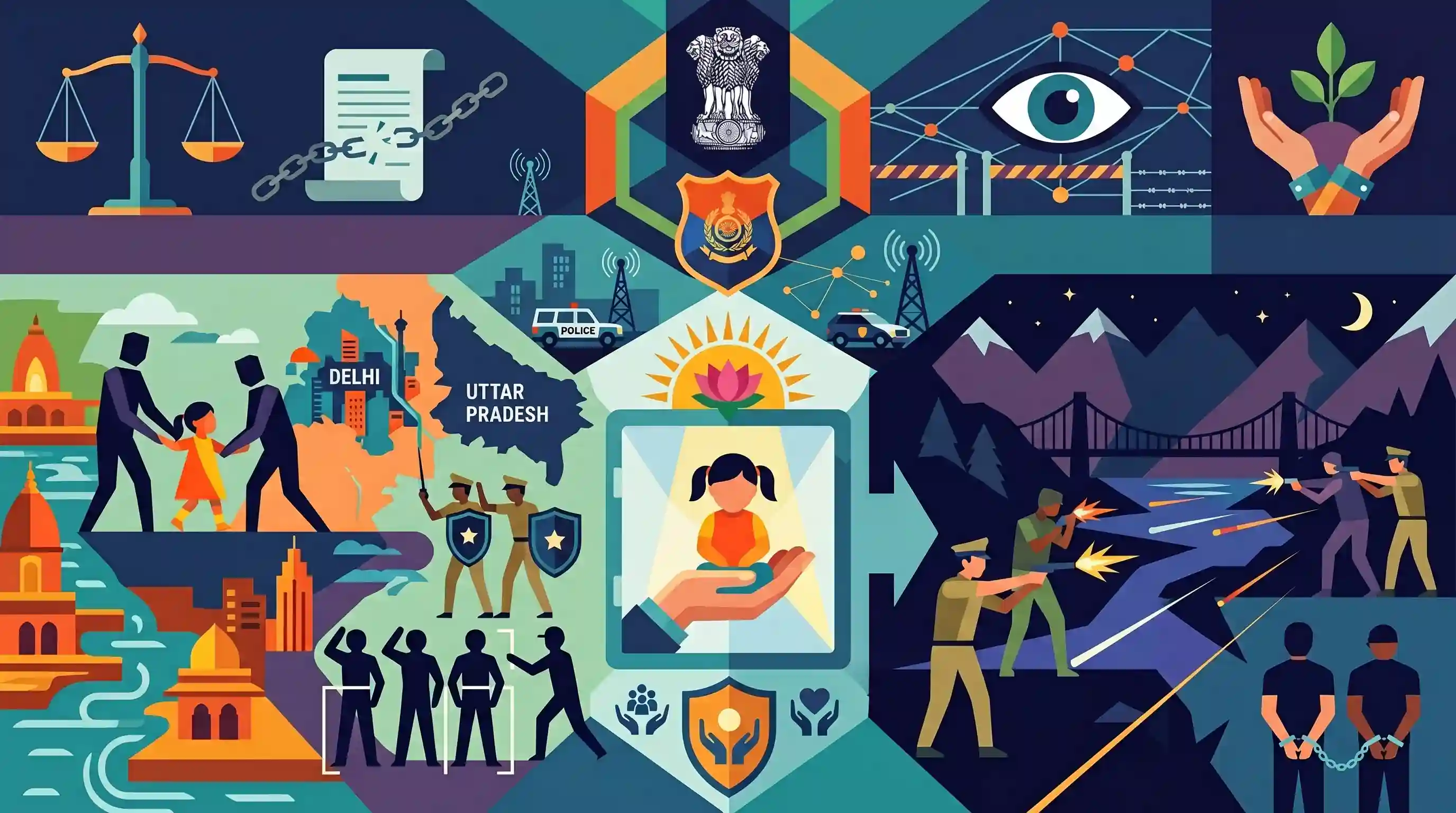
The Uttarakhand Police successfully dismantled an interstate child-lifting and trafficking gang, rescuing a 3-year-old girl kidnapped from Haridwar and arresting six individuals with connections to Delhi and Uttar Pradesh. Simultaneously, Dehradun Police captured two wanted criminals following a late-night encounter and shootout in the Rishikesh region. These operations underscore law enforcement efforts in child protection, internal security, and human rights frameworks in Uttarakhand.
Key Points
- The Uttarakhand Police dismantled an interstate child-lifting gang, rescuing a three-year-old girl abducted from Kankhal, Haridwar, and arresting six gang members (including two women).
- The gang specialized in abducting children to sell to childless couples, with an investigation linking their activities to an abduction in Delhi and a sale in Badaun, Uttar Pradesh, for Rs 1.5 lakh.
- In a separate operation, Dehradun Police (under SSP Promendra Dobhal) arrested two wanted criminals after a late-night encounter and exchange of fire in the Rishikesh (Shyampur) area.
- The interstate coordination and rescue highlight the importance of police initiatives like Operation Muskaan/Smile and constitutional protections against human trafficking (Article 23).
- The incident correlates with the roles of local police authorities, the State Commission for Protection of Child Rights (SCPCR), and the Uttarakhand Human Rights Commission (UHRC, established May 13, 2013) in safeguarding human rights.
Important Terms
Bharatiya Nyaya Sanhita (BNS)

The primary criminal code of India, enacted in 2023 (replacing the IPC), which establishes stringent legal frameworks and harsher penalties for child trafficking, kidnapping, and sexual exploitation.
UPSC context
GS Paper II (Criminal Justice Reforms) & GS III (Internal Security); tests updated legal frameworks against organized crime.
Protection of Human Rights Act 1993
A landmark parliamentary legislation that provides the statutory framework for establishing the National Human Rights Commission (NHRC), State Human Rights Commissions, and dedicated Human Rights Courts across India.
UPSC context
GS Paper II (Statutory Bodies); tests knowledge of institutional mechanisms safeguarding human rights and fundamental liberties.
Operation Muskaan
A nationwide initiative launched by the Ministry of Home Affairs (MHA) to locate, rescue, and rehabilitate missing and trafficked children and reunite them with their families.
UPSC context
GS Paper II (Government Schemes & Child Welfare) & GS III; tests strategies for child protection and safety.
Operation Smile
A dedicated child-rescue campaign that began as a successful pilot by the Ghaziabad Police in 2014, eventually leading to the MHA adopting the nationwide "Operation Muskaan" framework.
UPSC context
GS Paper II & III; tests local governance best practices scaled to national-level policy interventions.
Uttarakhand Human Rights Commission (UHRC)
A state-level statutory body established under Section 21 of the Protection of Human Rights Act, 1993, to investigate human rights violations and administrative negligence in Uttarakhand.
UPSC context
GS Paper II (State Statutory Bodies); tests mechanisms for governance accountability and regional human rights protection.
Indian Penal Code (IPC)
The colonial-era criminal code of India enacted in 1860, which served as the cornerstone of the country's criminal justice system until its replacement by the BNS.
UPSC context
GS Paper II (Judicial & Legal Reforms); tests historical and comparative understanding of criminal law evolution.
Prelims Trap
Operation Muskaan is a nationwide initiative launched and run by the Ministry of Women and Child Development.
While it targets child rescue and rehabilitation, Operation Muskaan was launched and is monitored by the Ministry of Home Affairs (MHA), not the Ministry of Women and Child Development.
Static Concepts Connected
What is the legal status and powers of Child Welfare Committees (CWCs)?
- Statutory basis: Mandated under Section 27 of the Juvenile Justice (Care and Protection of Children) Act, 2015, for every district.
- Judicial powers: Operates as a statutory bench with powers equivalent to a Metropolitan Magistrate or a Judicial Magistrate First Class.
- Final authority: Holds the final authority to dispose of cases involving the care, protection, treatment, development, and rehabilitation of children.
How does Article 23 of the Constitution protect against trafficking?
- Horizontal application: Enforceable against both the State and private individuals, establishing strong horizontal fundamental rights protection.
- Universal scope: Protects both citizens and non-citizens against human trafficking, begar (forced unpaid labour), and similar forced labour.
- Enabling legislation: Empowers Parliament to pass enabling laws like the Immoral Traffic (Prevention) Act to prescribe punishments for violations.
Cross-Topic Patterns
Interstate trafficking as organized crime
Organised child-lifting rings exploit state-border jurisdictions, making unified databases like TrackChild and integrated interstate policing under MHA vital for internal security.
Digital biometrics and child rights
Integrating police operations with portals like Khoya-Paya demonstrates how digital public infrastructure and AI-driven biometrics aid in realizing constitutional protections under Article 23.

A 2026 question may test the statutory powers of CWCs under the JJ Act, 2015, alongside the nodal ministry for Operation Muskaan.
Linked PYQs · 1
Linked PYQs · 1
- 2025UKPSC_PRELIMSGS1
Consider the following statements about Uttarakhand Human Rights Commission and choose the correct option from the options given below: 1. Uttarakhand Human Rights Commission came into existence on May 13, 2013. 2. The objectives of UHRC was to bring about greater accountability and transparency in governance.
