Supreme Court Upholds Fifty Percent Reservation Ceiling in Local Polls
Source:The Hindu ↗
Why It Matters
The issue lies at the intersection of social justice policies and constitutional limits, specifically the 50% reservation ceiling and the 'triple test' for local body quotas. Furthermore, it touches on the contentious constitutional mechanism of the Governor's assent to bills and the judicial imposition of timelines, which is critical for federalism and constitutional governance.
Summary
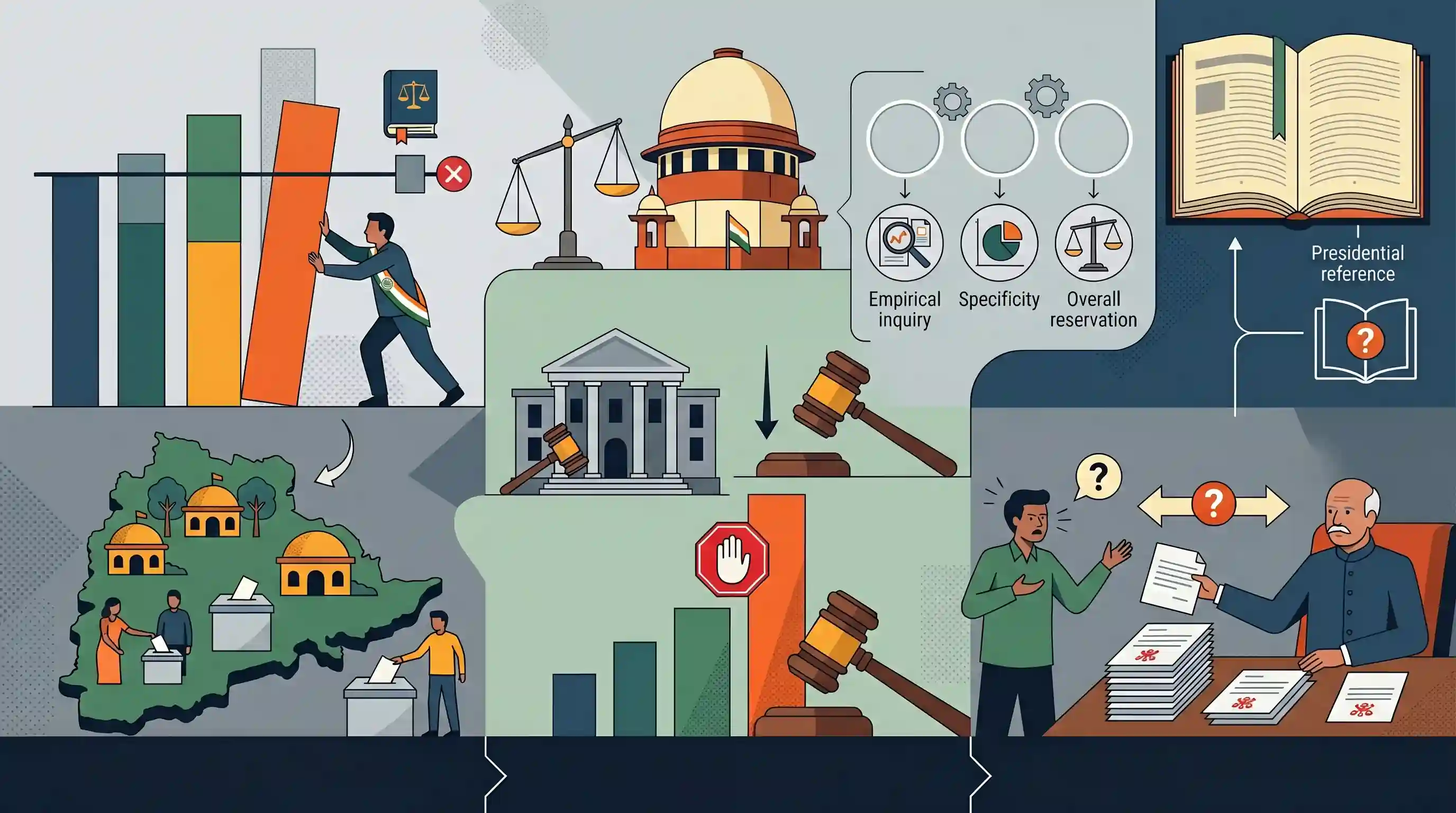
The Supreme Court of India has refused to stay a Telangana High Court order that halted the state government's decision to increase the Other Backward Classes (OBC) quota in local body elections to 42%. The apex court maintained that the hike would push total reservations to 67%, violating the 50% ceiling set in the Indra Sawhney and Vikas Kishanrao Gawali judgments. The Court also questioned whether the state had fulfilled the "triple test" mandated by the K. Krishna Murthy ruling before enhancing quotas. Additionally, the case highlighted the ongoing constitutional debate over the Governor's power to withhold assent to state bills, with the state invoking the concept of "deemed assent" pending a Presidential reference under Article 143.
Key Points
- The Supreme Court dismissed Telangana's plea against the High Court's stay on enhancing the OBC quota in local body elections to 42%.
- The proposed quota hike would have pushed total reservations in the state's local bodies to 67%, breaching the 50% ceiling established by the Supreme Court.
- The Supreme Court reiterated the necessity of the 50% cap on total reservations and invoked the "triple test" from the K. Krishna Murthy case as a prerequisite for local body reservations.
- The State's counsel invoked the concept of "deemed assent" (referencing a recent Tamil Nadu Governor case) to explain the delay in notification, as the Governor had withheld assent to the related Bill.
- A Presidential Reference under Article 143 is currently pending to clarify whether the judiciary can fix timelines for the President and Governors to clear State Bills.
Important Terms
Indra Sawhney v. Union of India

Landmark 1992 judgment that established a 50% ceiling on total reservations and introduced the 'creamy layer' concept to exclude affluent OBC members from reservation benefits.
UPSC context
GS Paper II: Reservation Policy. Tests understanding of constitutional limits on affirmative action and the 'equality of opportunity' doctrine.
K. Krishna Murthy v. Union of India
A 2010 Constitution Bench ruling that mandated a 'triple test' for OBC reservations in local bodies, distinguishing political representation from educational/employment quotas.
UPSC context
GS Paper II: Local Self-Government. Relevant for questions on federalism and the constitutional basis of local body quotas.
Vikas Kishanrao Gawali case
A 2021 Supreme Court judgment that reinforced the 'triple test' and affirmed that aggregate reservations (SC/ST/OBC) in local bodies cannot exceed the 50% threshold.
UPSC context
GS Paper II: Governance/Social Justice. Tests the application of the 50% cap specifically in the context of PRIs and ULBs.
Article 143
Constitutional provision granting the President of India the power to seek an advisory opinion from the Supreme Court on significant questions of law or public importance.
UPSC context
GS Paper II: Executive & Judiciary. Tests knowledge of the Supreme Court's advisory jurisdiction and the consultative relationship between high offices.
State Election Commission (SEC)
Constitutional bodies established under Articles 243K and 243ZA responsible for the 'superintendence, direction, and control' of elections to Panchayats and Municipalities.
UPSC context
GS Paper II: Constitutional Bodies. Crucial for topics related to the 73rd and 74th Amendments and grassroots democracy.
Prelims Trap
The 73rd Amendment mandates reservation for Other Backward Classes (OBCs) in Panchayati Raj Institutions.
Articles 243D and 243T mandate reservations only for SCs, STs, and women. Quotas for backward classes are strictly discretionary for the State Legislature, subject to the Triple Test.
Static Concepts Connected
What is the Supreme Court's "Triple Test" for local body OBC reservations?
- Dedicated Commission: States must establish an independent panel to empirically assess the nature and implications of backwardness within local bodies.
- Specify Proportion: The state must specify the exact proportion of reservation required, based strictly on the commission's recommendations.
- 50% Ceiling: Aggregate reservations for SCs, STs, and OBCs combined cannot exceed 50% of the total seats in the local body.
What are the Governor's powers regarding State Bills under Article 200?
- Assent Options: The Governor may grant assent, withhold assent, or reserve the Bill for the President's consideration.
- Reconsideration Power: The Governor can return non-money bills. If the legislature passes the bill again, granting assent becomes mandatory.
- Mandatory Reservation: Bills that endanger the position or constitutional powers of the State High Court must necessarily be reserved for the President.
Cross-Topic Patterns
Local quotas vs Public employment
Unlike Article 16(4) which guides public employment quotas, local body OBC quotas rely on Articles 243D(6)/243T(6) and are uniquely governed by the Supreme Court’s empirical 'Triple Test' framework.
Governor Assent & Judicial Intervention
The state's invocation of "deemed assent" and pending Article 143 references show how Governor-State legislative deadlocks are shifting from conventional political disputes into the active domain of constitutional judicial review.

Expect a multi-statement question in 2026 distinguishing between mandatory SC/ST/Women local quotas and discretionary OBC quotas.
Linked PYQs · 3
Linked PYQs · 3
- 2024MainsGS2
Analyse the role of local bodies in providing good governance at local level and bring out the pros and cons merging the rural local bodies with the urban local bodies.
- 2022MainsGS2
Discuss the essential conditions for exercise of the legislative powers by the Governor. Discuss the legality of re-promulgation of ordinances by the Governor without placing them before the Legislature.
- 2025PrelimsGS1
Consider the following statements : I. The Constitution of India explicitly mentions that in certain spheres the Governor of a State acts in his/her own discretion. II. The President of India can, of his/her own, reserve a bill passed by a State Legislature for his/her consideration without it being forwarded by the Governor of the State concerned. Which of the statements given above is/are correct?
