Thoppur ghat highway improvement project progress under HAM
Source:The Hindu ↗
Why It Matters
Provides a concrete example of the Hybrid Annuity Mode (HAM) in infrastructure development and highlights the environmental clearance and compensatory mechanisms for forest land diversion under infrastructure projects.
Summary
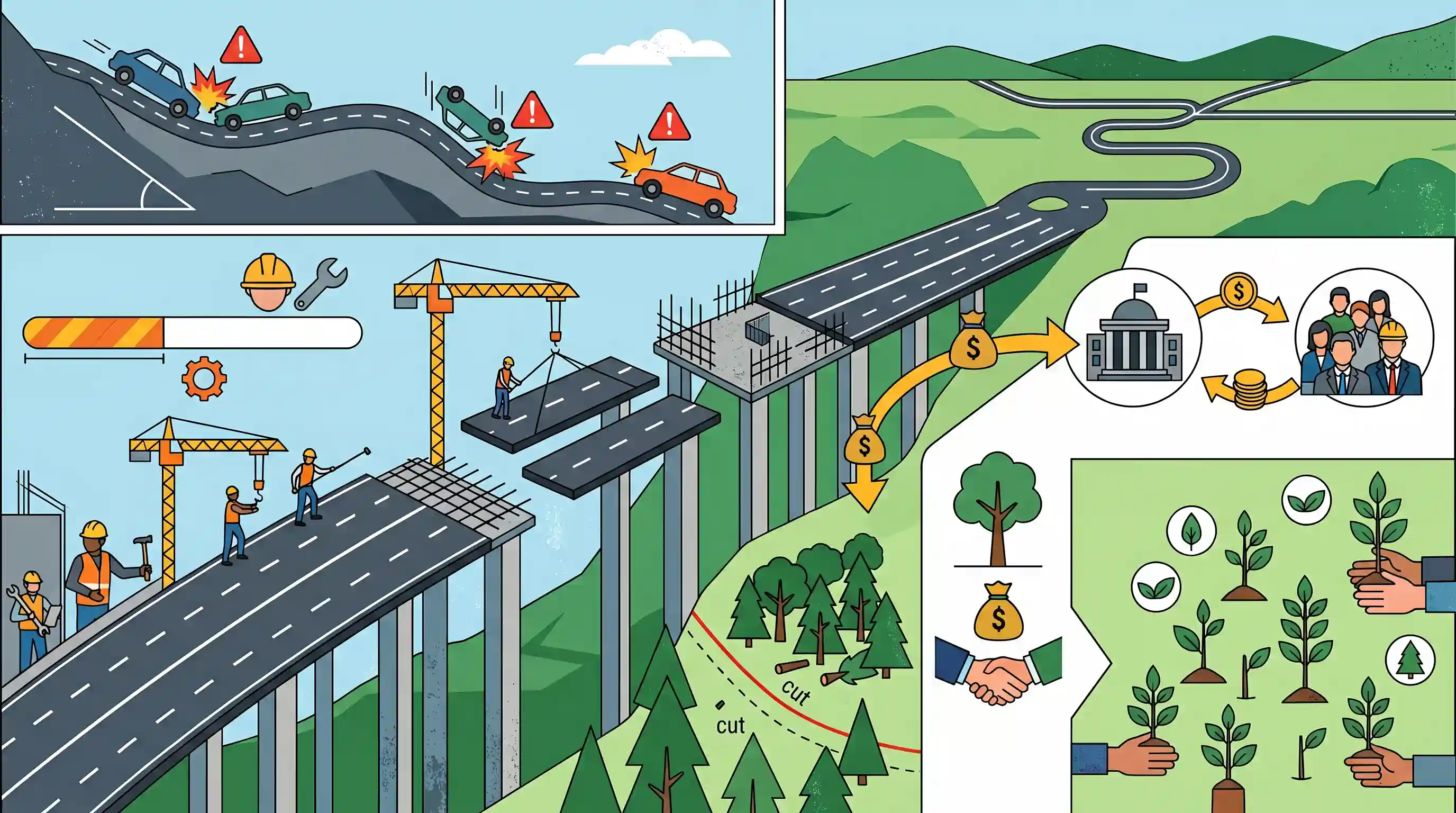
The NHAI has completed over 41% of the Thoppur ghat improvement project on NH-44 in Tamil Nadu. Executed under the Hybrid Annuity Mode (HAM) at a cost of ₹548 crore, the project addresses high accident rates by reducing the steep gradient from 9% to 3% using an elevated six-lane corridor. To facilitate construction, forest land was diverted, for which the Forest Department was compensated with alternative revenue land and funds.
Key Points
- A 6.60 km long ghat improvement project on NH-44 in Dharmapuri is being implemented by NHAI under the Hybrid Annuity Mode (HAM).
- The project aims to reduce road accidents by decreasing the road gradient from 9% to 3% through the construction of an elevated six-lane corridor.
- To execute the project, 13.427 hectares of forest land were acquired from Thoppur and Barigam reserve forests.
- The Forest Department received equivalent revenue land and ₹13 crore as compensation for the diverted forest land.
Important Terms
Hybrid Annuity Mode (HAM)

A PPP model mixing EPC (40% government-funded) and BOT-Annuity (60% developer-funded). Developers bear construction risk while the government manages toll collection, significantly reducing financial risk for private investors.
UPSC context
GS Paper 3 (Economy); Tests understanding of Public-Private Partnership (PPP) models and infrastructure financing mechanisms in India.
National Highways Authority of India (NHAI)
A statutory body established under the NHAI Act, 1988, responsible for the development, maintenance, and management of India's National Highways network under the Ministry of Road Transport and Highways.
UPSC context
GS Paper 2 (Governance); Tests knowledge of statutory bodies and GS Paper 3 (Infrastructure) regarding road network management.
National Highway 44 (NH-44)
India's longest National Highway, stretching approximately 4,112 km from Srinagar to Kanyakumari. It is a critical north-south corridor connecting 11 states and major economic and pilgrimage centers.
UPSC context
GS Paper 1 (Geography) and GS Paper 3 (Infrastructure); Tests familiarity with India's key transport corridors and regional connectivity.
Forest Land Diversion
A legal process under the Forest (Conservation) Act, 1980, requiring Central Government approval to use designated forest land for non-forest purposes like roads, mining, or industrial projects.
UPSC context
GS Paper 3 (Environment); Tests understanding of environmental legislation, conservation efforts, and the balance between development and ecology.
Compensatory Afforestation
The mandatory planting of trees on equivalent non-forest land or degraded forest land to offset forest loss, funded by project developers under the Compensatory Afforestation Fund (CAF) Act, 2016.
UPSC context
GS Paper 3 (Environment); Tests knowledge of the CAF Act, CAMPA funds, and mitigation strategies for industrial impact on forests.
Prelims Trap
Under the Hybrid Annuity Model (HAM), the private developer retains the right to collect tolls to recover their investment.
This is false. Unlike the BOT-Toll model, under HAM the government collects the toll and bears the revenue risk, while the private developer receives fixed annuity payments.
Static Concepts Connected
What are the key features of the Hybrid Annuity Model (HAM) for highway development?
- Funding split: The government provides 40% of the project cost during construction, while the private developer finances the remaining 60%.
- Annuity payments: The government repays the developer's 60% investment as bi-annual annuities along with interest over the operational period.
- Risk allocation: The government assumes traffic and toll-collection risks, while the private partner bears construction and maintenance risks.
How does the Compensatory Afforestation mechanism work during forest land diversion?
- Alternative land: User agencies must provide equivalent non-forest land (revenue land) or double the extent of degraded forest land to offset the diversion.
- Net Present Value: Agencies must pay the Net Present Value (NPV) to financially compensate for 50 years of lost ecological services like carbon sequestration.
- Fund sharing: The collected compensatory funds are managed by CAMPA, with 90% allocated to the respective State and 10% retained by the Centre.
Cross-Topic Patterns
HAM vs BOT vs EPC models
The evolution of PPP models is a high-yield theme. HAM bridges the gap by balancing the EPC model's heavy government funding burden with BOT-Toll's severe private-sector traffic risk.
Infra mapping & Peninsular Geography
UPSC often tests geographic awareness by mapping major arteries like NH-44 (the longest highway) against the specific hill ranges, ghats, and protected areas they traverse.

Expect a multi-statement question contrasting HAM with BOT-Toll models, emphasizing risk allocation and toll collection rights in 2026.
Linked PYQs · 2
Linked PYQs · 2
- 2022MainsGS3
Why is Public Private Partnership (PPP) required in infrastructural projects ? Examine the role of PPP model in the redevelopment of Railway Stations in India.
- 2017MainsGS3
Examine the development of Airports in India through joint ventures under Public-Private Partnership (PPP) model. What are the challenges faced by the authorities in this regard?
