Tiger mortality and linear infrastructure impact in Maharashtra
Source:Indian Express ↗
Why It Matters
The incident underscores the friction between infrastructure development and wildlife conservation, a recurrent theme in UPSC GS3. It highlights the practical governance required to implement eco-friendly infrastructure like wildlife crossings and the role of specialized forces in curbing poaching.
Summary
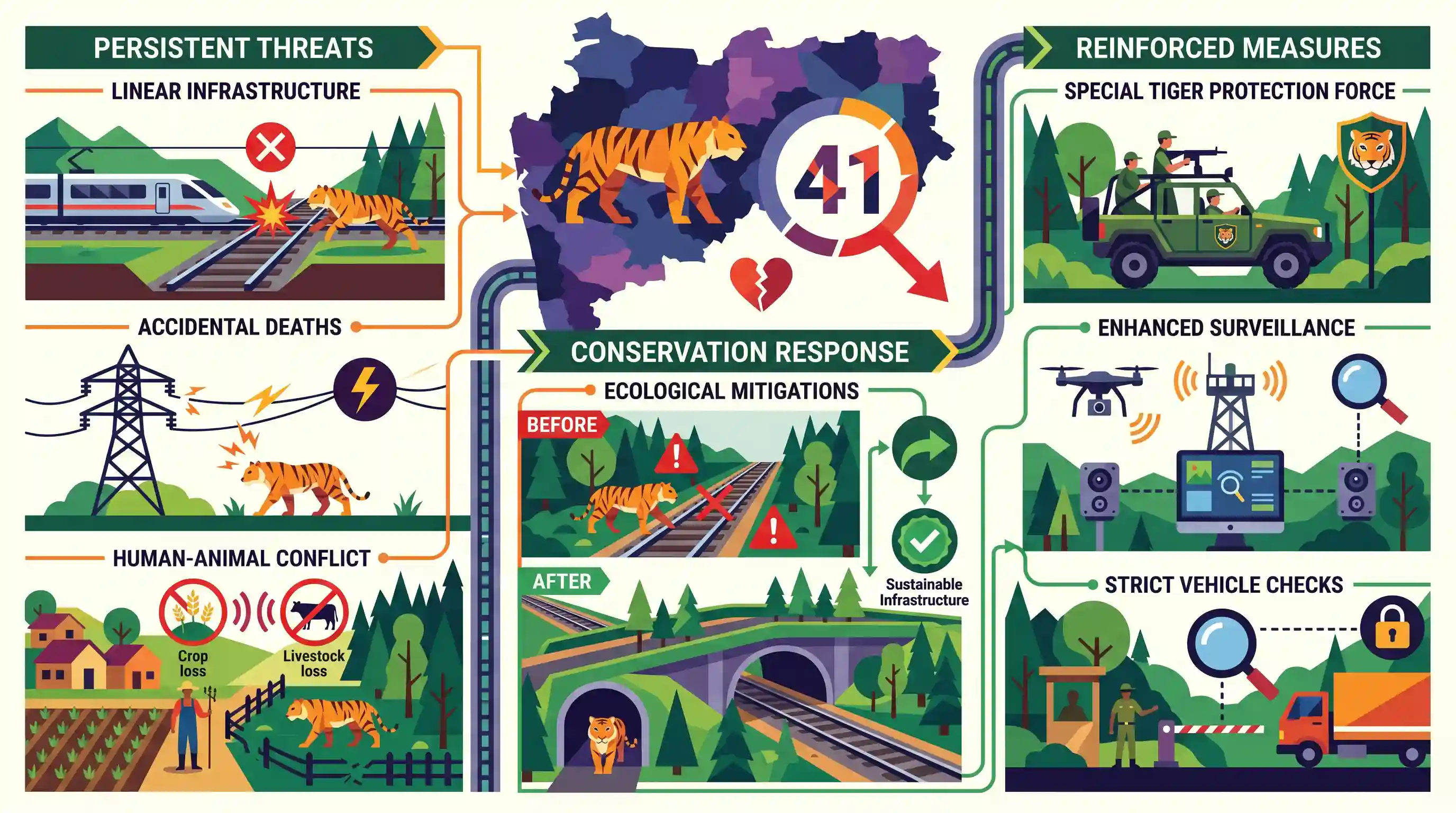
In a recent one-year span, Maharashtra recorded 41 tiger deaths, drawing attention to the persistent threat of human-animal conflict and linear infrastructure on wildlife. While most fatalities occurred naturally, accidental deaths—particularly those involving railway lines—and electrocutions remain significant concerns. Conservation authorities are responding by integrating ecological mitigations, such as overpasses and underpasses, into new railway proposals within forest zones. Concurrently, anti-poaching measures have been reinforced through the deployment of the Special Tiger Protection Force, enhanced surveillance, and strict vehicle checks.
Key Points
- Maharashtra recorded 41 tiger deaths over a one-year period, exposing ongoing vulnerabilities in apex predator conservation.
- The majority of the fatalities (28) were due to natural causes, but eight resulted from accidents, heavily driven by railway hits.
- To curb linear infrastructure impacts, the Forest Department has proposed constructing underpasses and overpasses and imposing 40 km/h speed limits along new railway lines in forested tracts.
- Anti-poaching and electrocution mitigation measures include deploying the Special Tiger Protection Force, establishing an informer network, and utilizing camera traps at crucial corridors.
Important Terms
Special Tiger Protection Force (STPF)

A specialized anti-poaching unit under Project Tiger (NTCA) comprising forest and police personnel. It provides a dedicated security layer to protect tiger reserves from illegal trade, hunting, and encroachment.
UPSC context
GS Paper 3 (Environment/Security). Tests knowledge of institutional mechanisms for biodiversity protection and specialized enforcement against wildlife crime.
National Tiger Conservation Authority (NTCA)
A statutory body under the MoEFCC, established under the Wildlife (Protection) Act, 1972. It provides central oversight, issues mandatory SOPs for tiger mortality, and implements Project Tiger across India.
UPSC context
GS Paper 2 & 3. Tests knowledge of environmental governance and regulatory frameworks for flagship species conservation.
Human-Wildlife Conflict (HWC)
Negative interactions between people and wild animals resulting in loss of life, crops, or property. It frequently leads to retaliatory killings, threatening both local livelihoods and species survival.
UPSC context
GS Paper 3 (Environment). Tests ability to analyze socio-ecological challenges and mitigation strategies for sustainable coexistence in fragmented landscapes.
Linear Infrastructure
Straight-form developments like railways, highways, and power lines cutting through natural habitats. They cause habitat fragmentation, direct mortality from accidents, and disrupt migration paths.
UPSC context
GS Paper 3 (Environment/Infrastructure). Tests the "Development vs. Conservation" balance and knowledge of green mitigation measures like underpasses and overpasses.
Wildlife Corridors
Geographical linkages between isolated wildlife habitats that allow for movement, gene flow, and survival. They are critical for landscape species like tigers to maintain genetic diversity and prevent isolation.
UPSC context
GS Paper 3 (Environment). Tests understanding of landscape-level conservation and strategies to mitigate habitat fragmentation caused by development.
Wildlife (Protection) Act, 1972
India’s primary legal framework for protecting wild animals and plants. It empowers the state to declare protected areas and provides the legal basis for authorities like the NTCA.
UPSC context
GS Paper 2 (Legislation). Fundamental for understanding environmental law and the statutory status of conservation initiatives in India.
Prelims Trap
"Critical Tiger Habitats are designated under the Forest Rights Act, 2006."
Critical Tiger Habitats (CTHs) are declared under the Wildlife Protection Act, 1972. It is Critical Wildlife Habitats (CWHs) that are established under the Forest Rights Act, 2006.
Static Concepts Connected
What is the legal and statutory basis for Tiger Conservation in India?
- WPA 1972 Amendment: Project Tiger received statutory backing via the 2006 amendment to the Wildlife (Protection) Act, 1972, which created the NTCA.
- NTCA Composition: The NTCA is a statutory body chaired by the Minister for Environment, Forests and Climate Change.
- Critical Tiger Habitats: State Governments, on the recommendation of the NTCA, notify CTHs as inviolate areas for tiger conservation under the WPA, 1972.
How do Eco-Bridges mitigate the impact of linear infrastructure on wildlife?
- Habitat Connectivity: Underpasses and overpasses (e.g., NH-44 connecting Kanha-Pench) provide safe migratory routes across bisecting highways and railway lines.
- Gene Flow Maintenance: By preventing populations from becoming isolated, eco-bridges maintain the genetic diversity and viability of apex predators.
- Mortality Reduction: They drastically decrease direct wildlife-vehicle collisions, lowering overall mortality and reducing subsequent human-animal conflict in fringe areas.
Cross-Topic Patterns
Eco-bridges & PM Gati Shakti
Aligning PM Gati Shakti's linear infrastructure projects with the MoEFCC's wildlife corridor mapping is crucial to preventing ecological fragmentation during rapid highway and railway expansion.
Wildlife trafficking & Internal Security
The deployment of the Special Tiger Protection Force (STPF) bridges local forest management with national agencies like the Wildlife Crime Control Bureau (WCCB) to curb organized international poaching networks.

Expect a Prelims question on the legal distinction between Critical Tiger Habitats (WPA 1972) and Critical Wildlife Habitats (FRA 2006).
Linked PYQs · 2
Linked PYQs · 2
- 2014PrelimsGS1
Consider the following statements : 1. Animal Welfare Board of India is established under the Environment (Protection) Act, 1986. 2. National Tiger Conservation Authority is a statutory body. 3. National Ganga River Basin Authority is chaired by the Prime Minister. Which of the statements given above is/are correct?
- 2020PrelimsGS1
Among the following Tiger Reserves, which one has the largest area under "Critical Tiger Habitat"?
