Missing Enriched Uranium in Iran Raises Global Proliferation Risks
Source:Indian Express ↗
Why It Matters
Highlights critical vulnerabilities in the global non-proliferation architecture (NPT, IAEA safeguards) and evaluates the cascading impact of Middle Eastern instability on global and regional security dynamics.
Summary
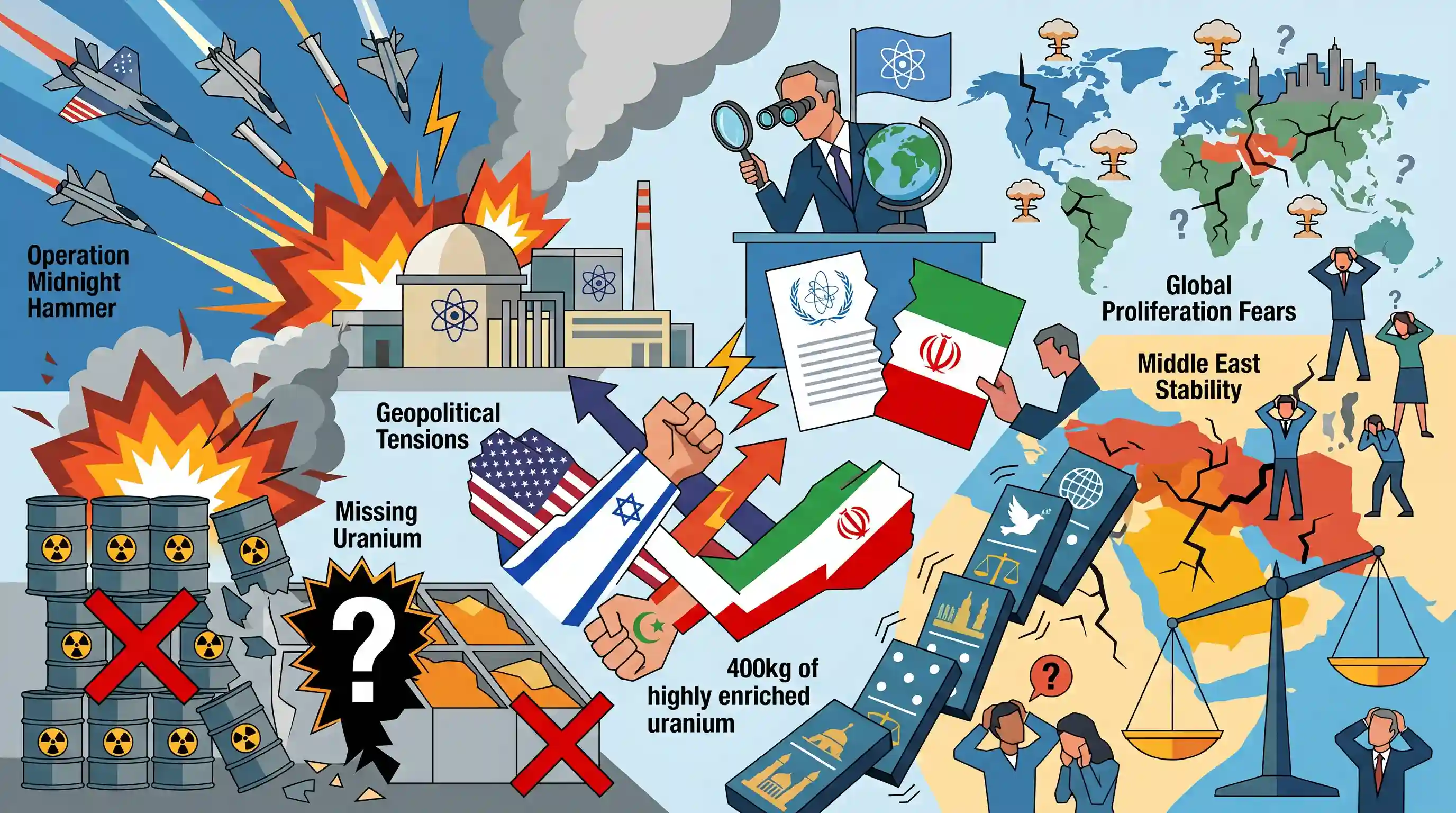
US Vice President JD Vance confirmed that 400kg of highly enriched uranium is missing following major US airstrikes ('Operation Midnight Hammer') on Iranian nuclear facilities. The incident has triggered profound global proliferation fears, prompting IAEA Chief Rafael Grossi to demand renewed inspections and leading Iran to threaten withdrawal from the Non-Proliferation Treaty (NPT). The development marks a severe escalation in the geopolitical tensions spanning the US, Israel, and Iran, holding major implications for Middle East stability.
Key Points
- US airstrikes under 'Operation Midnight Hammer' targeted Iranian underground nuclear facilities at Fordow, Natanz, and Isfahan using bunker buster bombs.
- Following the strikes, 400kg of uranium enriched to 60% purity is reported missing, raising fears of its diversion for a nuclear weapons program.
- IAEA Chief Rafael Grossi emphasized the critical risk of nuclear proliferation and demanded the immediate resumption of international inspections.
- In retaliation, Iran has threatened to withdraw from the Non-Proliferation Treaty (NPT), a move that would fundamentally destabilize global nuclear non-proliferation frameworks.
- The geopolitical fallout exacerbates the ongoing conflict involving the US, Israel, and Iran, threatening broader Middle East stability and global security.
Important Terms
Operation Midnight Hammer

A June 2025 U.S. military operation using B-2 bombers and "bunker busters" to strike Iranian nuclear facilities at Natanz, Fordow, and Isfahan to dismantle enrichment capabilities.
UPSC context
GS Paper-II (International Relations); tests understanding of military intervention impacts on regional stability and global non-proliferation regimes.
Non-Proliferation Treaty (NPT)
A 1968 landmark international treaty aimed at preventing the spread of nuclear weapons, promoting peaceful nuclear energy cooperation, and pursuing global disarmament.
UPSC context
GS Paper-II/III; central to global nuclear governance, international security frameworks, and India’s specific diplomatic stance on nuclear regimes.
International Atomic Energy Agency (IAEA)
The UN-affiliated "nuclear watchdog" responsible for inspecting nuclear facilities and ensuring that nuclear materials are not diverted for military purposes.
UPSC context
GS Paper-II (International Organizations); vital for monitoring compliance in regional flashpoints like Iran and North Korea.
Highly Enriched Uranium (HEU)
Uranium enriched to 20% or higher U-235; concentration levels of 60-90% are categorized as "near weapons-grade," posing significant proliferation risks.
UPSC context
GS Paper-III (Science & Technology/Security); key technical concept for analyzing nuclear "breakout" timelines and strategic threats.
Nuclear Latency
A state's possession of the technical, material, and scientific capacity to produce a nuclear weapon rapidly, despite not officially having one.
UPSC context
GS Paper-II (IR); essential for assessing "threshold" states and the effectiveness of counter-proliferation strategies.
Prelims Trap
A sovereign state cannot legally withdraw from the Non-Proliferation Treaty (NPT) once it has been ratified.
The NPT contains a specific exit clause (Article X) allowing member states to legally withdraw with three months' notice if their supreme national interests are jeopardized.
Static Concepts Connected
What are the distinct grades of uranium enrichment?
- Natural Uranium: Contains approximately 0.7% of the fissile U-235 isotope, requiring heavy water reactors for power generation.
- Low Enriched (LEU): Enriched to 3-5% U-235. It is the standard fuel used in most civilian commercial nuclear power reactors globally.
- Highly Enriched (HEU): Enriched to 20% or more U-235. Used in research reactors, medical isotope production, and naval propulsion.
- Weapons-Grade Uranium: Enriched to 90% or higher U-235. This extreme concentration is required to build practical, compact nuclear weapons.
What is the institutional relationship between the IAEA and the UN?
- Autonomous Organization: The IAEA is an independent, autonomous international organization, not a specialized agency of the United Nations.
- Reporting Mechanism: It reports annually to the UN General Assembly and escalates instances of non-compliance directly to the UN Security Council.
- Safeguard Mandate: It implements international safeguards to independently verify that member states do not divert civilian nuclear materials to military programs.
Cross-Topic Patterns
NPT limitations & India's stance
Iran’s NPT exit threat highlights the treaty's structural vulnerabilities, reinforcing India’s historical rationale for refusing to sign the NPT as a non-nuclear weapon state.
Energy security & Hormuz chokepoint
Military escalation in the Persian Gulf threatens maritime transit through the Strait of Hormuz, directly impacting India's oil imports, inflation targeting, and strategic petroleum reserve policy.

Expect a multi-statement Prelims 2026 question mapping IAEA safeguard protocols, NPT Article X, and uranium enrichment thresholds.
Linked PYQs · 4
Linked PYQs · 4
- 2018PrelimsGS1
In the Indian context, what is the implication of ratifying the 'Additional Protocol' with the 'International Atomic Energy Agency (IAEA)'?
- 2020PrelimsGS1
In India, why are some nuclear reactors kept under "IAEA Safeguards" while others are not?
- 2018PrelimsGS1
What is/are the consequence/consequences of a country becoming the member of the 'Nuclear Suppliers Group'? 1. It will have access to the latest and most efficient nuclear technologies. 2. It automatically becomes a member of "The Treaty on the Non-Proliferation of Nuclear Weapons (NPT)". Which of the statements given above is/are correct?
- 2025MainsGS2
"Energy security constitutes the dominant kingpin of India's foreign policy, and is linked with India's overarching influence in Middle Eastern countries.” How would you integrate energy security with India's foreign policy trajectories in the coming years?
